
 DCTC KSA

- Blogs
- / Ways to Turn Conference Connections Into Sales Leads With Follow-Up
A conference connection becomes a sales lead through relevant, timely follow-up, not the handshake alone. For high-priority contacts, follow up within 24 hours; turning conference connections into sales leads then depends on making each message specific to the conversation and giving the recipient a clear next step.
It’s easy to leave an event with a long list of names and lose momentum once the conversations end. A generic message rarely preserves the context that made a meeting valuable.
This guide explains how to capture useful notes, personalize outreach, and coordinate follow-up so promising conversations don’t disappear into an inbox. You’ll learn to ask thoughtful questions, agree on a practical next step, and build relationships that continue after the event. The goal is to turn initial interest into meaningful business conversations, with follow-up tailored to each person.
Key Takeaways
- Capture specific conversation details at the event so each follow-up feels personal and relevant.
- Research priority accounts in advance and coordinate with your sales team on who will follow up and how.
- Use thoughtful questions and useful next steps to build trust beyond the first meeting.
- Combine a clear follow-up sequence with consistent, human communication to keep promising conversations moving.
1. Personalized outreach and strategic networking
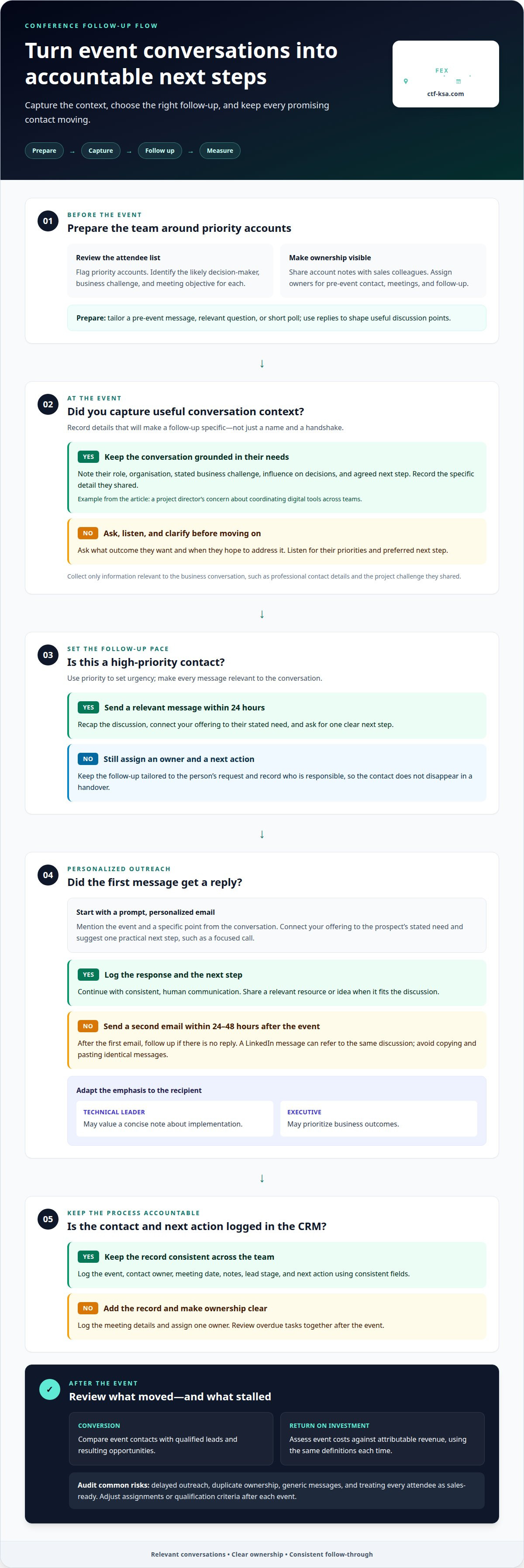
Start with the conversation, not a generic thank-you. Before leaving the event, note the person’s role, business challenge, and a detail they shared. For example, a project director may raise concerns about coordinating digital tools across teams. That detail gives your follow-up a relevant opening and keeps useful context from getting lost. Turning conference connections into sales leads starts with capturing specifics.
A strong sequence begins with a prompt, personalized email, followed by a LinkedIn message that refers to the same discussion. Send a second email within 24-48 hours after the event if the first message receives no reply. In each message, recap the conversation, connect your offering to the prospect’s stated need, and ask for one clear next step. For example, suggest a focused call to explore the challenge they described.
Keep your brand voice consistent while adapting the message to the recipient. Strategic communicators like EQ4 Brand Architects emphasize blending emotional intelligence with intentional messaging so outreach connects authentically. A technical leader may value a concise note about implementation, while an executive may prioritize business outcomes. Use a professional tone across email and LinkedIn, but avoid copying and pasting identical messages. Mention the event, a specific point from your conversation, and a relevant resource or idea. This makes outreach recognizable without making it sound automated.
Personalization also strengthens your networking strategy before the event. Identify priority attendees, learn about their roles, and prepare one useful insight or question for each conversation. At the event, listen for the prospect’s learning goals and record their preferred next step. Afterward, tailor your message around that request, whether it means sharing a relevant case study or arranging a discussion. Turning conference connections into sales leads takes more than collecting contact details; it depends on making each follow-up relevant and useful. This disciplined approach gives the connection a clearer path toward revenue.
2. Auditing event strategies and improving sales-team alignment
Before the event, review the attendee list and flag priority accounts. For each, identify the likely decision-maker, business challenge, and meeting objective. Share these notes with sales colleagues so each conversation has a clear purpose. This preparation helps the team engage strategically rather than collect contacts without context.
Start pre-event engagement with a tailored message, a relevant question, or a short poll. Use replies to understand attendees’ interests and prepare useful discussion points. Add the event dates to the team calendar and assign owners for pre-event contact, meetings, and follow-up. Clear ownership makes each handover visible.
Qualify contacts by recording their role, organisation, stated need, influence on decisions, and agreed next step. Ask what outcome they want and when they hope to address it. Collect only information relevant to the business conversation, such as professional contact details and the project challenge they shared.
For contacts in Saudi Arabia, don’t treat South Africa’s POPIA as the governing framework. Keep information collection relevant to the conversation and handle contact details responsibly under the requirements applicable to your outreach.
In your CRM, create an event record, assign each contact an owner, and log the meeting date, notes, lead stage, and next action. Use consistent fields across the team so your analytics are based on comparable information. After the event, review overdue tasks together.
Prompt follow-up matters because conversation details fade and other priorities take over. Send high-priority contacts a relevant message within 24 hours, then record the response and next step. Measure conversion by comparing event contacts with qualified leads and resulting opportunities. Assess ROI against event costs and attributable revenue, using the same definitions each time.
Common risks include delayed outreach, duplicate ownership, generic messages, and treating every attendee as sales-ready. Audit those issues after each event and adjust assignments or qualification criteria. For your next Saudi industry event, align account priorities with event attendance planning.
3. Building relationships that outlast a conference
A conference creates an opening, not an established relationship. Build trust by giving a prospect room to explain their priorities before presenting solutions. Ask one focused question, listen fully, and reflect their point in your response. If a project leader describes coordination delays, for example, ask which handoff creates the most friction. This makes the conversation collaborative rather than transactional.
Rapport grows through relevance and respect. On a follow-up call, reserve at least 10 minutes for building rapport, as recommended in the topic guidance. Use that time to understand the prospect’s role, current priorities, and preferred way to assess new ideas. Avoid treating a meeting as a pitch slot. A thoughtful question about their project can create a better chance to identify a genuine fit.
Record the commitments you make during the event and follow through. If you offered a case study, send one that addresses the prospect’s stated challenge and explain its relevance. If you agreed to introduce a colleague, make the connection with a brief note outlining both people’s interests. These actions show reliability and give the relationship a useful next step.
Keep contact meaningful after the first exchange. Share an insight only when it relates directly to the prospect’s work, such as a relevant project lesson or a practical question raised in a later discussion. Invite a response without pushing for a meeting every time. Track their priorities and adapt future conversations accordingly. In Saudi Arabia’s built-environment sector, decisions may involve several stakeholders, so learn who influences the decision and what each person needs. Relevant, consistent engagement can turn a conference connection into a trusted professional relationship, not just another contact.
Pay attention to the type, tone, sequence, and framing of your questions, not just how many you ask. Effective questions are respectful, time-efficient, relevant, thought-provoking, and collaborative. Introduce each question in a way that reflects the other person’s concerns and invites an exchange, rather than a one-sided response. Keep it purposeful and let the answer guide the next step.
4. Structured outreach and human follow-up
A clear sequence moves event contacts through your pipeline without making every touchpoint feel automated. Begin with the action you promised, such as sending a relevant case study or arranging a focused discussion. Plan the next contact around the prospect’s response, not a fixed script. Each follow-up should add context or value.
Give email, LinkedIn, and phone calls distinct purposes. Use email to recap the conversation and share a resource, LinkedIn to reinforce the connection with a brief personal note, and a call to address an open question or agree on a next step. Each touchpoint should feel like part of one conversation, not repeated sales pressure.
Use social media to build familiarity before asking for a meeting. In a LinkedIn connection request, mention the event and a specific topic you discussed. After the person accepts, share an insight related to their work. Avoid sending the same promotional message on every platform. Match the channel to the contact’s preference and keep your tone consistent with your organisation’s brand.
Persistence matters, but relevance sets the standard. Treat these figures as a reminder to plan thoughtful contact, not a reason to send identical messages five times. If a prospect doesn’t respond, offer something different or ask whether the timing is suitable.
Review your follow-up sequence after each event. Identify where contacts stalled, which messages prompted replies, and whether ownership was clear. Use these observations to refine your outreach for the next event. A short demo or a specific meeting agenda can make the next step easier to accept.
Explore event attendance opportunities
Construction Technology ConFeX KSA: Sponsorship Packages
Construction Technology ConFeX KSA offers sponsorship packages for organisations seeking a strategic presence at an event focused on digital and sustainable transformation across Saudi Arabia’s built environment. If your sales follow-up depends on meeting industry leaders and presenting your work in a relevant setting, sponsorship can support that relationship-building.
Choose an approach that fits your participation goals. Sponsorship packages and exhibition stands support your organisation’s presence, while speaking opportunities provide a platform to share expertise. Delegate passes give access to conference sessions, networking, and technical demonstrations. Align your choice with the audience you want to reach and the conversations you want to continue after the event.
To explore the available sponsorship options, visit Construction Technology ConFeX KSA’s sponsorship opportunities.
Make the next conversation count
Valuable conference relationships can develop well beyond the event. Make your next move deliberate: give each contact room to share changing priorities and keep your contribution relevant as their needs evolve. A consistent approach to turning conference connections into sales leads helps your team build commercial relationships without rushing toward a decision.
Plan future participation around the relationships you want to develop. Assign a team member to continue each important conversation, decide what useful perspective they can bring, and connect the next interaction to the contact’s interests. This turns event participation into an ongoing part of your business development strategy.
For organisations contributing to Saudi Arabia’s built-environment sector, Construction Technology ConFeX KSA offers sponsorship packages, delegate passes, and speaking opportunities. Choose the participation route that best supports your role and goals.
Take your next step with purpose, and make each new conversation an opening for a lasting partnership.
Frequently Asked Questions
How soon should you follow up with conference leads?
Contact a high-priority lead within 24 hours, and reach a time-sensitive, highly interested contact sooner. If you spoke about an active project, send a brief message while that discussion is still fresh. For other contacts, prioritise follow-up by stated need and agreed next step. Record the reason for each priority so your team can act consistently.
How can you personalize outreach based on conversations at a conference?
Use a detail the person shared to make your message recognizable and useful. For example, mention their challenge coordinating project information, then offer a relevant insight or ask a focused question about their current process. Don’t repeat their words mechanically. Acknowledge the conversation, connect it to a practical next step, and keep the tone natural to your brand.