
 DCTC KSA

- Blogs
- / Trade Show CPL in KSA: Calculate the Cost of Each Lead
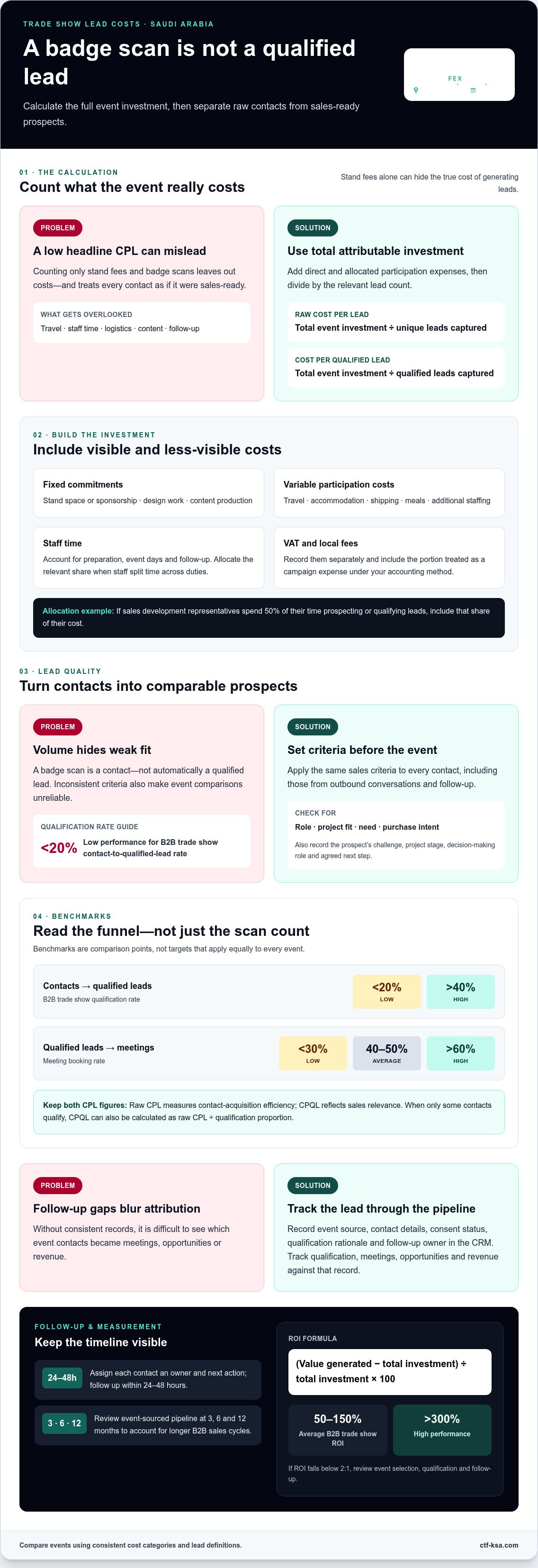
A high lead count can make an expensive trade show look efficient. Calculating the cost per lead for trade shows in KSA starts with a simple formula: divide the event’s total attributable spend by the number of unique leads captured. To calculate cost per qualified lead, divide the same investment by the contacts that meet your sales criteria.
Focusing only on stand fees and badge scans can obscure the campaign’s real cost. Travel, staff time, logistics, content and follow-up all contribute to the investment, while unqualified contacts can make a low headline CPL misleading.
This guide shows how to calculate a complete event cost, work out raw and qualified CPL, and interpret the results in light of lead quality and sales potential. It covers how visible and less obvious expenses affect the calculation, what can shift CPL, and how to use the figures to assess exhibiting in Saudi Arabia.
Key Takeaways
- Use total event investment, not stand fees alone, to understand what each captured contact truly costs.
- Separate raw contacts from qualified prospects so badge scans don’t disguise the cost of sales-ready leads.
- Include less visible expenses, such as staff time, travel, logistics and content, for a more complete calculation.
- Compare participation formats with your goals: an exhibition stand, sponsorship, speaking opportunity or delegate pass each serves a different purpose.
What factors drive trade show lead generation costs up or down?
Across Saudi Arabia, exhibition costs depend on the event, participation format, travel, staffing and lead volume. There is no standard cost for every trade show. Calculate each event’s total investment against its captured leads, then compare the qualified-lead results.
Trade Show Cost Inputs
Trade show cost inputs are the direct and allocated expenses required to participate and generate leads. A stand fee alone does not reflect all the resources needed to reach attendees and turn conversations into prospects.
Include event space or sponsorship, travel, accommodation, shipping, stand production, promotional content and staff time. If salespeople split their time between event work and other duties, allocate the relevant share. For example, when sales development representatives spend 50% of their time prospecting or qualifying leads, include that share of their cost. This broader total shows what the campaign actually required.
Event CPL and Performance Benchmarks
An event CPL benchmark is a point of comparison, not a target that applies equally to every trade show. Consider it alongside qualification and conversion rates to see whether the investment is generating useful opportunities.
A B2B trade show contact-to-qualified-lead rate below 20% is categorized as low performance, while a rate above 40% is high performance. These benchmarks reveal why a large badge-scan count can disguise weak lead quality. Track raw contacts and qualified leads separately, and use consistent criteria when comparing events.
Assess return on investment using this formula: (value generated minus total investment) ÷ total investment × 100. A B2B trade show ROI of 50-150% is presented as average, while ROI above 300% is categorized as high performance. Keep cost categories and lead definitions consistent across event comparisons. This gives teams a clearer basis for deciding whether to adjust audience targeting, participation scope or follow-up priorities for their next Saudi Arabia campaign.
Cost per qualified lead
How should companies track and attribute trade show leads? Record the event source for each contact in your CRM, then track qualification, meetings, opportunities and revenue against that record. This preserves the event’s contribution as leads move through the pipeline.
Cost per qualified lead (CPQL) is total event investment divided by the number of qualified leads captured. If only some contacts qualify, you can also calculate CPQL by dividing raw CPL by the qualification proportion. Keep both figures: raw CPL measures contact-acquisition efficiency, while CPQL reflects sales relevance.
Lead volume alone can give a distorted picture. A badge scan is a contact, not automatically a qualified lead. Set qualification criteria before the trade show, such as role, project fit, need and purchase intent. Apply the same criteria to every contact, including those generated through outbound conversations or follow-up.
A B2B trade show lead qualification rate of 25-35% is presented as typical. From qualified leads, the average meeting booking rate is 40-50%; below 30% is categorized as low performance, while above 60% is high performance. These measures show where prospects drop out, from initial fit to a sales conversation.
Purchase intent adds useful context to a qualification score. Record each prospect’s stated challenge, project stage, decision-making role and agreed next step. A contact with a clear project fit may belong in the pipeline even if they are not ready to meet immediately. A general-interest scan may need nurturing instead.
Attribution requires consistent records, not memory after travel. Capture the event name, contact details, consent status, qualification rationale and follow-up owner. Companies with a scored target list of ICP-fit prospects generate 2-3 times more qualified leads from the same event. Follow up within 48 hours to support meeting bookings, then track pipeline movement over 6-12 months to assess buying intent and eventual conversion.
Including hidden and fixed event expenses
How do Saudi VAT and other local fees affect trade show lead costs? They affect the out-of-pocket investment used to calculate event CPL. Record VAT and each local fee separately, then include the portion treated as a campaign expense under your accounting method.
Build the event budget from fixed commitments and costs that vary with participation. Fixed inputs can include stand space, sponsorship, design work and content production. Variable expenses may include travel, accommodation, shipping, meals and additional staffing. Account for staff hours too: preparation, event days and follow-up all take time, even if salaries do not appear as a separate event invoice.
Expected lead volume should come from evidence, not an ambitious target alone. Review previous event records, the number of relevant contacts reached and how many progressed to qualified conversations. Before travelling, aim to book 40% of meetings in advance. A scored target list helps the team focus on likely prospects, while a forecast built from past results makes the final CPL more useful.
Follow-up influences what the investment generates after the exhibition closes. Assign each captured contact an owner and a next action, then follow up within 24-48 hours. Track responses, meetings and opportunities in the CRM. Nurture programs often reduce effective CPL by 40% or more, because they can develop early contacts without adding acquisition spend—an area where strategic marketing and sales specialists like stratagon.com help organizations turn event leads into lasting revenue.
Measure actual performance through pipeline and revenue, not badge scans alone. Review event-sourced pipeline at 3, 6 and 12 months to account for longer B2B sales cycles. If ROI falls below 2:1, review event selection, qualification and follow-up. Compare those results consistently with the original forecast to identify which cost inputs generated opportunities and which added expense without moving prospects forward.
Calculating cost per lead from campaign spend and leads
Standard trade show CPL is total event campaign spend divided by total captured leads. It answers a practical question: how much investment produced each recorded contact? Use a consistent definition of “lead” across campaigns, or the metric will not support a fair comparison.
Start by building the numerator. Include event fees, travel, staff time, advertising, tool subscriptions, agency fees and content production. Add pre-event, onsite and follow-up costs when they support lead acquisition. For shared resources, allocate only the portion attributable to the campaign. This keeps unrelated business expenses out of the event total.
Next, establish the denominator. Count unique contacts captured through event conversations, badge scans or scheduled meetings, and remove duplicates. Keep raw contacts separate from qualified leads: the first measures reach, while the second reflects prospects that meet your sales criteria. Apply the same capture rules to every event and campaign.
For example, compare two trade show campaigns using the same cost categories and lead definition. If one generates more contacts but fewer qualified prospects, its raw CPL may look lower even as its effective acquisition cost rises. Record both CPL and qualified-lead conversion rates, then review which channel, audience and follow-up activity contributed to pipeline and revenue.
Trade shows are one part of a wider channel mix. Attribute outreach, paid campaigns and event-sourced contacts separately, without counting every touch as an independent lead. For organizations looking to optimize multi-channel acquisition and conversion funnels, consulting specialists like xcellentdigital.com can help streamline lead generation across both digital and in-person touchpoints. This helps show whether the event generated demand or influenced an existing opportunity. Review results after follow-up, since captured contacts alone do not reveal the full commercial outcome.
For reliable comparisons, preserve the original spend, lead count, qualification status and attribution method in your CRM. Apply those same definitions when assessing new campaigns. This discipline turns calculating cost per lead for trade shows in KSA into a repeatable decision metric rather than a one-off estimate.
Explore event sponsorship opportunities
Construction Technology ConFeX KSA: Sponsorship Packages
Construction Technology ConFeX KSA gives built-environment technology companies a platform to connect with industry leaders in Saudi Arabia. Once you’ve modelled event spend against qualified leads, choose a participation format that supports your campaign objective.
Sponsorship Packages can suit organizations seeking a strategic event presence, while Exhibition Stands offer a place to present your work and engage with attendees. Speaking Opportunities may suit teams looking to share expertise with the conference audience. Professionals focused on industry engagement can consider Delegate Passes.
Use your CPL model to define your participation objective, such as qualified conversations, visibility or industry engagement. Align the format with that goal, then track outcomes using the same lead definitions and attribution approach as your other campaigns.
Explore Sponsorship Packages, or visit ctf-ksa.com to learn more about participating.
Turn Event Measurement Into Your Next Strategic Move
A disciplined approach to calculating cost per lead for trade shows in KSA can inform more than your event budget. Use the results to clarify campaign objectives, refine your audience and decide how to engage with Saudi Arabia’s construction technology community.
Construction Technology ConFeX KSA offers Sponsorship Packages, Delegate Passes and Speaking Opportunities. Choose the format that aligns with your organisation’s priorities, whether you want to raise visibility, join industry conversations or share expertise. Make each choice part of a considered plan to build relevant connections and assess their value.
Make your next step a focused one: explore the event and consider how participation aligns with your objectives.
With a clear objective and consistent measurement, your next trade show can support better decisions and stronger industry engagement.
Frequently Asked Questions
What is cost per lead (CPL)?
Cost per lead (CPL) is the average campaign investment associated with acquiring one lead. For a trade show, the comparison depends on how your team defines a lead: a unique contact, a person requesting information or a prospect meeting sales criteria. Set that definition and the campaign period before comparing events, and remove duplicate records to keep the metric meaningful.
Trade show ROI: Are you measuring the right metrics?
Measure more than immediate sales: review qualified meetings, opportunities created, pipeline value and revenue attributed to the event. Separate deals that began at the show from existing opportunities it influenced. For example, a conversation with an attendee may advance a known account without originating its purchase. Record both roles in your CRM so leadership can see the event’s contribution across the sales journey.
What is a good CPL?
A good CPL is one your business can sustain while generating leads that progress towards valuable sales. The right benchmark depends on qualification standards, conversion rate, deal value and sales-cycle length. A lower figure can still underperform if contacts rarely become opportunities. Compare CPL with qualified-lead and customer conversion, then assess whether the resulting revenue supports the acquisition investment.
Why is CPL important?
CPL helps decision-makers assess whether campaign spending is producing leads at a sustainable cost. It can reveal differences between events or marketing channels, especially when the team applies consistent counting rules. Use it alongside lead quality and sales progression to guide budget allocation. For example, a higher CPL may be acceptable if qualified opportunities and revenue contribution also improve.
How do you calculate cost per lead for a trade show?
Divide the event’s attributable campaign spend by its unique captured leads. When calculating cost per lead for trade shows in KSA, keep your accounting basis consistent and record the event source in your CRM. To measure the cost of sales-ready prospects, use qualified leads as the denominator instead. Track both results to distinguish contact acquisition from sales relevance.
Which trade show expenses should be included in cost per lead?
Include expenses that directly support event participation and lead acquisition, such as stand or sponsorship charges, travel, accommodation, shipping, promotional materials and staff time. Add relevant content production, advertising, agency fees and tools when they support the campaign. For shared salaries or subscriptions, allocate the event-related portion. Record taxes and local charges separately, then apply your organisation’s consistent accounting method.