 DCTC KSA

- Blogs
- / Sustainable Urban Development in Saudi Arabia Through Better Planning
With public space per capita at 6.9 m² in 2024, sustainable urban development in Saudi Arabia depends on planning cities around how people live, move and access essential services, while balancing growth with efficient use of resources. The pressure is real: expanding urban areas need connected infrastructure, effective municipal governance and public spaces that support communities.
You’ll learn how community involvement shapes planning priorities, how municipal coordination turns urban goals into action, and how digital infrastructure can support responsive services across the Kingdom.
From local participation to smart infrastructure, these connected factors show what sustainable urban development requires in Saudi Arabia and why collaboration matters for long-term progress.
Key Takeaways
- See how community input can shape spatial planning and help align urban policies with local needs.
- Understand how municipal coordination, stakeholder participation and reliable data can strengthen urban decision-making.
- Explore how connected infrastructure can support sustainability, while planning for privacy, resilience and resource efficiency.
- Identify ways to contribute to the sector’s progress through speaking, sponsorship, exhibition stands or delegate participation at Construction Technology ConFeX KSA.
Participatory planning and community involvement
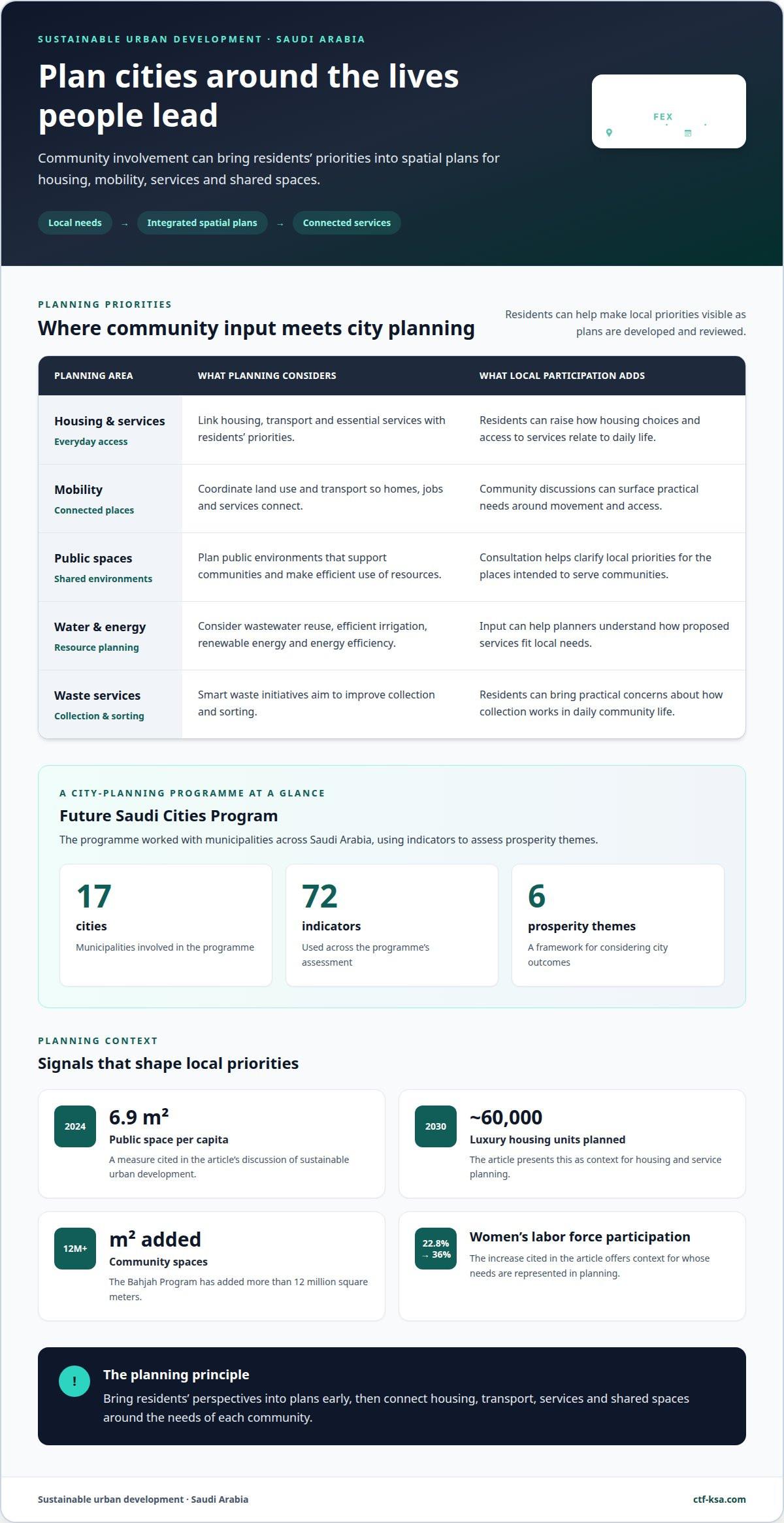
Saudi Arabia’s urban planning must link housing, transport, services and residents’ priorities. The Future Saudi Cities Program worked with municipalities in 17 cities, using 72 indicators across six prosperity themes. Participation brings local needs into integrated spatial plans.
Gulf countries share urban pressures, but national priorities and delivery models differ. The Saudi Building Code shapes housing design, while Vision 2030 guides national development. Riyadh is a major planning example; the programme spans 17 cities. For NEOM and The Line, sustainability planning must consider land use, mobility, energy and resource demand. Saudi Green Initiative urban work aims to expand greener public environments; the Bahjah Program has added more than 12 million square meters of community spaces. Water planning can consider wastewater reuse and efficient irrigation, while cities can assess renewable energy and energy efficiency when planning urban operations.
These plans can be considered alongside changing housing needs and participation in the economy. Luxury housing is planned to account for about 60,000 new units in Saudi Arabia against 2030. Women's labor force participation in Saudi Arabia increased from 22.8% to 36%. These facts offer context for planning conversations: residents can raise how housing choices and access to services relate to daily life, while planners can consider whose needs are represented. Community involvement can help make those priorities visible as plans are developed and reviewed.
Smart waste management aims to improve waste collection and sorting in Saudi Arabia’s smart city initiatives. Involving residents in discussions can bring practical concerns into planning, including how collection services fit into daily community life. Housing, participation and waste services all benefit from planning that considers residents’ perspectives. Consultation helps clarify local priorities and connect proposed services with the communities they are intended to serve.
Municipal governance and stakeholder participation
Saudi Arabia’s municipal governance links national priorities with local spatial decisions. National policy can help guide local urban planning. 28119 was issued on 2013/06/02. It assigned the Ministry of Municipal and Rural Affairs, working with UN-Habitat, to implement the Future Saudi Cities Program. The Ministry’s strategy was approved in February 2015, setting a policy framework for municipal initiatives. This connects Vision 2030 ambitions with city-level planning and delivery.
For zoning enforcement, municipalities apply land-use plans when assessing development proposals and coordinating infrastructure and services. Monitoring helps identify conflicts between planned uses, service capacity and urban growth. Residents, developers and service operators can add practical knowledge to participation processes, identifying access gaps and operational constraints. Data-driven governance can turn these insights into measurable priorities instead of isolated project requests. Riyadh Municipality contributes to 7 of the 17 Sustainable Development Goals, connecting local initiatives with wider outcomes.
Smart infrastructure and digital transformation
Smart infrastructure connects transport, utilities and public services through shared data and coordinated operations. In Saudi Arabia, digital transformation needs to go hand in hand with privacy safeguards and plans to restore services after failures, often relying on high-precision data acquisition and mapping from geospatial leaders such as GEOTECH 3D.
Public Infrastructure Investment
Public infrastructure investment funds shared systems such as transit, utilities and digital networks. Coordinating investments across transport, water and energy helps reduce service gaps. Saudi Arabia has concluded more than 56 private-sector partnership agreements supporting infrastructure and municipal service projects.
Transit, Walkability, and Car Dependence
Transit and walkability planning connects homes, jobs and services with practical alternatives to car travel. The Riyadh Metro carried more than 100 million passengers during its first nine months of operation, while national bus ridership exceeded 96.8 million passengers in 2025. These figures show substantial use, not a specific national target. Cities can support lower car dependence through connected routes, accessible stations and safe walking links, coordinated with land-use and transport policies.
Saudi Arabia’s urbanisation and urban challenges
Urban growth creates opportunity while increasing pressure on housing, infrastructure and services. Planning must account for the Kingdom’s varied regional and economic conditions.
Urbanization in Saudi Arabia
Urbanization concentrates people and economic activity in cities, shaping demand for homes, transport and services. Saudi Arabia’s population was 35.3 million in 2024, and urbanization was projected to reach 97.6% by 2030. For decision-makers, the priority is coordinating housing and infrastructure with growth instead of planning each separately.
Environmental and Social Risks
Environmental and social risks include rising water and energy demand, heat exposure and unequal access to services. In fast-growing settlements, weak connections between housing, jobs and transport can deepen access gaps. Assess resource needs, mobility and community impacts early, then adapt project design and phasing. This helps balance economic development with environmental limits and inclusive access. Protecting shared public spaces also supports everyday community life.
Speaking Opportunities for Construction Technology Leaders
Speaking opportunities at Construction Technology ConFeX KSA let construction technology providers and industry experts explain how their work can address Saudi Arabia’s built-environment priorities. Strong presentations connect a clear challenge with a practical response, such as digital transformation, construction automation, workforce safety or resource efficiency. This helps delegates assess real-world relevance rather than broad claims.
Shape your presentation around a specific audience need: explain the project context, the decision or constraint involved, and the outcomes your approach supports. Where relevant, use evidence from project experience and distinguish measured results from expected benefits. Clear, specific insights encourage useful discussion among technology providers, owners, developers and built-environment professionals.
The event connects technology providers with built-environment stakeholders, giving speakers a setting to exchange perspectives across the sector. With 55% of attendees at director level or higher, a focused contribution can speak directly to senior decision-makers.
Sponsorship Opportunities for Construction Technology Companies
Sponsorship at Construction Technology ConFeX KSA gives your company a platform to connect with construction decision-makers and contribute to industry-wide collaboration. For technology providers working on efficient project delivery, resource management or digital transformation, it can bring relevant solutions into discussions about Saudi Arabia’s built environment. The strongest fit comes from aligning your message with the challenges stakeholders are addressing.
Plan your sponsorship around a clear purpose: build awareness, support knowledge exchange or create opportunities to discuss sustainability priorities. A focused message can help owners, developers and industry professionals understand where your expertise fits, without presenting one solution as right for every project. Sponsorship packages provide a way to align your participation with your business objectives and the event’s professional audience. Explore the sponsorship opportunities to consider suitable ways to participate.
Make collaboration tangible by linking your sponsorship presence to practical discussions, such as lower-impact construction methods or better coordination across project teams. The aim is meaningful engagement, not visibility alone.
Sponsorship Packages at Construction Technology ConFeX KSA
Construction Technology ConFeX KSA sponsorship packages help companies align their participation with business priorities. The options cover different focuses, including event partnership, conference presence, industry alignment, thought leadership and awards recognition. Choose a package based on whether your priority is visibility, sharing expertise or association with a programme.
Options include Lead Partner, Strategic Partner, Conference Partner, Industry Partner, Thought Leadership Partner, and Awards & Red Carpet Partner packages. Branding opportunities include lanyard and awards-category branding. Use these options as a starting point, then match your selection to the audience you want to reach and the message you want them to remember.
Companies advancing sustainability can connect their participation to practical themes such as efficient construction, digital transformation and collaboration across project teams. A clear focus helps stakeholders understand how your expertise relates to Saudi Arabia’s built-environment priorities. Sponsorship can complement speaking opportunities or exhibition stands, each offering a distinct way to participate.
Exhibition Stands and One-to-One Business Meetings
An exhibition stand gives your team a focused setting to present construction technology solutions to built-environment stakeholders. Use concise demonstrations or visual examples to show how a solution addresses project delivery constraints, resource efficiency or workforce safety. Keep the message specific: identify the challenge, explain your approach and show its relevance to projects in Saudi Arabia.
Facilitated one-to-one business meetings create space for direct discussions with stakeholders. They can help you explore project priorities, understand operational needs and identify where further collaboration may make sense. The event reports that 87% of exhibitors develop tangible business opportunities, reflecting the value of purposeful engagement.
Prepare for each conversation by clarifying the solution’s intended use, the project challenge it addresses and the evidence you can share. Link your stand presentation to focused discussions, helping stakeholders move from an introduction to a practical exchange about fit, implementation considerations and sustainability priorities.
Construction Technology ConFeX KSA
Construction Technology ConFeX KSA connects construction technology providers with built-environment stakeholders to discuss how innovation can support sustainable urban development in Saudi Arabia. If you work on project efficiency, resource management, digital delivery or lower-impact construction, the event can bring your ideas into industry-wide conversations.
Take part through delegate passes, speaking opportunities, sponsorship packages or exhibition stands. Each offers a different way to engage: attend discussions, share expertise, build visibility or present solutions. Together, these options create opportunities to exchange perspectives with professionals across construction and the built environment.
Use the event to connect your expertise with practical priorities, from digital transformation to more sustainable project delivery. Clear examples and focused conversations help stakeholders understand where your work fits and where collaboration could develop. The event brings construction technology and industry participants together around these shared priorities.
Contact Construction Technology ConFeX KSA to discuss taking part.
Frequently Asked Questions
What funding, incentives, and public-private partnerships support sustainable urban development in Saudi Arabia?
Support can include public investment, private-sector partnerships, green bonds and sustainable sukuk. Saudi Arabia’s green finance activity and the Public Investment Fund’s Green Finance Framework can support investment aligned with sustainability priorities. Project teams can start by identifying the infrastructure need, assessing whether public or private finance fits, and aligning project objectives with the relevant funding framework. Partnership structures can bring public bodies and private companies together to develop infrastructure and municipal services.
How does sustainable urban development in Saudi Arabia compare with other Gulf countries?
Gulf countries share urban pressures, but their national priorities and delivery models differ. Saudi planning links local needs with national priorities such as Vision 2030.
What are Saudi Arabia's green building codes, regulations, and certification requirements?
The Saudi Building Code shapes housing design. While it does not explicitly mandate green-building certification requirements, project teams looking to achieve international sustainability standards often engage consulting specialists like Ekocentric for guidance on green building certifications.
Which Saudi cities have major sustainable urban development projects?
Riyadh is identified as a major planning example. The Future Saudi Cities Program also worked with municipalities in 17 cities, though they are not named here.
What are the goals and current status of Saudi Green Initiative urban projects?
Saudi Green Initiative urban work aims to expand greener public environments. The Bahjah Program has added more than 12 million square meters of community spaces.