
 DCTC KSA

- Blogs
- / Presenting Event Outcomes to Stakeholders With Clear Priorities
A post-event report should connect results to the goals set before the event, then show what the evidence means for each stakeholder. Presenting event outcomes to stakeholders is most effective when the report brings key findings forward, supports them with relevant measures and feedback, and explains what should happen next. Attendance matters, but so do engagement, satisfaction, sponsor visibility, audience fit, and lessons for future events.
It’s easy to focus on what happened on the day. Stakeholders also want to know whether the event delivered value, how their support contributed, and what the results mean for their priorities. A clear report answers those questions directly instead of burying them in a data dump.
This article explains what a post-event report should include and how to tailor it to stakeholders’ interests, concerns, and expectations. Learn how to select useful measures, present evidence clearly, address likely objections, and turn outcomes into practical recommendations for future initiatives.
Key Takeaways
- Prepare for stakeholder questions by linking event results to the goals and expectations set before the event.
- Choose report measures that fit the audience, from attendance and engagement to sponsor visibility and audience fit.
- Map stakeholder roles and concerns so you can present the outcomes that matter most to each group.
- Turn evidence into practical next steps, showing how lessons and stakeholder input can strengthen future initiatives.
1. Anticipating questions and objections
Set the report’s objectives before the event, then connect each objective to an outcome stakeholders can assess. If the goal is stronger industry engagement, for example, track session attendance, questions during Q&A, and poll participation. The final report can then show what was planned, what happened, and what the evidence reveals.
Which event outcome metrics should you report to stakeholders? Compare target and actual attendance, then choose measures that reflect the event’s goals, such as engagement, satisfaction, feedback, audience fit, and sponsor visibility. Include digital signals, such as website traffic, social media mentions, shares, and livestream views, when they support a specific conclusion.
Anticipate objections by listing the questions partners may raise. A sponsor might ask whether the audience matched its priorities; an executive might ask why attendance fell short of its target. Respond with relevant evidence, explain contributing factors, and distinguish measured results from interpretation. If the event missed a commitment made beforehand, acknowledge the gap and explain the response.
How should you present event results with charts and data visualizations? Choose a chart that makes one comparison clear: a bar chart can compare target and actual attendance, while a line chart can show registration patterns over time. Label measures plainly, use concise captions, and pair each visual with its key insight.
How should you communicate negative event outcomes and risks to stakeholders? State the result clearly, explain its effect, and propose a practical corrective action. If a session drew less interest than planned, for example, report the attendance evidence and suggest adjusting its timing or format.
Keep the presentation focused on strategy: lead with the main outcome, support it with evidence, and identify a next step. A disciplined approach to presenting event outcomes to stakeholders also leaves room for questions and feedback. Close by thanking supporters and explaining how their input shaped decisions or can inform the next event.
2. What is a Post-Event Report?
A post-event report records what the event set out to achieve, what happened, and what the results mean. Include objectives, target and actual attendance, engagement, satisfaction, feedback, and relevant impact or return-on-investment measures. Compare planned and actual attendance, for example, then explain how session participation relates to the event’s goals.
What should an event post-event report include? Begin with a concise summary of the main outcomes, followed by supporting measures, stakeholder feedback, and recommendations. Keep detailed data in a report or appendix; a dashboard can help readers track changing indicators.
Tailor the findings to each audience. Executives may need a concise account of outcomes against organisational priorities; sponsors may focus on audience fit, visibility, and return on investment. Keep the evidence consistent, but adjust its order, detail, and format to suit each group. Clear language helps decision-makers move from findings to action.
How soon after an event should stakeholders receive a results report? Share it once attendance figures, feedback, and other relevant evidence have been gathered and reviewed. A timely initial summary can communicate headline outcomes, with a fuller report to follow when detailed analysis is ready.
For event communications, identify each recipient’s role and the information they need to act. A concise, one-page project overview can communicate purpose and relevance more directly than a slide presentation. Shape the message around the stakeholder’s work, mission, and related projects, then record key communications and feedback for the event history.
What are the best practices for presenting event outcomes to executives and sponsors? Put the central insight first, support it with relevant evidence, and connect recommendations to stakeholder priorities. Archive the final report with the objectives and feedback. This provides a useful benchmark for recurring events and helps teams improve future planning.
Event analysis helps professionals assess success and impact, identify areas for improvement, and communicate value to stakeholders and partners. Comparing outcomes with objectives also gives organisers a basis for judging whether the event met its goals.
Present event analysis in reports, dashboards, infographics, slides, videos, or webinars. Choose a format that reflects the interests, priorities, and expectations of each stakeholder group. Preserve reports to maintain an event history and provide a benchmark for assessing progress across recurring events.
3. Assessing stakeholder interests and concerns
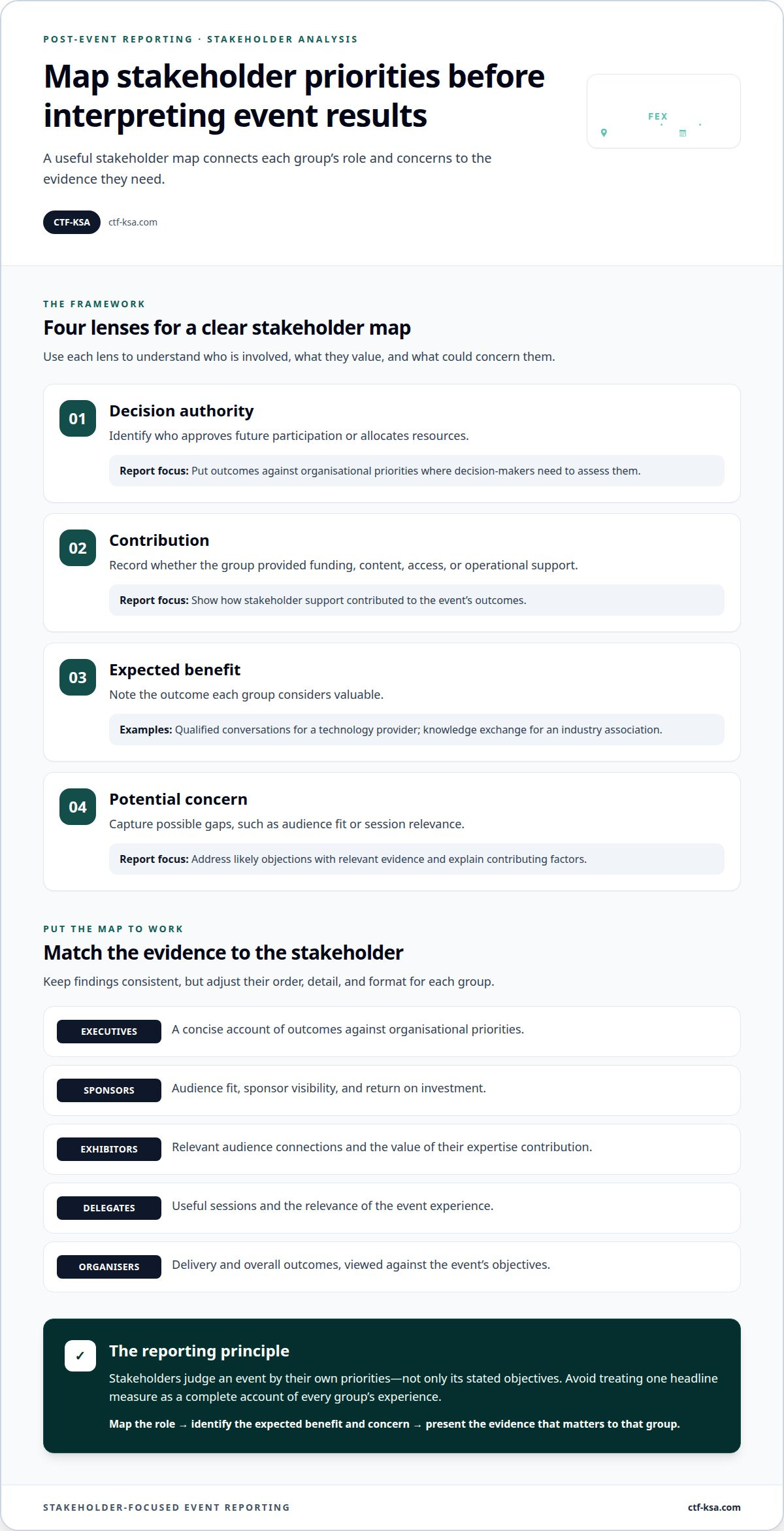
Stakeholders judge an event by their own priorities, not only its stated objectives. A technology provider may value qualified conversations, while an industry association may focus on knowledge exchange. Map each group’s relationship to the event before interpreting results. This avoids treating one headline measure as a complete account of every stakeholder’s experience.
Build a stakeholder map around four practical lenses: decision authority, contribution, expected benefit, and potential concern. At a construction technology event, an exhibitor contributes expertise and may seek relevant audience connections. A delegate may prioritise useful sessions, while an organiser focuses on delivery and overall outcomes. These differences determine what evidence each group needs.
- Decision authority: identify who approves future participation or allocates resources.
- Contribution: record whether the group provided funding, content, access, or operational support.
- Expected benefit: note the outcome each group considers valuable.
- Concern: capture possible gaps, such as audience fit or session relevance.
Use conversations, feedback forms, and meeting notes to assess stakeholder interests. Group comments by topic and distinguish recurring concerns from individual observations. If delegates say a technical session did not meet their needs, for example, relate that feedback to the session format and audience profile. This turns comments into insights that can guide action.
Prepare a simple interest-and-evidence grid before drafting the report. For each stakeholder group, record its priority, the relevant outcome, supporting evidence, and any unresolved concern. A sponsor’s question about visibility calls for visibility evidence; a speaker’s concern about audience engagement calls for participation feedback. The grid keeps the presentation relevant without changing the underlying results.
Show where collaboration influenced decisions. If partner feedback prompted a schedule adjustment, record the input, action taken, and resulting observation. This makes stakeholder contributions visible and clarifies how their perspectives shaped delivery. A structured assessment supports a credible discussion of outcomes and helps teams identify where future engagement can improve.
4. Aligning outcomes with stakeholder priorities
Alignment means connecting event results to outcomes stakeholders recognise as relevant to their goals. Link each finding to a priority, explain its significance, and show what action it supports. Strong participation in a technical session, for example, may signal demand for deeper discussion, not simply a successful agenda item.
Build a clear chain from outcome to priority. Start with the stakeholder’s goal, select related event evidence, and explain its implications. If a partner wants stronger industry relationships, report evidence of meaningful interactions and identify ways to continue those connections. Avoid claiming lasting impact based on attendance data alone.
Use stakeholder feedback to make the connection credible. Place sponsor feedback about return on investment, audience fit, and visibility alongside relevant event outcomes. Show how input shaped decisions, such as refining session topics after partners identified a knowledge gap. This demonstrates that stakeholder perspectives influenced the event, rather than appearing only in its final report.
Base recommendations directly on evidence. If attendees engaged most with practical demonstrations, propose expanding that format or adjusting the agenda to support it. If a challenge limited participation, explain its effect and recommend a realistic change. For each action, name the intended benefit and the stakeholder group it supports.
Present the same underlying results through different lenses without changing the facts. An executive summary can emphasise organisational priorities and next steps; a speaker discussion can focus on audience response and content opportunities. For a future event, speaking opportunities can let experts share relevant perspectives and advance industry conversation.
Close by connecting outcomes to the next decision. State what should continue, what needs adjustment, and where collaboration could create further value. This turns reporting into a strategic tool: stakeholders can see how their goals shaped the event and how its outcomes can strengthen future initiatives.
Explore speaking opportunities
Frame project outcomes in terms of stakeholder goals, key challenges, and broader organisational priorities. Build trust by showing how stakeholder input influenced project decisions and results. This keeps reporting relevant and clarifies the connection between stakeholder perspectives, project choices, and intended organisational value.
Construction Technology ConFeX KSA
Construction Technology ConFeX KSA brings technology providers and industry leaders together around the digital and sustainable transformation of Saudi Arabia’s built environment. If you’re turning event insights into future priorities, the event offers a setting to exchange perspectives, share expertise, and build relevant industry connections. Sponsorship Packages, Delegate Passes, Speaking Opportunities, and Exhibition Stands provide different ways to participate, contribute, and engage with the sector.
Let your stakeholder priorities guide the next step. Professionals seeking fresh perspectives can explore Delegate Passes, while those ready to share their expertise can consider Speaking Opportunities. Organisations aiming to strengthen their presence can explore Sponsorship Packages or Exhibition Stands. Contact Construction Technology ConFeX KSA to discuss participating.
Make the Next Event More Strategic
An event report does more than document what happened. Use its insights to inform decisions, deepen partner relationships, and clarify the purpose of future initiatives. Presenting event outcomes to stakeholders with this forward focus turns evidence into a basis for continued collaboration and more relevant event experiences.
Construction Technology ConFeX KSA creates opportunities to connect with Saudi Arabia’s construction technology community. Stakeholders can choose Sponsorship Packages, Delegate Passes, or Speaking Opportunities based on how they want to participate and contribute. The right next step depends on whether the priority is building visibility, engaging in industry conversations, or sharing expertise.
Bring your objectives and intended contribution to the conversation, then explore the participation route that best fits your goals.
Build on what you’ve learned to make your next event more purposeful and strengthen stakeholder relationships.
Frequently Asked Questions
What is a Post-Event Report?
A post-event report records an event’s performance, evidence, and implications for future decisions. It can also preserve operational knowledge, such as which registration channels attracted the intended audience or where schedule changes affected delivery. Include data definitions and collection methods so future teams can interpret results consistently. For recurring events, this provides a useful reference beyond individual memories or informal debriefs.
How to compare event outcomes against budget and benchmarks
Compare results with the event’s objectives and targets, including target versus actual attendance and relevant return-on-investment measures. Use reports from recurring events to track progress against earlier results.