 DCTC KSA

- Blogs
- / Making the Most of a Three-Day Construction Conference: A 2026 Playbook
What if the value of a construction conference is decided before you reach the first session? Making the most of a three-day construction conference takes more than a full calendar. With overlapping sessions, brief introductions and a busy return to work, it’s easy to leave with plenty of notes but few clear next steps. A focused plan turns those three days into useful learning, relevant connections and a pipeline of opportunities to evaluate.
You can’t be everywhere at once, and not every conversation will advance your priorities. This playbook shows you how to set objectives, choose sessions and approach networking with purpose. You’ll also build a practical follow-up process for turning useful insights and contacts into actions.
Prepare before you arrive, engage with intent and convert your strongest takeaways into work. Learning, facilitated meetings and technical demonstrations can reinforce one another at Construction Technology ConFeX KSA, which connects construction technology providers with sector decision-makers. The result is a clearer way to evaluate participation against your business goals.
Key Takeaways
- Set two or three measurable goals across learning, relationship-building and business development before you arrive.
- Use the three-day framework to move from priority sessions and peer conversations to applying what you learn.
- Choose sessions for their relevance to your projects, practical insight and speaker expertise. Give each networking conversation a clear purpose and next step.
- Making the most of a three-day construction conference means turning notes into prioritized follow-up, internal knowledge-sharing and actions you can assess against your goals.
Before a Three-Day Construction Conference: Set Outcomes and Build Your Plan
Conference value comes from planned outcomes, not attendance alone. Before making the most of a three-day construction conference, decide what you want to understand, who you need to meet and which business opportunity you want to explore. A conference brings together perspectives from across the construction industry, so a defined focus helps you use that breadth strategically.
How do you define success before the conference begins?
Choose two or three measurable goals across learning, relationships and business development. Pair each goal with an action and a way to assess progress. For example, identify a method you want to understand, a stakeholder role you want to speak with or a project need to discuss with relevant technology providers. If colleagues attend as a team, assign an owner to each goal and agree on how you’ll share findings.
- Learning: Attend a session or demonstration relevant to a current project and capture one practical insight.
- Relationships: Arrange or pursue a conversation with a priority stakeholder and record the agreed next step.
- Business development: Explore a defined need or opportunity, then decide whether it merits follow-up.
Attendance metrics show who was there; relevant conversations and agreed next steps show what participation may make possible.
How should you prepare your conference shortlist?
Review the agenda, exhibitors, speakers and meeting options before committing your time. Rank sessions and technical demonstrations by their connection to active projects, the practical insight they offer and the presenter’s expertise. Put essential items first, then choose alternatives in case timings overlap or priorities shift. Focus on themes such as BIM, digital twins, digital delivery or sustainability when they connect to your objectives—for example, evaluating how aerial survey specialists like tdbsolutions.ai collect reality capture data for modern site planning.
Next, list the people or organizations you’d like to approach. Prepare a specific opener linked to their work or a shared industry challenge, then ask about their current priorities. For example: “What project challenge is shaping your technology priorities this year?” A focused question makes for a stronger start than a generic introduction and helps you decide whether a follow-up is worthwhile.
A Three-Day Construction Conference Plan: Learn, Connect, Then Apply
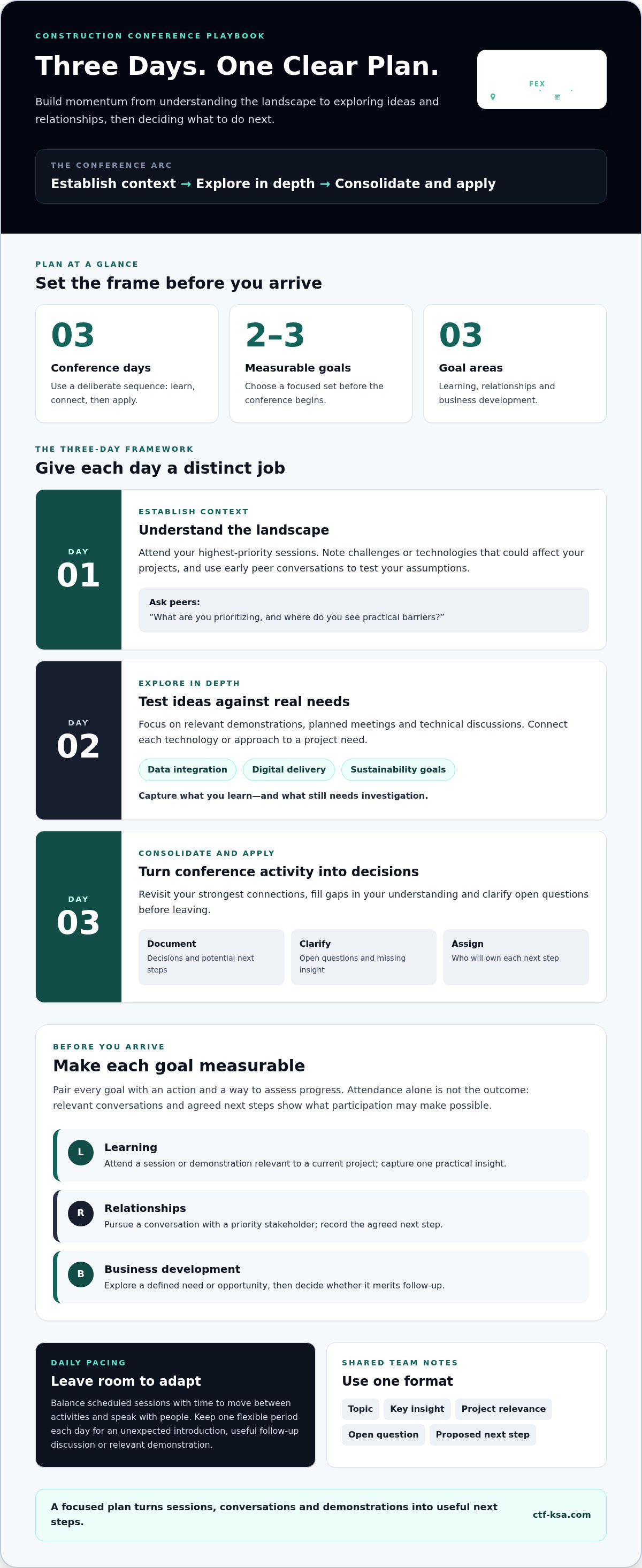
Use this itinerary as a planning framework, not an event schedule. The aim of making the most of a three-day construction conference is to build momentum: first understand the landscape, then explore relevant ideas and relationships, and finally capture decisions you can act on. Adapt the sequence to the agenda and your priorities.
- Day one, establish context. Attend your highest-priority sessions and note the challenges or technologies that could affect your projects. Use early conversations with peers to test your assumptions. Ask what they’re prioritizing and where they see practical barriers, then adjust your focus for the next day.
- Day two, explore in depth. Focus on relevant demonstrations, planned meetings and technical discussions. Prepare questions that connect a technology or approach to a real project need, such as data integration, digital delivery or sustainability goals. Record what you learn and what needs further investigation.
- Day three, consolidate and apply. Revisit your strongest connections, fill gaps in your understanding and clarify open questions. Before leaving, document decisions, potential next steps and who will own them. This creates a bridge between conference activity and the work you’ll do afterward.
What should you prioritize on each conference day?
Balance scheduled sessions with time to move between activities and speak with people. Avoid filling every block. Keep one flexible period each day for an unexpected introduction, a useful follow-up discussion or a demonstration that directly relates to your objectives. At CTF KSA, use the agenda and facilitated meeting opportunities to shape your plan without overbooking yourself.
How can a team cover more ground without duplicating effort?
Divide coverage by role, expertise and business objective. For example, one colleague can focus on digital delivery while another explores sustainability applications or stakeholder conversations. Agree on a shared note format: topic, key insight, relevance to a project, open question and proposed next step. CTF KSA delegate passes provide access to conference sessions, networking events and technical demonstrations, making it easier for team members to attend with different priorities.
Make Construction Conference Sessions and Networking More Productive
A strong conference plan needs more than a shortlist. Choose sessions for their relevance to active projects, the practical insight they offer and the speaker’s expertise. Then use conversations and demonstrations to test what you hear against real business needs. Making the most of a three-day construction conference means connecting learning to people, questions and specific actions.
How do you choose between overlapping sessions?
Compare each option with your priority goals, not just its title. Look for a clear connection to a current project, methods you can apply and speakers with relevant experience. If both sessions matter, ask a teammate attending the other one to capture its central insight, practical example and unanswered questions. Agree on the exchange beforehand so both sets of takeaways reach the team promptly.
How can you make technical demonstrations and meetings useful?
Arrive with questions grounded in a real challenge, workflow or decision. At a digital delivery demonstration, for example, ask how the approach supports the information flow your team needs to improve. Keep conversations purposeful:
- Establish relevance by briefly explaining your role or project interest.
- Ask about the other person’s current priorities and related experience.
- Agree on a suitable next step, such as sharing information or arranging a follow-up discussion.
A clear next step turns a promising conference conversation into an actionable professional connection.
Capture concise notes while details are fresh: the key insight, the relevant contact and one specific follow-up action. Record what supports your goals. This format helps you compare ideas across sessions and demonstrations, share useful findings with colleagues and identify which conversations deserve attention after the event.
After the Three-Day Construction Conference: Turn Insights into Action
The value of making the most of a three-day construction conference is realized in what happens next. Before notes and contacts disappear into crowded inboxes, sort what you gathered into three categories: actions to start now, questions requiring longer-term research and ideas worth sharing internally. This separates immediate opportunities from insights that need further validation.
How should you follow up after the conference?
Prioritize contacts by their relevance to your goals and any next step you agreed on. Send a concise, personalized message that refers to your discussion and proposes the action you identified together. Avoid generic follow-ups that could apply to anyone. Then share a short internal debrief: summarize the strongest insights, assign an owner to each priority opportunity and set a timeline for the next review.
Close the loop by comparing your original goals with what you achieved. Did you gain useful learning, have qualified conversations and cover the priorities assigned across your team? Note what advanced, what remains unresolved and what you would change in your next conference plan. This gives you a practical basis for assessing participation against business objectives, rather than relying on impressions alone.
How can CTF KSA support purposeful conference participation?
Choose a participation format to match your aims. Delegate passes provide access to conference sessions, networking events and technical demonstrations. Facilitated meetings create a structured setting for relevant conversations, while speaking opportunities let industry experts share insights with a professional audience. Companies seeking visibility can use sponsorship packages and exhibition stands to showcase solutions to construction-sector decision-makers.
CTF KSA sponsorship packages combine brand visibility with opportunities for engagement. All sponsorship tiers include onsite lead scanning, and facilitated 1:1 meetings are available to Lead, Strategic, Workshop, Thought Leadership and Industry partners. Speaking options also vary by tier: Solo Talks are available to Lead, Strategic and Thought Leadership partners, while panel discussions include Lead, Strategic, Thought Leadership and Industry partners. Consider CTF KSA sponsorship opportunities in light of your objectives, audience and preferred way to contribute. Define the intended outcome and track relevant conversations, learning and agreed next steps.
Turn Conference Momentum into What Comes Next
The strongest conference outcome isn’t a crowded notebook. It’s a decision that moves a real priority forward, a connection that develops into a useful exchange or an insight your team puts to work. Keep that standard in view as you plan your next step. Making the most of a three-day construction conference means treating participation as the start of progress, not a standalone event. For teams also considering hosting their own corporate summits or industry gatherings, engaging professional organizers such as AMA Event Management can help translate clear objectives into impactful event delivery.
Choose an opportunity that aligns with how you want to contribute and connect. Whether your focus is learning, visibility or engagement with construction-sector decision-makers, set a clear intention before you take part. Then make space to build on the conversations and ideas that matter to your organization. Each purposeful step can strengthen your position in a changing industry.
Explore Construction Technology ConFeX KSA participation options
Bring your priorities, curiosity and ambition to the next conversation. Your next meaningful industry connection can begin with a clear purpose.
Frequently Asked Questions
How do I justify attending a three-day construction conference to my manager?
Present a concise business case that connects the conference to a live organizational need. Explain what decision or capability the team could advance, which stakeholders or technical perspectives would inform it, and how you’ll share useful findings afterward. For making the most of a three-day construction conference, show your manager how attendance supports a specific work priority rather than framing it as time away from the office.
Can one person cover a three-day construction conference effectively?
Yes, if you define a focused scope and accept that you can’t attend everything. Choose a priority theme, identify essential sessions or demonstrations, and leave enough time to absorb and record what matters. If your remit spans several disciplines, distinguish must-know findings from topics that can wait. A clear brief from your manager can help you represent the organization without trying to speak for every team.
What should I do if two important conference sessions overlap?
Choose the session that can inform an immediate decision or resolve a more pressing project question. Consider whether one offers detailed technical analysis while the other provides a broader overview, then select the format that fills your knowledge gap. If neither is clearly more valuable, note the unanswered questions and raise them in relevant conversations afterward.
How can I make conference networking feel less transactional?
Start with genuine curiosity about the other person’s work, not a pitch or a request for contact details. Ask what they’ve learned from a recent project or which industry challenge they’re thinking through, then share a relevant perspective of your own. Let the discussion develop naturally. Exchange details when there’s a clear reason to continue the conversation, and follow up with something useful to that shared interest.
What should I do when a planned conference meeting is cancelled?
Respond graciously and suggest another time if the other person is open to it. Then use the opening to pursue a nearby priority: visit a relevant demonstration, speak with another stakeholder or review notes before your next commitment. Keep the cancelled meeting on your follow-up list, but don’t let one change derail the day. A calm adjustment protects your focus and leaves the relationship on good terms.
Explore CTF KSA sponsorship opportunities and choose a participation format that supports your conference goals.