 DCTC KSA
- Blogs
- / Low Carbon Materials for Saudi Giga-Projects (2026)
Building at the speed of Saudi Arabia’s giga-projects is no longer just an engineering challenge; it's a carbon accounting mandate. As SBC 2024 standards move into total enforcement, the industry faces a definitive shift. You can't achieve Vision 2030 scale without revolutionizing how you source and track low carbon construction materials.
The pressure is undeniable. You're balancing the demand for rapid delivery with the rigorous sustainability requirements of projects like NEOM and the Red Sea. It’s often difficult to identify which materials are truly available in the KSA market or how to measure their impact across complex, high-stakes supply chains.
This guide provides the strategic roadmap you need. You'll discover the high-performance green materials ready for 2026 and learn how to integrate carbon tracking into your digital workflows. We'll also show you how to connect with the elite technology and material partners who are already accelerating the Kingdom’s net-zero transformation.
Key Takeaways
- Master the strategic shift from operational efficiency to embodied carbon mandates driven by Saudi Vision 2030 and the Saudi Green Initiative.
- Identify the high-performance low carbon construction materials, such as carbon-negative additives and recycled structural frames, that are now essential for giga-project delivery.
- Integrate advanced digital workflows, including BIM and Digital Twins, to gain precise visibility into material sustainability and lifecycle performance.
- Secure a competitive advantage by connecting with global climatetech leaders and discovering innovative building solutions at CTF KSA.
Defining the Shift: Embodied Carbon and Saudi Vision 2030
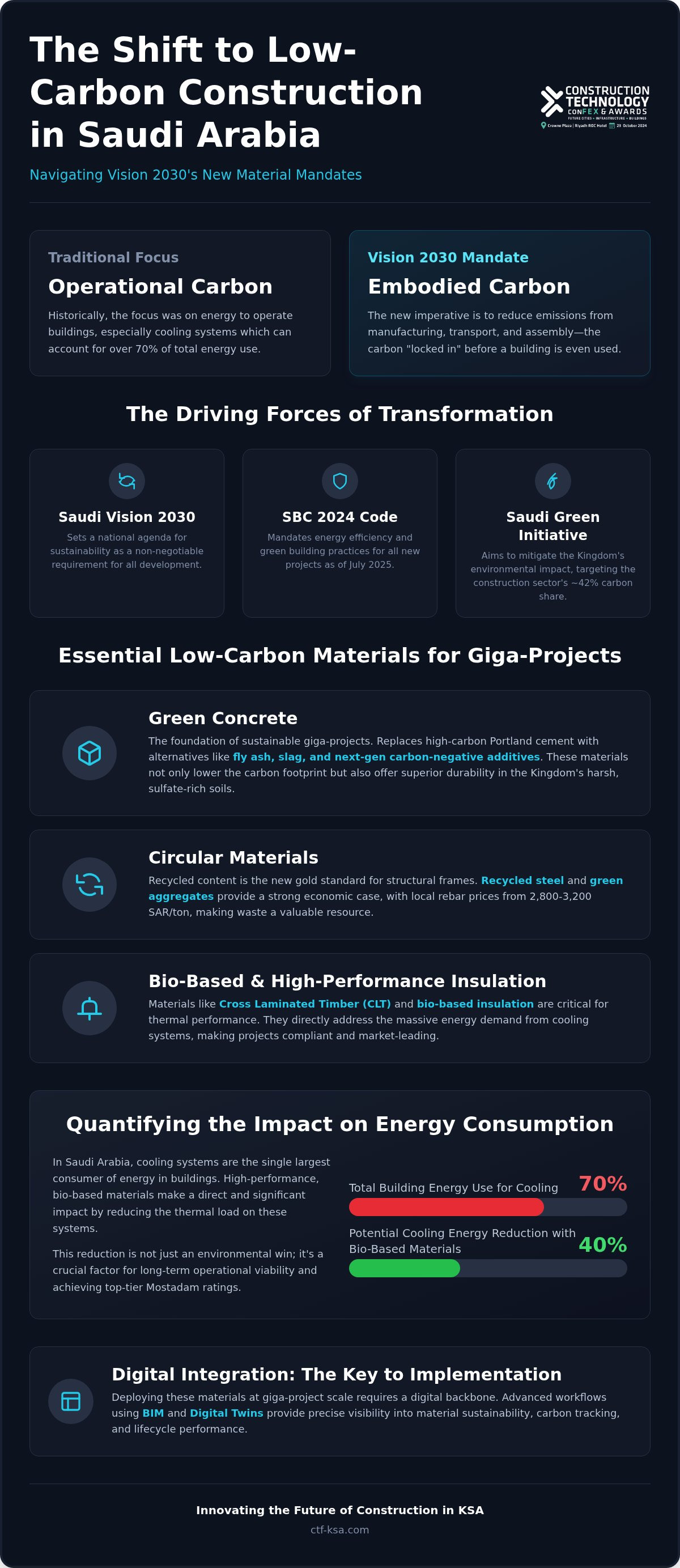
Saudi Arabia’s construction sector is undergoing a massive transformation. For years, the industry focused almost exclusively on operational carbon, the energy required to cool structures in an environment where cooling systems often exceed 70% of total energy use. That focus is expanding. Embodied carbon, the emissions generated during the manufacturing, transport, and assembly of building components, represents the next critical hurdle for project leaders. It's the carbon footprint already "locked in" before a building's first tenant arrives.
The Saudi Green Initiative and Vision 2030 have turned sustainability into a non-negotiable requirement. With the global construction and real estate sector responsible for approximately 42% of carbon emissions, the Kingdom is moving fast to mitigate its impact. The SBC 2024 code now mandates energy efficiency and green building practices for all new projects as of July 2025. Low carbon construction materials are products engineered to minimize CO2 emissions throughout their entire lifecycle, from extraction to end-of-life.
Achieving prestige in the KSA market means securing top-tier Mostadam ratings. For Gold and Diamond certifications, the submission of Environmental Product Declarations (EPDs) is now mandatory. This requirement is driving a surge in interest for bio-based building materials and carbon-negative concrete additives. These aren't just "green" choices; they're essential components for regulatory compliance and long-term project viability in a market that rewards innovation.
The Role of Giga-Projects in Setting New Material Standards
Giga-projects like NEOM and Red Sea Global act as the ultimate proving grounds for material innovation. They possess the scale to disrupt traditional supply chains and demand entirely new performance standards. We're seeing a decisive pivot away from high-carbon, traditional concrete toward low carbon construction materials that don't compromise on structural integrity or delivery speed. To explore how specialized engineering techniques like CFRP are revolutionizing this sector, check out Composites Construction UK for their insights on structural strengthening and repairs. These developments aren't just building cities; they're establishing a new national benchmark for how infrastructure is conceived and delivered across the region.
Key Low-Carbon Materials Redefining the Saudi Built Environment
The speed of giga-project execution necessitates a high-performance inventory of low carbon construction materials. It's no longer about experimentation; it's about industrial-scale deployment. Project owners are now prioritizing materials that offer a dual benefit: meeting the stringent carbon caps of Saudi Vision 2030 while maintaining the structural resilience required for the Kingdom's ambitious architectural designs. This focus on premium quality and performance is also driving demand for specialized finishing services across the region, such as those provided by NovoTech, a leader in high-end renovation and painting for residential, commercial, and industrial projects.
Green Concrete: The Foundation of Sustainable Giga-Projects
Replacing traditional Portland cement is the industry's highest priority. By utilizing fly ash, slag, or next-gen carbon-negative additives, contractors can drastically lower the carbon intensity of their pours. Recent research on sustainable materials in Saudi Arabia highlights that these alternatives aren't just eco-friendly; they offer superior durability in the Kingdom's harsh, sulfate-rich soils. These additives improve workability and thermal performance, which is vital for maintaining integrity during high-heat casting cycles.
Circular Materials: Recycled Content and Waste as a Resource
Circularity is the new gold standard for structural frames. With local rebar steel prices ranging from 2,800 to 3,200 SAR per ton in early 2026, the economic case for recycled steel and green aggregates is as strong as the environmental one. Leveraging these materials requires sophisticated tracking and logistics. You can explore the technical requirements for this transition in our guide on how to implement construction waste management technology in Saudi giga-projects.
Beyond the structural frame, we're seeing the rise of Cross Laminated Timber (CLT) and bio-based insulation. These low carbon construction materials can reduce cooling energy use by up to 40%, a vital metric when cooling accounts for over 70% of a building's total energy consumption. Adopting these technologies ensures your projects aren't just compliant, but market-leading. If you're looking to source these innovations at scale, securing a delegate pass for the next forum is the most direct route to the material innovators shaping the market.
Overcoming Implementation Barriers: Digital Integration and Lean Workflows
Deploying low carbon construction materials at the scale required for NEOM or Qiddiya demands more than just a sustainable catalog. It requires a digital nervous system. Without Building Information Modeling (BIM) and Digital Twins, tracking the embodied carbon of millions of tons of material becomes an impossible administrative burden. Digital integration is the only way to ensure that sustainability doesn't compromise delivery speed or project prestige.
BIM-Driven Carbon Accounting
BIM is now the definitive tool for automated carbon footprint calculations at the procurement stage. By embedding Environmental Product Declaration (EPD) data directly into the 3D model, design teams can simulate the carbon impact of different structural options in real-time. This level of precision is essential for meeting the 2026 mandates of the Saudi Building Code and ensuring every material choice aligns with Mostadam requirements. For a deeper dive into these requirements, see our Digital Transformation in Construction KSA strategic roadmap.
Energy Efficiency and Material Synergy
The true power of sustainable design lies in the synergy between the building envelope and its internal systems. High-performance, low carbon construction materials like bio-based insulation work in tandem with Energy Efficient Building Technology to slash cooling loads. When smart building systems receive real-time data from material-embedded sensors, operational efficiency peaks. This data-driven selection is the most reliable way to secure Mostadam Diamond ratings while keeping giga-projects on their aggressive 2026 timelines.
Secure your delegate pass to master these digital workflows
Scaling Sustainability: Networking with Global Material Innovators at CTF KSA
Scaling these solutions across the Kingdom’s massive project pipeline requires more than just technical data. It requires a physical headquarters for innovation. CTF KSA is that definitive venue. It's where the visionaries behind the Red Sea and NEOM meet the creators of the next generation of low carbon construction materials. This is the platform where climate targets transition into executed contracts.
To move beyond theoretical models, industry leaders need tangible proof. Delegate passes provide exclusive access to technical demonstrations where you can witness the performance of these materials firsthand. We facilitate high-stakes 1:1 meetings that connect giga-project stakeholders directly with material innovators. These interactions are designed to bypass logistical bottlenecks and accelerate the delivery of net-zero infrastructure.
Thought Leadership in Sustainable Construction
The conversation around carbon is evolving rapidly. We invite industry experts to apply for speaking opportunities to share their low-carbon success stories on a global stage. Being part of the Kingdom’s #1 ConTech and innovation platform places you at the center of the Saudi Green Initiative. It's an opportunity to influence the standards that will define the region's built environment for decades.
Securing a Competitive Edge in the Saudi Market
Visibility is the currency of the giga-project era. Our sponsorship and exhibition packages offer material providers a direct line to senior decision-makers. With 80% of our audience comprised of clients and end-users, the platform ensures your sustainable solutions are seen by those with the power to specify them. Supported by PIF, CTF KSA provides the elite reliability and institutional gravitas required to drive tangible business opportunities in the 2026 market. Don't just watch the transformation; lead it.
For international exhibitors looking to showcase their sustainable innovations with high-impact visual displays, Coker Exhibition Systems Ltd (CokerExpo) provides bespoke solutions that ensure your brand stands out in a competitive global market.
In addition to high-impact visual branding, successful event participation often hinges on logistical support, such as the cooler and freezer trailer rentals provided by KC Frost Wagon for specialized commercial and event needs.
Leading the Kingdom’s Net-Zero Transformation
The roadmap to 2030 is now defined by the precision of our building blocks. We've moved beyond the era of simple efficiency into a landscape where low carbon construction materials and digital transparency are the primary drivers of prestige. By aligning material selection with BIM-driven carbon accounting, you ensure your projects meet the rigorous standards of SBC 2024 without sacrificing the momentum of giga-project delivery.
The future of the built environment isn't just being planned; it's being built through strategic collaboration. As the Kingdom’s #1 ConTech and innovation platform, CTF KSA is explicitly supported by the Public Investment Fund (PIF) to accelerate this shift. It's the definitive venue for high-stakes networking, where 87% of exhibitors develop tangible business opportunities.
Secure your delegate pass for CTF KSA to discover the future of sustainable materials
The transformation of the Saudi construction landscape is happening at an unprecedented pace. Secure your place at the forefront of this industrial evolution and lead the way toward a net-zero future.
Frequently Asked Questions
What are low carbon construction materials exactly?
Low carbon construction materials are products engineered to minimize carbon dioxide emissions throughout their entire lifecycle. This encompasses everything from raw material extraction and manufacturing to transport, assembly, and eventual end-of-life disposal. In the Kingdom's current landscape, this primarily includes green concrete, recycled steel, and bio-based insulation designed to mitigate the environmental impact of the built environment.
How do low carbon materials support Saudi Vision 2030 goals?
These materials are fundamental to the Saudi Green Initiative and the Kingdom's push toward Net Zero. By reducing the embodied carbon of massive infrastructure projects, developers can align with the Circular Carbon Economy framework. Utilizing low carbon construction materials ensures that giga-projects don't just meet delivery speed targets but also fulfill the strict sustainability mandates required for national progress.
Are low carbon materials durable enough for the Saudi Arabian climate?
Yes, many sustainable alternatives provide superior performance in extreme desert conditions. Green concrete mixes incorporating fly ash or slag often exhibit higher resistance to sulfate-rich soils and improved thermal stability during high-heat casting. These materials are specifically engineered to maintain structural integrity under the Kingdom's intense solar radiation and temperature fluctuations, often outperforming traditional high-carbon options.
How can BIM help in tracking the carbon footprint of construction materials?
Building Information Modeling (BIM) acts as a digital ledger for environmental data. By integrating Environmental Product Declaration (EPD) information directly into the model, project teams can automate carbon calculations during the design and procurement phases. This digital workflow allows for real-time visibility into the project's total carbon footprint, making it easier to optimize material selection and secure Mostadam certifications.
Where can I meet suppliers of low carbon construction materials in Saudi Arabia?
The definitive venue to connect with material innovators is CTF KSA, scheduled for October 12, 2026, at the Crowne Plaza Riyadh, RDC Hotel. As the Kingdom’s premier platform for construction technology, it brings together global suppliers and senior giga-project decision-makers. It's the most efficient environment to discover high-performance low carbon construction materials and establish the partnerships necessary for large-scale project delivery.