
 DCTC KSA

- Blogs
- / Justifying a Construction Conference Budget to Management
A conference budget earns approval through measurable project value, not attendance alone. When justifying a construction conference budget to management, connect each requested expense to a defined business outcome, explain the full cost in Saudi riyals, and assign an owner to track commitments, spending, and forecasts. The case should show why participation supports project or organizational priorities.
Industry events can generate useful connections and insights, but management needs a clear reason to fund them. A persuasive proposal bridges that gap with measurable outcomes, transparent cost assumptions, and accountability after the event. Define the objectives, present the budget, clarify decision-making authority, and explain how results will be monitored. Construction Technology ConFeX KSA offers a next step for engaging with construction technology through delegate passes, speaking opportunities, sponsorship packages, and exhibition stands.
Key Takeaways
- Frame conference participation around a project or business outcome, then show how the proposed budget supports it.
- Document who approves spending, who owns each commitment, and how decisions will be shared with stakeholders.
- Track committed costs, actual expenditure, changes, and forecasts in regular budget reviews to identify variances early.
- Assess expected business value against the full cost, and define how you’ll evaluate connections, insights, or opportunities after the event.
Defining project outcomes, budget, and decision-making authority
Start with a defined construction project outcome, then show how conference funding supports it. A decision-ready case links learning or new connections to schedule, quality, cost, or project progress.
Project Goals and Funding Priorities
Funding priorities show which project goals justify conference participation. Construction projects face uncertainty, so budgets must balance the resources needed to meet goals against unnecessary spending. Link each expected outcome to a project need, such as evaluating digital methods that could improve coordination. Record the assumptions and risks that may affect the value of attending.
Assign one person to prepare the request, name the approver, and identify who will track follow-up. Keep conference objectives, budget, decisions, and updates in a shared project environment. For example, connect a learning objective to schedule, quality, cost, and progress reporting, then compare results with the project baseline. Contractors and project leads can refer to the same record to understand funding priorities and approval decisions.
Evidence for the Budget Proposal
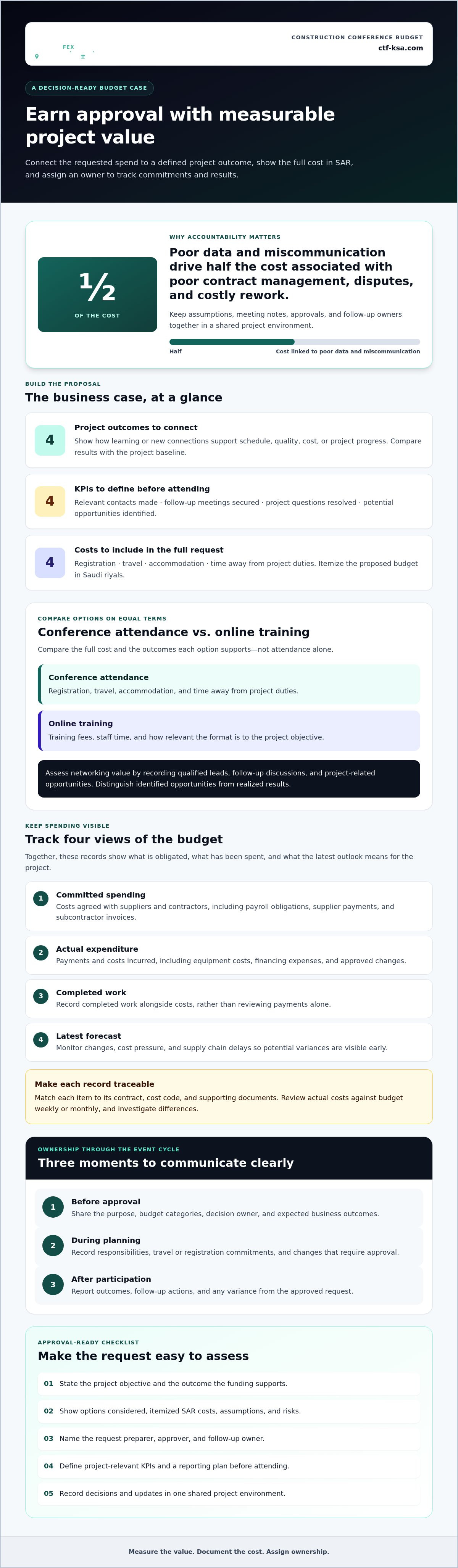
A budget proposal is an evidence-based case for funding that sets out expected outcomes, costs, measures, and an accountable owner. It helps management compare the request with other financial priorities. Define KPIs before attending, such as relevant contacts made, follow-up meetings secured, project questions resolved, and potential opportunities identified. Choose measures that reflect the stated project goal, not attendance alone.
Compare conference attendance with online training by assessing the full cost and the outcomes each option supports. Include registration, travel, accommodation, and time away from project duties. Compare these with training fees, staff time, and how relevant each format is to the project objective.
Assess networking value by recording qualified leads, follow-up discussions, and opportunities related to project needs. Assign an owner to document potential revenue or avoided costs, and distinguish identified opportunities from realized results.
Write the business case around the objective, options considered, itemized SAR budget, assumptions, approval owner, KPIs, and reporting plan. End by stating the decision management must make and the project outcome the request supports.
Budget communication and stakeholder accountability
Clear budget communication turns approval into shared responsibility across the project team. Record the conference request, funding owner, approval status, and reporting expectations in a shared project environment. A centralized record gives the client, project leads, and contractors one reference for decisions, reducing conflicting versions and unclear commitments.
Use concise, accurate reports to explain what changed, why it matters, and who needs to act. If a conference objective relates to a project risk, for example, record the relevant insight, mitigation decision, and effect on the contingency plan. Separate approved spending from proposed changes so stakeholders can compare actual commitments with the agreed budget.
- Before approval: Share the purpose, budget categories, decision owner, and expected business outcomes.
- During planning: Record assigned responsibilities, travel or registration commitments, and changes requiring approval.
- After participation: Report outcomes, follow-up actions, and any variance from the approved request.
Progress meetings should connect conference-related decisions with project delivery. Include cost forecasts, contingency status, emerging risks, mitigation actions, and decisions required from the client or project team. A missed milestone can signal wider delivery pressure, so show how any proposed action affects schedule, quality, and project cost. Assign each action to a named role and record its status in the shared reporting environment.
Accountability also depends on disciplined stakeholder communication. Poor data and miscommunication drive half of the cost associated with poor contract management, disputes, and costly rework. Keep meeting notes, assumptions, approvals, and follow-up owners together, especially when decisions affect contractors or client expectations. This provides a clear record if disputes arise or overruns need explaining.
For stakeholder planning, conference attendance details can help teams align participation with approved objectives. Keep the same reporting discipline before and after the event, so management can trace the request to decisions and documented outcomes.
Document and formalize construction budgets in a common project environment to support stakeholder buy-in and accountability. A shared formal budget gives stakeholders a consistent basis for discussion and aligns budget communication with the project record.
Tracking commitments, expenditure, and forecasts
Reliable tracking compares committed spending, actual expenditure, completed work, and the latest forecast. A consistent record helps reveal pressure early, including procurement changes and supply chain delays.
Commitments and Spending Records
Commitment tracking records costs agreed with suppliers and contractors, while expenditure tracking records payments and costs incurred. Together, they show how much of the project budget is already obligated and what remains available. Track payroll obligations, supplier payments, subcontractor invoices, equipment costs, financing expenses, approved changes, and completed work. Match each item to its contract, cost code, and supporting documents. This makes variance analysis more useful than reviewing payments alone.
Review the budget weekly or monthly, investigating differences between actual and budgeted costs. Monthly cost value reconciliation compares costs incurred with the value of completed work, helping teams assess margins, risks, and recovery opportunities. Record who owns each variance and what action is required.
Forecasting Total Attendance Costs
Estimate total attendance costs by combining registration, travel, accommodation, local transport, meals, and work time allocated to participation. Calculate each category in SAR using your organization’s applicable estimates, then add them to establish the forecast. This gives management a complete cost picture rather than treating registration as the full expense. Update the forecast if travel plans, attendance duration, or procurement assumptions change.
For broader project forecasting, track contract value updates, approved variations, provisional sums, dayworks, risk allowances, finance costs, claims adjustments, and forecast revisions. Compare expected cash outflows with funding dates. Payment delays or disputes over work progress can create funding gaps, so record when commitments and payments are due.
Treat the resulting estimate as a live forecast, not a fixed figure. If supply chain changes or schedule delays affect project costs, document the cause, quantify the impact using current project records, and update the forecast. Progress reviews should identify risks, contingency status, mitigation actions, and required decisions. Keep each revision traceable to its assumptions, approvals, and supporting cost information.
What are the business benefits and expected ROI of attending a construction conference?
A construction conference can create business value through technical insight, professional connections, and opportunities to address project challenges. Compare expected returns with the full attendance cost, then track which outcomes lead to decisions or commercial results.
Begin with a specific business objective. A project team facing coordination issues, for example, might seek ways to improve information flow or reduce avoidable rework. Another team may prioritize contacts who can inform procurement decisions or future project planning. Link each objective to a business measure, such as qualified follow-up meetings, useful technical insights adopted, or opportunities entered into the organization’s pipeline.
- Knowledge: Record relevant methods or technologies, and document any resulting project decision.
- Relationships: Track qualified contacts, follow-up discussions, and the business need each connection addresses.
- Commercial opportunities: Log opportunities identified, their status, and any resulting revenue or cost avoidance.
Calculate ROI using attributable benefits and the full cost in SAR. A practical measure is net value divided by attendance cost, with net value calculated as attributable benefits minus total cost. Keep estimated benefits separate from realized results. A potential supplier saving, for example, remains a forecast until procurement confirms an actual saving. Include registration, travel, accommodation, local transport, and staff time in the cost baseline.
Set a post-event review point and assign an owner to each follow-up. Compare results with the original objectives, noting which conversations advanced, which insights informed project decisions, and which opportunities remain open. This gives management a defensible view of value without treating every contact as revenue. It also strengthens future budget requests: actual results refine assumptions, while unproductive activities can be reconsidered. In Saudi Arabia’s construction sector, relate findings to specific delivery, cost, quality, or sustainability priorities rather than claiming broad benefits without evidence.
Use market forecasts as context, not as a guaranteed conference benefit: Saudi Arabia construction tender prices and material costs are influenced by ambitious giga-project pipelines, Vision 2030 developments, and shifting supply chain dynamics across the Kingdom.
A construction budget covers expected costs for labor, materials, equipment, subcontractors, permits, professional services, contingencies, and other expenses. Assess conference-related decisions against these costs and project priorities, keeping expected savings or avoided costs grounded in the budget.
Construction Technology ConFeX KSA: Sponsorship Packages
Construction Technology ConFeX KSA gives construction organizations a platform to connect with technology providers and industry leaders focused on the built environment’s digital and sustainable transformation in Saudi Arabia. If your approved objectives include industry engagement or presenting your organization’s work, consider whether a Sponsorship Package, Speaking Opportunity, or Exhibition Stand fits your role. Professionals seeking conference access, networking sessions, and technical demonstrations can consider a Delegate Pass.
Choose the format according to the outcome you plan to measure. Decide whether your objective is to build visibility, share expertise, connect with peers, or explore technical developments. For teams that also organize off-site industry showcases or outdoor exhibitions requiring canopy and marquee infrastructure, resources like eventrentalmalaysia.com can provide useful insight into physical equipment planning. Assign an owner to record relevant conversations and follow-up actions, linking participation to your organization’s goals and budget review.
To explore participation options, contact Construction Technology ConFeX KSA or visit ctf-ksa.com.
Turn Approval Into Forward Momentum
When justifying a construction conference budget to management, treat approval as the start of a deliberate investment, not the finish line. Turn the agreed purpose into action by connecting participation to your team’s priorities and carrying relevant insights into project decisions and future planning.
Keep value visible after the event. A well-managed follow-up can move a promising conversation toward collaboration or turn a new perspective into a practical change. Either way, the organization has a clearer basis for deciding where to focus next. For companies that ultimately plan to host their own corporate conferences or stakeholder forums, collaborating with experienced planners like AMA Event Management helps ensure budgeting, coordination, and execution deliver measurable returns.
Construction Technology ConFeX KSA can help your organization engage with construction technology in Saudi Arabia. Choose the participation option that aligns with your objectives.
Build on the approved plan with confidence, making each next move purposeful.
Frequently Asked Questions
What risks should management consider when approving a construction conference budget?
Management should weigh uncertain outcomes, staff time away from delivery, schedule conflicts, and the possibility that conversations will not develop into useful opportunities. Attending during a critical handover period, for example, may carry a greater operational cost than participating during a quieter project phase. Reduce exposure by selecting attendees whose roles match the objectives, setting clear limits for authorized spending, and arranging cover for time-sensitive project decisions.