 DCTC KSA

- Blogs
- / How to Train Teams for Trade Show Networking & Rejection
82% of trade show attendees have buying authority, so a polished booth is only part of the equation. Training your team for effective trade show networking helps staff turn that opportunity into meaningful conversations, handle a polite rejection with confidence, and recognize when to take the next step. The difference comes down to how well your team listens, asks relevant questions, and follows up.
A strong booth can attract attention, but your team shapes the visitor’s experience. This guide explains how to prepare staff to start natural conversations, qualify potential connections without pressure, and respond professionally when visitors are not interested.
You’ll also learn how to turn promising conversations into relevant follow-ups, making each interaction more purposeful before, during, and after the event.
Key Takeaways
- Prepare staff to ask focused questions that reveal a visitor’s role, priorities, and readiness for a next step.
- Capture the reason a conversation matters, then use those details to make follow-up personal and relevant.
- Build a shared approach to booth conversations while giving staff room to respond naturally to each visitor.
- Handle rejection with courtesy: acknowledge the response, close the exchange gracefully, and keep the interaction professional.
Why does trade show booth staff training matter more than your booth design?
A striking booth draws attention; trained staff turn visits into meaningful conversations. Prepare your team to ask, listen, capture relevant details, and agree on a useful next step.
-
Qualify Visitors with Focused Questions
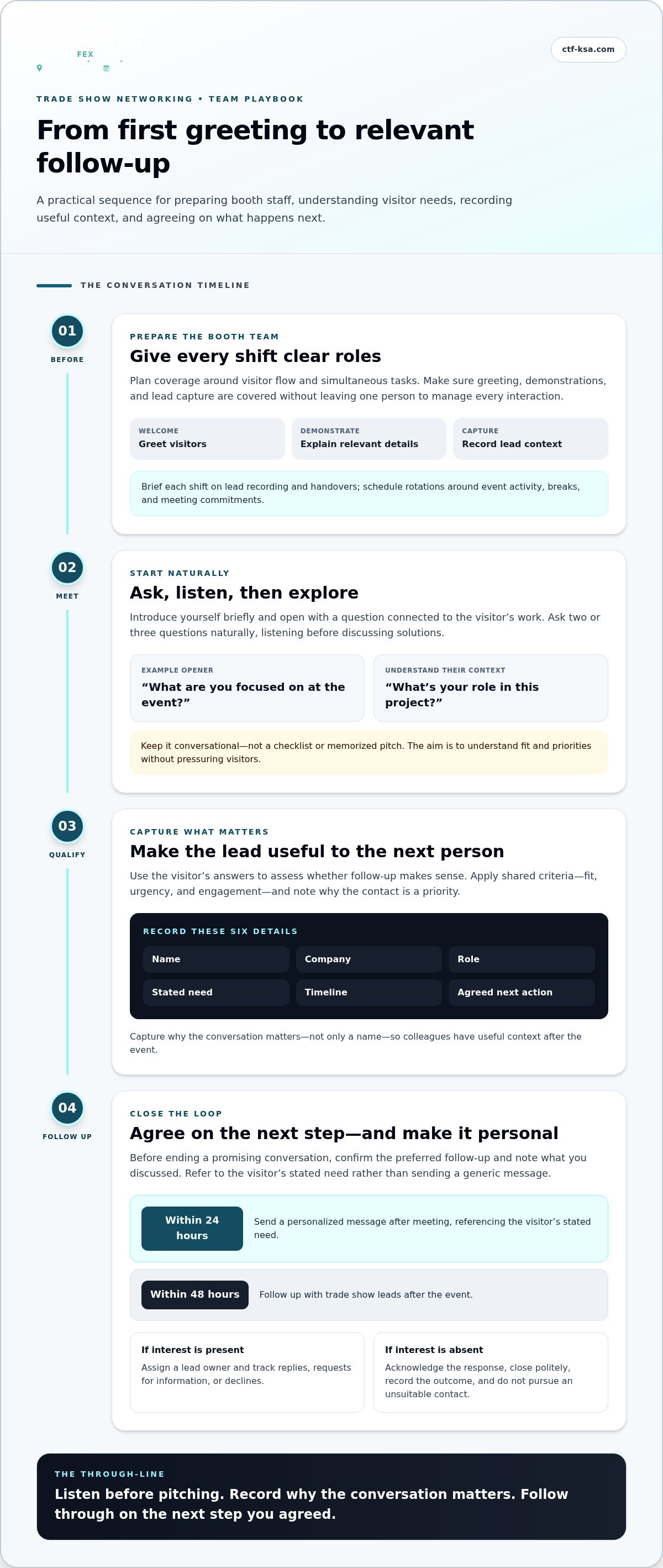
Begin with open questions about the visitor’s role, project timeline, and priorities. Ask two or three questions naturally, such as, “What’s your role in this project?” and “When are you looking to move forward?” Listen before discussing solutions. Avoid treating the conversation like a checklist: the aim is to understand fit and priorities, not pressure visitors to share details.
-
Identify Contacts and Generate Leads
Use the visitor’s answers to decide whether follow-up makes sense. Record their name, company, role, stated need, timeline, and agreed next action in your lead-capture system. Apply consistent criteria, such as fit, urgency, and engagement, and note why a contact is a priority. This helps distinguish a relevant project contact from a brief exchange and gives colleagues useful context after the event.
-
Plan Follow-Up and Avoid Networking Mistakes
Before ending a promising conversation, confirm the preferred follow-up and note what you discussed. Send a personalized message within 24 hours of meeting, referencing the visitor’s stated need; follow up with trade show leads within 48 hours after the event. Avoid common mistakes such as dominating the conversation, pitching before listening, or capturing only a name. Close politely when interest is absent, and record that outcome without pursuing an unsuitable contact.
-
Assign Booth Staff and Schedule Shifts
Plan booth staffing around expected visitor flow and simultaneous tasks, including greeting, demonstrations, and lead capture. Provide enough coverage without isolating staff or leaving one person to manage every interaction. Schedule rotations around event activity, breaks, and meeting commitments. Brief each shift on lead recording and handovers so visitor conversations receive consistent attention throughout the event.
How do you turn a good conversation into a follow-up that actually closes?
Give every promising exchange a clear next step. Staff should open confidently, tailor the discussion, and capture the details that make follow-up relevant. Training your team for effective trade show networking means practising the whole sequence, from the first greeting to thoughtful follow-through.
-
Start with a Confident, Open Invitation
Introduce yourself briefly and ask a question connected to the visitor’s work, such as, “What are you focused on at the event?” Keep the opening conversational rather than launching into a memorized pitch. Listen for priorities, then ask permission to explore a relevant topic. This creates a natural bridge from a greeting to a useful business discussion.
-
Personalize Each Conversation
Shape what you share around the visitor’s stated interests. If a contact is exploring digital project workflows, for example, focus on what relates to that priority instead of delivering a broad company overview. Ask follow-up questions and reflect their language to show you have understood. Don’t assume every attendee has the same needs or send identical messages afterward.
-
Record Details and Follow Up Promptly
After the conversation, record the contact’s interests, engagement, key discussion points, and agreed next action. Group leads by interest and engagement so each message reflects the conversation. Follow up while the exchange is fresh: refer to the discussion, offer a relevant next step, and include a feedback link where appropriate. Connect on social media soon after meeting, while you both remember the interaction.
Make follow-ups specific. A message to someone interested in project workflows should mention that topic, not rely on a generic “great to meet you” template. Assign each lead an owner and track whether the contact replies, requests more information, or declines. Training your team for effective trade show networking also means rehearsing how to adapt to each response, prioritize relevant opportunities, and avoid over-contacting people.
Why staff training matters more than booth design
-
Define Team Roles at the Booth
Assign each team member a clear responsibility before the event. One person might welcome visitors, another lead demonstrations, and a third record engagement and coordinate meetings. Rotate duties when needed, but make ownership clear during every shift.
Train staff to explain your value proposition consistently while answering visitor questions naturally. Rehearse handovers so contacts don’t have to repeat project details when moving from a conversation to a demonstration. When visitor activity increases, avoid leaving the greeting, technical explanations, and lead capture to one person.
-
Set Measurable Networking Goals
Choose objectives the team can record and review, then connect each goal to a clear action. For example, set a target of 100 qualified leads or 50 product demos. Define what qualifies as a lead before the event, so staff assess contacts using shared criteria rather than counting every conversation.
Turn each objective into a clear responsibility: decide who records leads, who tracks completed demonstrations, and how the team reports progress. A shared view of activity helps staff assess whether their work supports the event’s purpose, rather than simply counting booth traffic.
After the event, review booth traffic, engagement, and lead quality as a team. Compare results with your original objectives to see where conversations advanced and where visitors lost interest. Use those observations to refine role-play scenarios, product explanations, and lead-capture practice before the next event. A visually impressive booth can draw attention; trained staff turn that attention into purposeful engagement.
Handling rejection politely
Coach staff to accept a visitor’s response, close warmly, and respect personal space. Professional booth etiquette means listening without interrupting, avoiding pressure, and keeping conversations focused on the visitor’s interests.
- Acknowledge the response without challenging it. If a visitor says, “We’re not looking for a solution today,” staff can reply, “Understood. I hope you find the sessions useful.” Don’t argue, launch into another pitch, or demand an explanation. A calm response keeps the exchange respectful and lets the visitor choose whether to continue.
- Make it easy for someone to leave when they signal they need to go. Say, “Thanks for stopping by. Enjoy the event,” then step aside. Don’t follow visitors down an aisle, block their path, or press a business card into their hands after they decline.
- Read the visitor’s words and actions together. A brief answer, turning away, or returning attention to a colleague may signal that they want to end the conversation. Ask once whether a short overview would help; if they decline, accept their decision and greet the next visitor without showing frustration.
- Keep your body language and team conversations professional throughout the event. Face visitors when speaking, avoid side conversations while someone is waiting, and put phones away during active discussions. If a colleague is already speaking with an attendee, for example, wait for a natural pause rather than interrupting to take over.
- Practise rejection scenarios during team preparation. Have one person play a busy attendee while another rehearses a courteous close, such as, “Thanks for letting me know. Enjoy the exhibition.” Give feedback on tone, listening, and respect for the visitor’s answer. Rehearsal helps staff respond consistently without sounding scripted.
Construction Technology ConFeX KSA: Sponsorship Packages
Construction Technology ConFeX KSA connects built-environment technology businesses with industry leaders through Sponsorship Packages and Exhibition Stands. These opportunities suit teams ready to put their networking preparation into practice and build visibility among professionals focused on the sector’s digital and sustainable transformation.
Professionals seeking conference sessions, networking, and technical demonstrations can participate with Delegate Passes. Speaking Opportunities give industry experts another way to contribute to the event’s discussions. Choose the format that fits your goals: exhibit, attend as a delegate, speak, or pursue sponsorship.
Explore the sponsorship opportunities and contact Construction Technology ConFeX KSA to discuss your next step.
Make Every Event a Stronger Starting Point
Training your team for effective trade show networking builds a capability that extends beyond one event. Each event gives your team a chance to refine how it represents your organisation, builds professional relationships, and turns meaningful exchanges into future opportunities. Carry those lessons into your next event plan and make networking readiness part of your preparation.
For businesses shaping the built environment in Saudi Arabia, the right event can bring these conversations into a focused industry setting. Decide how your team wants to participate, then align that choice with its goals for visibility, expertise, and connections.
Prepare your people to participate with purpose. A valuable connection can begin with one well-prepared conversation.
Frequently Asked Questions
How do I train multiple staff members to sound consistent?
Give every staff member the same core message, then coach them to deliver it in their own voice. Agree on three essentials: who you serve, the challenge you address, and the next step you invite. Practise with rotating partners and different visitor profiles. Compare accuracy and clarity rather than identical wording, then address any gaps in a short team briefing.
How do you prepare staff for a trade show before they ever step on the floor?
Before the event, review attendee information and identify the organisations your team most wants to meet. Assign each target to a staff member and prepare a clear reason for approaching them. Rehearse likely opening scenarios, test the lead-capture process, and agree on shift handovers. Staff can then arrive with useful context instead of relying on improvised introductions.
How does trained booth staff turn a casual visitor into a qualified lead?
A conversation becomes a qualified lead when it reveals a relevant business need and a suitable next action. If someone requests an overview, clarify whether they want a technical discussion, demonstration, or information for a colleague. Record the request and ask permission for the appropriate follow-up. A friendly exchange alone does not establish business intent.
How should staff handle rejection or a visitor who isn’t interested?
Accept the visitor’s answer and end the exchange without trying to change their mind. If someone says, “Send me information,” but seems only mildly interested, ask whether one specific resource would be useful. If they decline, thank them and move on. Record the interaction accurately so another team member doesn’t repeat the same pitch later.
How do you write an elevator pitch?
Build a concise pitch around the audience, the problem you address, and the value of continuing the conversation. Aim to deliver it in under 15 seconds, then invite a response with a relevant question. For example: “We help project teams improve digital delivery. Which part of your workflow are you looking to strengthen?” Keep the language clear and conversational.
How do you train staff to start conversations and qualify trade show leads?
Practise several opening lines so staff can adapt to different situations, such as meeting someone after a presentation or greeting a visitor examining a display. Ask trainees to connect the opener to what the person is doing instead of interrupting with a generic pitch. Then role-play follow-up questions and coach staff to identify whether the conversation warrants a business next step.