
 DCTC KSA
- Blogs
- / How to Implement Construction Waste Management Technology in Saudi Giga-Projects
Construction waste in the Kingdom is no longer a peripheral concern; it's a billion-dollar challenge that defines the success of our giga-projects. With landfill tipping fees at $70 per ton and fines reaching $8 million, the cost of inefficiency is simply too high. You understand that manual on-site sorting cannot keep pace with the visionary scale of Saudi Arabia’s built environment. This guide empowers you to master construction waste management technology, utilizing AI and robotics to transform debris into a strategic resource.
You'll gain a comprehensive blueprint for implementing digital workflows that achieve zero-waste-to-landfill targets and reduce material costs through circularity. We'll explore the sophisticated tools and automated systems required to meet the 60% recycling mandate by 2035 while cementing your reputation as a global leader in sustainable innovation. It's time to move beyond simple compliance and lead the transition to a high-performance, circular economy that mirrors the Kingdom's boldest ambitions.
Key Takeaways
- Align your projects with Saudi Vision 2030 by adopting circular economy principles that transform waste into a high-value resource.
- Leverage AI and robotics to automate hazardous material handling and real-time sorting, drastically increasing site productivity.
- Implement a data-driven strategy using BIM for pre-construction audits to forecast and mitigate material loss before ground is even broken.
- Follow a structured five-step blueprint to integrate construction waste management technology into the complex workflows of Saudi giga-projects.
- Explore how strategic networking with key decision-makers from NEOM and Red Sea Global accelerates the adoption of sustainable building practices.
The Strategic Role of Waste Management in Saudi Vision 2030
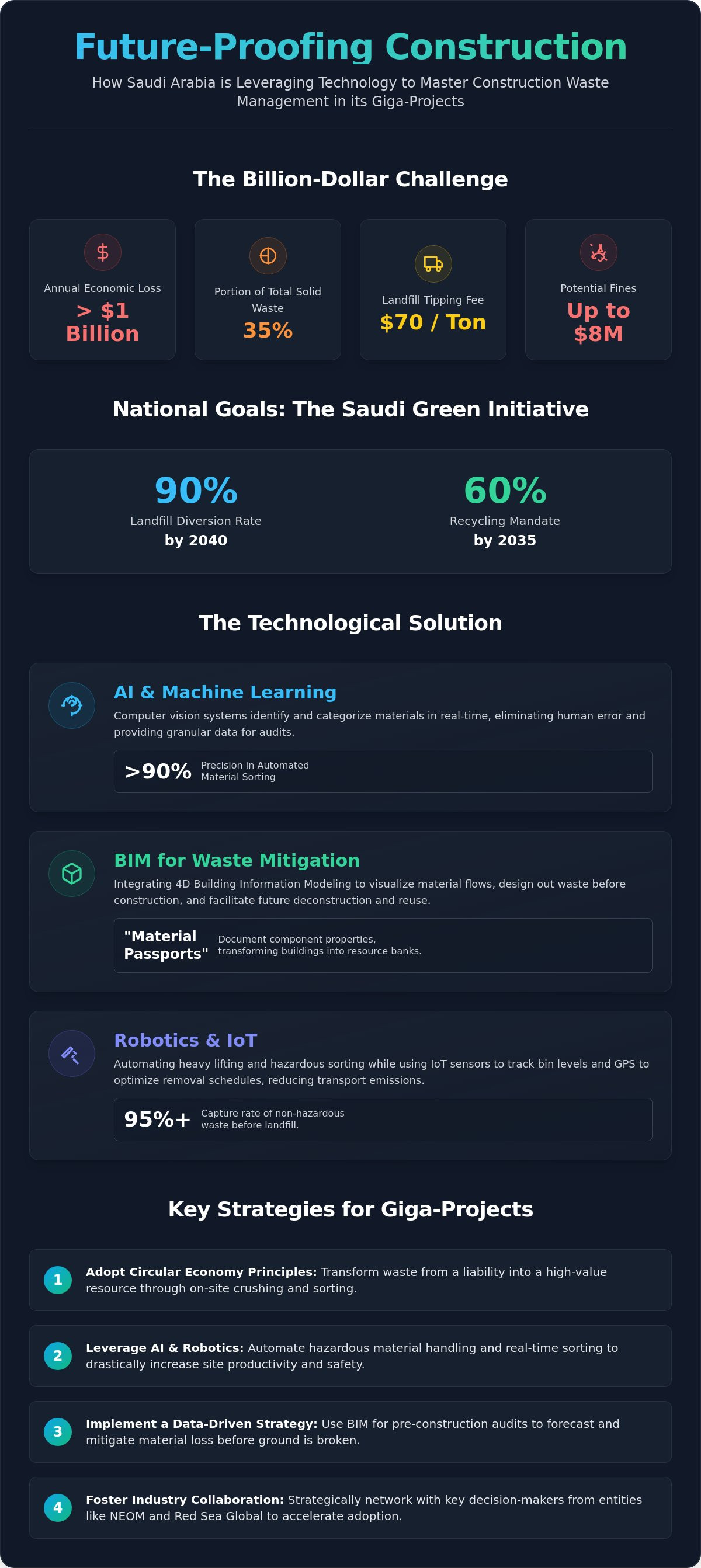
The scale of the Kingdom's transformation demands a departure from legacy disposal habits. Modern construction waste management technology isn't merely a set of tools; it's a sophisticated integration of digital tracking, mechanical sorting, and automated recycling systems designed to recover maximum value from every ton of debris. This shift is a core pillar of the Saudi Green Initiative. By targeting a 90% diversion rate from landfills by 2040, the National Center for Waste Management (MWAN) is turning environmental necessity into a catalyst for industrial innovation.
Traditional "dump and forget" practices are no longer viable. With construction waste accounting for 35% of Saudi Arabia's total solid waste, the annual economic loss exceeds $1 billion. Contractors who ignore this reality face more than just environmental guilt. They face a $70 per ton landfill tipping fee and potential fines of up to $8 million under Royal Decree M/3. Success in this new era requires adopting sustainable deconstruction methods that treat every building element as a future resource rather than a liability.
Drivers of Change in the Kingdom's Built Environment
The momentum is driven by the uncompromising standards of PIF-backed developers. For entities like NEOM and Red Sea Global, zero-waste isn't a suggestion; it's a contractual mandate. High-tier contractors are realizing that "Greener Construction Delivery" is their strongest competitive edge. It signals a level of operational maturity that aligns with the Kingdom's global leadership in Climatetech and professional excellence.
Economic Benefits of Circularity
Circular systems offer a direct path to margin protection. On-site crushing and sorting allow developers to repurpose concrete and bricks, which make up over 55% of construction waste, back into road bases and non-structural elements. This reduces procurement costs and shields projects from global supply chain volatility. For those looking to dominate this space, the sponsorship opportunities at major industry hubs provide the necessary visibility to lead this regional transformation and connect with the sector's most influential decision-makers.
Advanced Technologies Driving Site Productivity and Sustainability
High-performance construction in the Kingdom is evolving from a physical discipline into a data-driven science. Deploying construction waste management technology at the scale of NEOM or Roshn requires an integrated stack of AI, robotics, and digital modeling. These aren't just incremental improvements. They're fundamental shifts in how we handle the current 14% recycling rate, aiming for the ambitious targets set within The Strategic Role of Waste Management in Saudi Vision 2030. Success depends on moving beyond reactive disposal and embracing a proactive, tech-led ecosystem.
AI and Machine Learning for Waste Analytics
Computer vision is the new standard for on-site sorting. By using high-speed cameras and machine learning algorithms, systems can identify and categorize materials like concrete, rebar, and timber with over 90% precision in real-time. This eliminates the human error inherent in manual sorting. These systems generate granular data-driven reports, providing the transparency required for mandatory third-party audits on projects exceeding 10,000 square meters.
Integrating BIM with Waste Mitigation
The most effective waste is the waste that's never created. By integrating 4D BIM, project managers can visualize material flows across the entire lifecycle. This proactive approach uses "Material Passports" to document the chemical and physical properties of components, facilitating future deconstruction and reuse. It transforms a building into a temporary warehouse of resources. When you attend the next industry summit, you'll see how these digital twins are already optimizing logistics for the world's most complex developments.
Robotic units are now handling the heavy lifting and hazardous sorting that previously slowed down site turnover. Combined with IoT sensors that track bin levels and GPS-optimized removal schedules, the result is a lean, responsive waste ecosystem. This connectivity reduces unnecessary transport emissions and ensures that the 95.76% of non-hazardous waste generated is captured before it ever reaches a landfill. It's a high-stakes transition that rewards early adopters with unparalleled operational efficiency.
5 Steps to Implementing Waste Tech on Large-Scale Projects
Deploying construction waste management technology at scale is a strategic maneuver, not a software purchase. The complexity of Saudi Arabia's giga-projects requires a disciplined roadmap to bridge the gap between ambitious zero-waste targets and site-level execution. You must move beyond fragmented efforts and implement a centralized, data-driven framework.
- Conduct a Digital Pre-Demolition Audit: Use BIM data to quantify potential waste streams before ground is broken. This allows for precise resource recovery planning and identifies materials for immediate on-site reuse.
- Establish an On-Site Sorting Hub: Deploy automated sensors and AI-driven sorting belts directly on the project site. This captures high-value recyclables before they are contaminated by mixed debris.
- Partner for Real-Time Tracking: Integrate with technology providers to capture every movement of debris. This ensures total compliance with MWAN's classification schedule and avoids the $8 million fines associated with regulatory violations.
- Upskill the Site Team: Transition from manual labor to digital delivery workflows. Empower your workforce to manage automated systems rather than sorting by hand.
- Analyze and Optimize: Use analytics to adjust future procurement. Reducing the 35% of solid waste typically generated by construction starts with data-backed purchasing decisions.
Selecting the Right Technology Partner
Success depends on the scalability of your vendors. Your partners must demonstrate the capacity to handle the unprecedented volume of projects like NEOM or Roshn. Explore strategic sponsorship opportunities to connect with these innovators who are redefining regional standards and providing the infrastructure for the Kingdom's circular economy.
Workforce Upskilling and Digital Literacy
Technology is only as effective as the hands that guide it. Technical demonstrations and VR-based simulations are essential for training operators on advanced waste machinery. This ensures safety while accelerating the adoption of digital delivery across your entire project portfolio. If you are ready to lead this transformation, secure your position as a pioneer in the Kingdom's sustainable built environment.
Scaling Innovation: The Power of Industry Collaboration
Innovation thrives on connectivity. In the Kingdom’s high-stakes construction sector, isolated efforts often stall before they reach the scale required for national impact. The sheer magnitude of Saudi giga-projects means that construction waste management technology must be integrated into a wider, collaborative ecosystem. Success is a collective achievement. It requires seamless alignment between developers, contractors, and tech innovators to turn vision into reality.
Isolated technology adoption is a recipe for obsolescence. Without high-level networking with decision-makers from NEOM, Roshn, and Red Sea Global, even the most advanced systems remain underutilized. The 2026 outlook is clear. We're transitioning from fragmented pilot projects to rigorous national waste-management standards. Leading this shift requires more than just a product; it requires a seat at the table where the future of the Kingdom's built environment is being decided.
Networking for a Greener Kingdom
Facilitating direct, intent-driven dialogue between technology buyers and sellers is the catalyst for rapid change. The complexity of the Saudi market rewards those who build deep, strategic partnerships. Attend the Kingdom's #1 ConTech event to lead this transformation and engage in the 1:1 meetings that convert sustainability goals into operational contracts. It's the definitive platform for those who refuse to be spectators in this regional evolution.
Showcasing Solutions to Decision-Makers
Visibility is authority. In an industry defined by prestige and performance, live technical demonstrations are the most effective way to secure high-value contract wins. Positioning your brand as a "Lead Partner" in the sustainability roadmap ensures you're recognized as an indispensable institutional player. By taking advantage of strategic sponsorship packages and speaking slots, you don't just join the conversation. You define it. This is your opportunity to demonstrate how your construction waste management technology will safeguard the Kingdom's resources for generations to come.
Lead the Kingdom's Circular Transformation
The transition to a circular built environment is a defining moment for the Saudi construction sector. We've moved beyond theoretical sustainability. Real success now depends on the seamless integration of construction waste management technology into every phase of the project lifecycle. By mastering digital audits, AI-driven sorting, and high-level industry collaboration, you don't just meet regulations; you redefine operational excellence for the world's most ambitious developments.
CTF KSA is the definitive arena where these transformations happen. Supported by the Public Investment Fund (PIF), our platform is the Kingdom's #1 hub for ConTech innovation. It's where 80% of attendees are senior decision-makers and project owners looking for the systems that will power NEOM, Roshn, and beyond. This is your moment to command the stage and influence the stakeholders shaping our national infrastructure.
Secure your sponsorship for CTF KSA 2026 and lead the waste management revolution. The opportunity to shape a zero-waste future is here. Let's build it together.
Frequently Asked Questions
What is the most effective technology for construction waste management in Saudi Arabia?
Integrated AI-powered sorting systems combined with on-site crushing equipment represent the most effective solution for the Kingdom’s unique landscape. These tools identify and process the 55.10% of waste that consists of concrete and bricks, allowing for immediate reuse in road bases or non-structural elements. This tech-led approach is essential for meeting the national goal to recycle 60% of construction and demolition waste by 2035.
How does BIM help in reducing waste on giga-projects?
BIM facilitates "Material Passports" and 4D visualization to predict material surplus long before ground is broken. By creating a high-fidelity digital twin, project managers can optimize procurement and identify specific opportunities for sustainable deconstruction. This digital precision significantly reduces the volume of solid waste generated by the sector, protecting project margins and ensuring total alignment with PIF-backed environmental mandates.
Are there specific regulations for construction waste in the Kingdom?
The Waste Management Law of 2021 and the National Center for Waste Management (MWAN) govern all sector activities with strict enforcement. Projects exceeding 10,000 square meters must perform on-site segregation and undergo mandatory third-party audits. Violations can trigger catastrophic fines of up to $8 million, making the adoption of robust construction waste management technology a legal necessity for any contractor operating at scale.
Can robotics really replace manual sorting on-site?
Robotics can automate the most hazardous and repetitive sorting tasks, significantly outperforming manual labor in both speed and categorization accuracy. Autonomous units equipped with computer vision categorize non-hazardous materials, which make up over 95% of debris, with extreme precision. While human oversight remains necessary, robotics is the only viable method to handle the massive waste volumes generated by giga-projects like NEOM and Roshn.
How can technology providers showcase waste solutions to Saudi developers?
Strategic networking at premier institutional platforms like CTF KSA is the most direct path to engagement with the Kingdom’s elite developers. Providers can secure speaking opportunities or exhibition stands to demonstrate their construction waste management technology to an audience where 80% of attendees are senior decision-makers. These high-stakes environments allow innovators to prove their scalability to stakeholders from Red Sea Global in a professional, results-oriented setting.