
 DCTC KSA

- Blogs
- / How to Attract Decision-Makers to Your Exhibition Stand
A crowded stand isn’t the same as a commercially successful one. To understand how to attract decision-makers to your exhibition stand, focus on the people and organisations you want to reach, make your business value clear at a glance, and give visitors a reason to start a focused conversation. Measure progress by qualified discussions and agreed next steps, not footfall alone.
More visitors can mean more opportunities, but numbers alone don’t show whether those visitors are likely buyers. In Saudi Arabia’s construction technology sector, connect your offer to a real business need and look for signs that a visitor has the influence, requirements and intent to move a discussion forward.
This guide explains how to tailor your message to your audience, prepare your team to recognise buying intent, and plan activity that encourages meaningful conversations. It also shows how to set objectives around decision-makers, prioritising relevant contacts and clear follow-up over unqualified scans.
Key Takeaways
- Shape your stand message around the industries, roles and business needs you want to reach, then make your value clear at a glance.
- Brief staff on priority contacts and buying signals so they can qualify conversations and capture useful next steps.
- Use an inviting layout and purposeful activities to turn attention into relevant discussions, not just passing traffic.
- Set success measures around qualified contacts, meetings and follow-up actions, then use them to assess your exhibition results.
1. Audience-specific stand messaging and reasons to visit
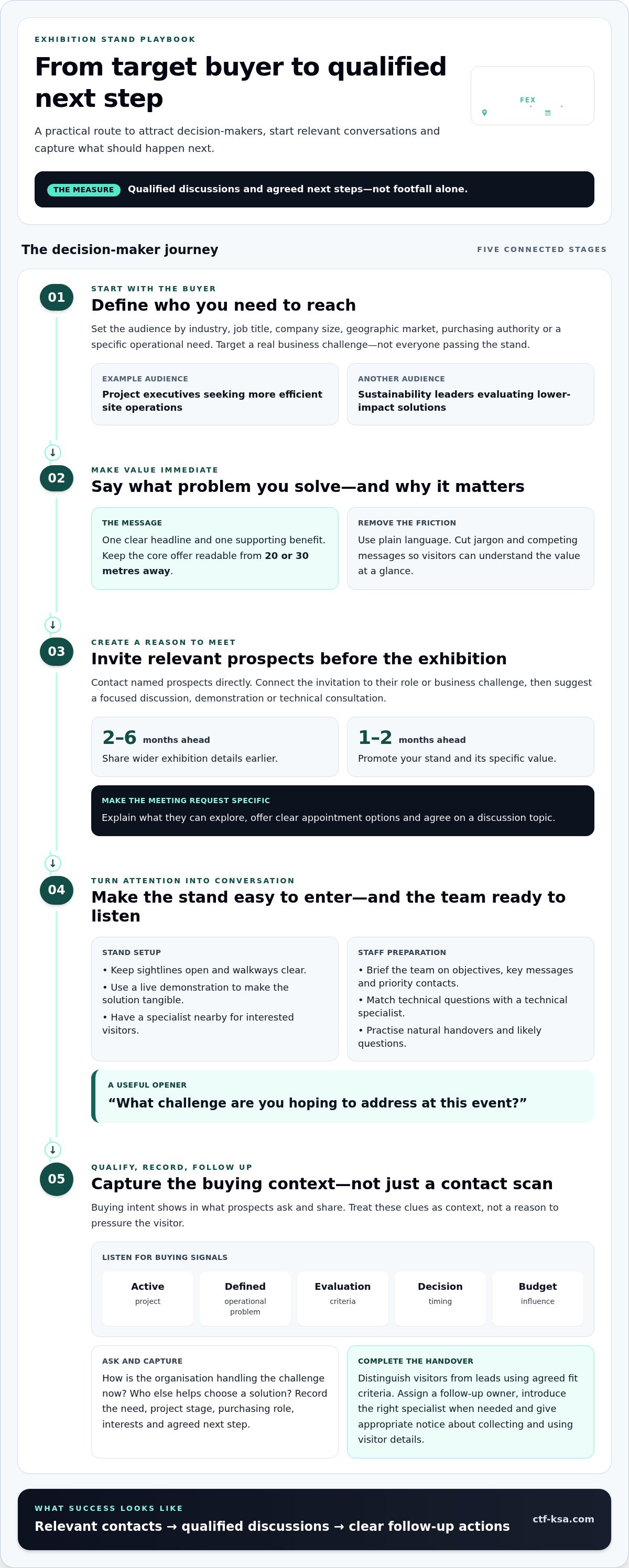
Start with the buyers you need to reach, not a broad claim about your business. Define the audience by industry, job title, company size, geographic market, purchasing authority or a specific operational need. For Saudi Arabia’s construction technology sector, that might mean targeting project executives seeking more efficient site operations or sustainability leaders evaluating lower-impact solutions. Then make the message answer two questions: what problem do you address, and why should this visitor care? Keep the core offer readable from 20 or 30 metres away, with a clear headline and one supporting benefit. Visitors give a passing stand only a few seconds, so remove jargon and competing messages.
Give named prospects a reason to meet before the exhibition opens. Send a direct invitation that connects your offer to their role or business challenge, then propose a focused discussion, demonstration or technical consultation. Promote your stand roughly 1-2 months before the event, and share the wider exhibition details earlier, around 2-6 months ahead. Make the meeting request specific: explain what the visitor can explore and offer clear appointment options. This answers how to book meetings with decision-makers before an exhibition: identify relevant people, contact them directly with a tailored benefit, and agree on a time and discussion topic.
Location and layout affect whether visitors notice your message. Review the venue plan, expected footfall and stand position, but remember that a busy aisle matters only if it brings your target audience. Keep sightlines open and walkways clear so visitors can enter without disrupting a conversation. Use a live demonstration to make a complex solution tangible, with a specialist nearby to speak with interested visitors. Invite people to pause without creating congestion.
Capture useful context from the start of each conversation. Ask which technical requirement the visitor is addressing, what outcome matters, and whether they influence budget decisions. Add a few qualification fields beyond contact details, such as project stage, requirement and purchasing role. Record the visitor’s interests and agreed next step, and give appropriate notice about collecting and using their details. This context makes a lead more useful than a scan alone.
2. Training staff to identify decision-makers and buying intent
Choose staff who listen well, explain clearly and feel comfortable approaching unfamiliar visitors. A technical specialist can answer product questions, while a commercially experienced colleague can explore the prospect’s role and purchasing process. Both should make visitors feel welcome rather than launching into a rehearsed pitch. Try opening with, “What challenge are you hoping to address at this event?” This gives visitors room to explain why they’re there and helps staff respond appropriately.
Before the exhibition opens, brief everyone representing the business on its objectives, key messages, priority contacts and enquiry process. Share a concise profile of the target organisation and buyer, then explain which problems your offer addresses. Prepare for likely questions about implementation, technical requirements and business value. A brief role-play can help staff move from a general greeting to a relevant discussion. Practise referring a visitor to a specialist, too, so the handover feels natural and the conversation continues smoothly.
Buying intent shows in what prospects ask and share, not in their job title alone. Train staff to listen for an active project, a defined operational problem, evaluation criteria, decision timing and the visitor’s influence over budget approval. Ask how the organisation currently handles the challenge and who else helps choose a solution. Someone describing an upcoming project and requesting a technical discussion signals a clearer opportunity than someone collecting general information. Treat these clues as context, not a reason to pressure the visitor.
Agree on a straightforward qualification and handover process before the team takes its positions. Distinguish visitors from leads, then qualify leads based on relevant interest, contact details and fit with your agreed criteria. Record the prospect’s need, role in the purchasing process and next action, and assign someone to follow up. If a question is outside one team member’s expertise, introduce the right colleague and briefly explain what has been discussed. Review the process after each event day and clarify any unclear steps.
3. Balancing stand design with conversation-generating activity
Senior decision-makers notice stand design that communicates business value quickly, looks professional and makes conversation easy. Keep the brand name and core message visible at eye level, even if a tall structure helps the stand stand out. Use a consistent colour palette and a visual that tells one clear story. A construction technology exhibitor, for example, could show how its solution addresses a specific site challenge rather than filling every panel with product features. Give busy visitors a clear reason to pause.
Design the layout around the next action. Position a concise product display where visitors can see it from the aisle, with an open route to a demonstration or conversation area. A live demonstration can make an abstract claim easier to assess. For a project management platform, staff might show a sample workflow based on a realistic project scenario. Keep storage and equipment out of the visitor path, and leave enough room for technical discussions without blocking access.
Bespoke design works best when every element has a purpose. Map the visitor journey from first glance to interaction: brand message, proof point, demonstration, then discussion with a knowledgeable team member. Add a screen or physical sample only if it explains your offer or prompts a useful question. A polished display without a conversation prompt may attract attention but leave visitors unsure what to do next. An activity that overwhelms the message can draw a crowd without reaching relevant buyers.
Use sensory details selectively. Lighting can draw attention to a demonstration, while clear graphics make technical information easier to scan. Keep audio low enough to support conversation, and avoid competing screens or messages. Before the event, walk through the stand as a visitor: can you identify the offer, understand its relevance and see where to speak with someone? Adjust the displays and meeting areas if any step feels unclear. Aim for a cohesive experience, not decoration for its own sake.
4. Setting objectives focused on decision-makers
Set objectives around business progress, not stand activity alone. Before a trade show, choose a primary outcome: connect with decision-makers from target companies, uncover requirements or arrange qualified sales discussions. A clear objective helps define how to attract decision-makers to your exhibition stand and what a valuable conversation should achieve, such as identifying a relevant need and agreeing on a next step. This focus helps staff prioritise prospects instead of treating every interaction equally.
Turn that objective into measures your team can record. Track qualified leads, meetings, sales opportunities, conversion rates, pipeline value and influenced revenue. Badge scans and visitor counts show activity, but not whether contacts match your ideal customer profile. For example, compare the qualified prospects who agree to follow-up meetings with the total exhibition investment. Calculate cost per qualified lead by dividing the total investment by the number of qualified leads captured.
To assess how to attract decision-makers to your exhibition stand, compare your investment with qualified leads, meetings, sales opportunities and influenced revenue. Follow up with each decision-maker using notes on their requirements, interests and agreed actions, then review replies and meetings after the first week.
Make the stand experience support your measures. An interactive display or live demonstration should help visitors assess a relevant business challenge, not merely entertain passers-by. Give staff a clear process for moving from engagement to qualification, introduction, lead capture and follow-up. Before the trade show, assign ownership of each prospect and agree what happens after a conversation. Afterward, review stalled handovers and disqualified leads alongside successful meetings. This shows whether the stand attracted the right audience and where the process needs work.
Set objectives that reflect your sales cycle. In advanced engineering and manufacturing, purchasing decisions can involve multiple stakeholders and take several months. A promising meeting may be valuable before it leads to immediate revenue. Record the opportunity’s stage and next action, then assess progress over time. This gives leadership a clearer view of the stand’s contribution and helps shape future exhibition plans around decision-maker engagement.
Review the event programme
Construction Technology ConFeX KSA: Sponsorship Packages
Construction Technology ConFeX KSA connects construction technology businesses with industry leaders and provides a platform to present their work. For organisations aiming to engage decision-makers in person, an exhibition stand supports direct conversations and live demonstrations. Sponsorship Packages offer opportunities for brand visibility, while Speaking Opportunities let you share expertise with an industry audience. Professionals seeking access to conference sessions, networking and technical demonstrations can choose Delegate Passes.
Consider these opportunities if your audience includes stakeholders shaping the digital and sustainable transformation of the built environment. Match your participation to your objective: exhibit to start prospect conversations, speak to share a point of view, or attend to build industry connections. Explore Construction Technology ConFeX KSA at ctf-ksa.com.
Turn Every Exhibition Into a Stronger Next Step
A key step in learning how to attract decision-makers to your exhibition stand is to treat each conversation as insight for the next opportunity. Note which business challenges prompt deeper discussions, which demonstrations clarify value and where prospects hesitate. These patterns can sharpen your message and help your team prepare more relevant conversations for future events.
Build that learning into your planning cycle. After each exhibition, bring sales, technical and marketing colleagues together to review lead quality, meeting outcomes and follow-up progress. Use their observations to refine your audience priorities and participation goals. In Saudi Arabia’s evolving construction technology sector, a focused presence can help your organisation contribute to important industry conversations and build meaningful connections.
Construction Technology ConFeX KSA offers organisations a platform to engage with the built environment’s digital and sustainable transformation. Explore the participation option that best fits your objectives.
Refine your next exhibition plan and make every interaction count.
Frequently Asked Questions
How do you identify and target decision-makers attending a trade exhibition?
What messaging and offers appeal to business decision-makers at exhibitions?
Decision-makers respond to a clear connection between your solution and an operational or commercial priority. Replace broad claims with a specific use case, such as showing how a digital workflow can improve visibility across project delivery. Offer a useful next step, like a tailored demonstration or a discussion of their requirements. Avoid generic giveaways that attract attention without helping qualify a relevant business conversation.
How can you promote an exhibition stand to decision-makers on LinkedIn and email?
Use LinkedIn to share a concise business case, a relevant demonstration preview or a speaker’s practical insight, then invite suitable prospects to meet. In email, tailor the message to the recipient’s role or organisation and state what the conversation will cover. Include the event, your stand location if available and a straightforward way to request a meeting. Follow up with useful context instead of repeating the same reminder.
What lead-capture tools help qualify decision-makers at a trade show?
Badge scanners can speed up contact capture, while QR codes and digital forms let visitors share their details directly. Include fields that show why the prospect stopped, their role in the decision and the business issue they want to address. Record permission for relevant follow-up and add useful notes to your CRM. A tool is valuable when it preserves context and assigns a clear next action, not simply when it collects names.
How should stand staff engage and qualify decision-makers?
Start with an open question about the visitor’s work, such as which project challenge they’re exploring at the event. Listen for signs of an active requirement, then ask how their organisation will evaluate possible solutions and who else is involved. Keep the conversation consultative. Before it ends, summarise the need in the visitor’s words and agree on one relevant next step, such as a product discussion with the appropriate specialist.