 DCTC KSA

- Blogs
- / Finding Construction Partners in KSA: Choose Local or MNC Expertise
Neither local expertise nor multinational experience is automatically better for construction in Saudi Arabia. The right partner is the one whose project record, capabilities, and delivery approach fit your goals. Finding reliable local partners for construction in KSA means weighing local knowledge alongside international experience.
Local partners may bring familiarity with Saudi regulations, permitting, suppliers, and business practices. Multinational companies may offer experience with complex projects and international teams. Compare both against your technical requirements, project location, collaboration needs, and sustainability priorities.
This guide explains how to assess local and multinational expertise, identify potential construction partners for market entry, and account for Saudi business practices as you build relationships for responsible growth in the Kingdom.
Key Takeaways
- Choose local or multinational expertise based on comparable project experience, technical fit and the demands of your Saudi market entry.
- Build a partner shortlist around legal registration, relevant capabilities, delivery planning and financial stability, not bid price alone.
- Account for local business practices by prioritizing clear communication, collaboration and sustainability from the start of the relationship.
- Use government information portals to support your partner research, then consider industry events to connect with construction technology providers and built-environment stakeholders.
1. Should You Choose Local Expertise Or MNC Construction Companies in Saudi Arabia?
Choose a partner whose delivery record matches your project, not simply a company with a familiar name. To find reliable local partners for construction in KSA, compare local knowledge and multinational experience against the same requirements. Ask for examples involving similar infrastructure, utilities, energy systems, and delivery conditions. A partner with relevant Saudi experience may understand local coordination needs, while a multinational company may bring experience managing international teams. Neither profile proves suitability on its own.
Assess evidence, not reputation alone. Review completed work, the partner’s role, project scope, delivery outcomes, and client references. For an energy project, seek comparable power or grid work; for transport infrastructure, assess relevant roads, airports, or rail experience. Ask how the proposed team handled schedule changes, quality controls, and sustainability goals. Relevant experience matters most when the company can explain its contribution and assign capable personnel to your work.
Saudi Arabia’s Vision 2030 projects are expanding construction opportunities across infrastructure and the wider sector. Treat procurement opportunities as distinct processes, and verify which entity is responsible for each package. Treat each procurement opportunity as a distinct process. Match your capabilities to package requirements, then assess the contractor responsible for that scope. Local and MNC companies can both participate, but their fit depends on project requirements and proven capacity.
For infrastructure, utilities, and energy projects, examine the proposed team’s technical experience and supply-chain coordination. Ask how its enterprise resource planning (ERP) system tracks approvals, procurement records, and compliance documentation. These systems can support oversight, but they do not replace contractual or regulatory obligations. Compare record-keeping and reporting processes alongside technical skills.
Labor, Saudization, safety, and insurance obligations depend on applicable rules and project scope. Assess documented workforce practices, site safety arrangements, and insurance coverage relevant to the contract. Do not assume that local or multinational status ensures compliance. This evidence-based comparison keeps your partner decision grounded in delivery capability.
2. Construction market entry and partner identification
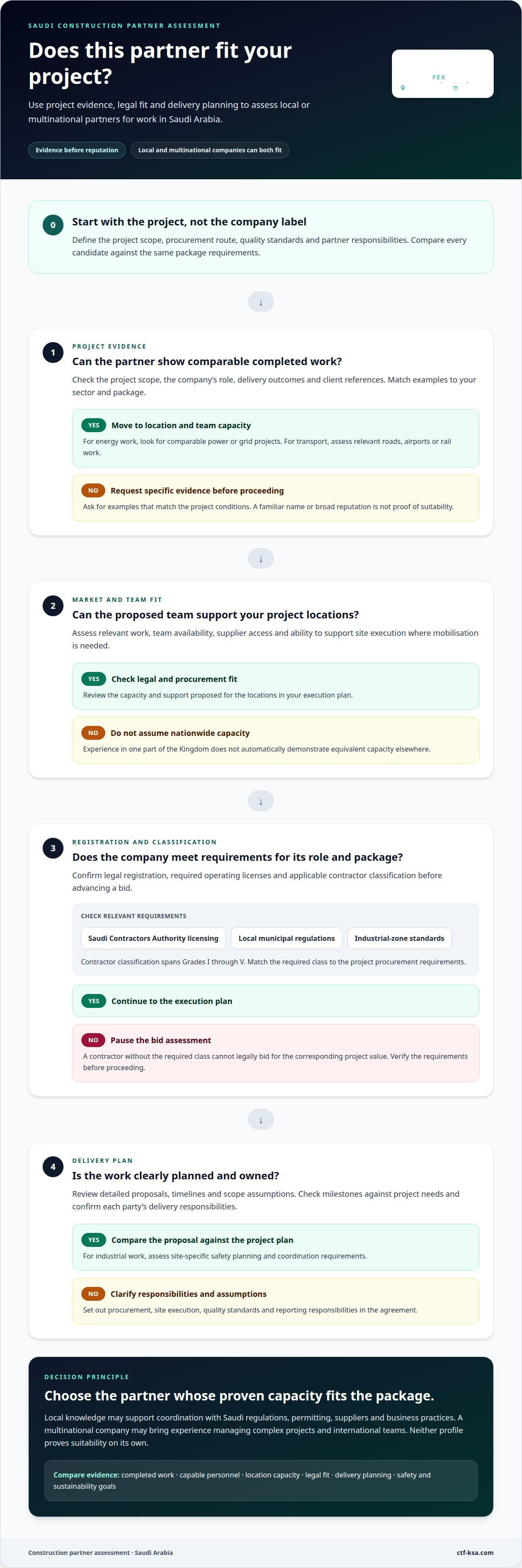
Start with the project scope, then identify contractors whose capabilities and presence across Saudi Arabia match the execution plan. A residential development may need different resources from an industrial facility. Define the client’s scope, procurement route, quality standards, and partner responsibilities before building a shortlist. Assess companies against the specific package, not a broad claim of national reach.
Compare contractors in the locations where your project may require mobilisation. Assess relevant work, team availability, supplier access, and the ability to support site execution in each location. Experience in one part of the Kingdom does not automatically demonstrate equivalent capacity elsewhere. Location-specific fit matters for infrastructure, industrial, and residential projects.
Foreign companies should treat market entry and partner selection as separate but connected decisions. A partnership does not replace the legal registration and operating licenses required for each company’s role. Confirm that the proposed local contractor is legally registered and holds the licenses required to operate. Define responsibilities for procurement, site execution, quality standards, and reporting in the agreement so each party understands its delivery obligations.
Saudi contractor classification spans Grades I through V as of September 2026. A contractor without the required class cannot legally bid for the corresponding project value. Match the project’s procurement requirements with the contractor’s classification before advancing a bid. Contractors must also comply with Saudi Contractors Authority licensing, local municipal regulations, and industrial-zone standards.
Use a structured shortlist to focus partner identification. Compare relevant project experience, capacity in the required locations, registration, licensing, and the proposed execution plan. Request detailed proposals that set out timelines and scope assumptions, then review milestones against project needs. For industrial work, assess whether the proposed team addresses site-specific safety planning and coordination requirements. This approach helps owners compare delivery capability rather than bid rank alone.
If meeting potential collaborators is part of your market-entry plan, exhibition participation can provide a way to connect with construction-sector stakeholders. Online industry communities and professional directories such as Constructology 101 can also serve as practical resources for discovering peers, networking, and researching sector capabilities.
3. Cultural understanding and business practices
In the Kingdom, strong partnerships grow through clear communication, respect, and consistent follow-through. Set expectations early: identify decision-makers, agree on meeting objectives, and record actions after each discussion. For example, an engineering team can circulate a concise meeting summary listing owners, deadlines, and unresolved design decisions. This creates a shared record and demonstrates commitment without relying on assumptions.
Build trust through reliable execution. If a supplier commits to a delivery date, record it, along with the responsible contact and dependencies, in the project schedule. When a constraint threatens progress, raise it promptly and propose practical options. Direct communication helps both companies resolve issues before they affect procurement or site coordination. Keep the tone professional, especially when discussing delays, scope changes, or quality concerns.
Local awareness matters across Saudi Arabia. Teams working in different parts of the Kingdom may face different coordination needs. Agree on communication channels, meeting cadence, escalation contacts, and document responsibilities with local counterparts. If project teams work across time zones, set a clear response window rather than assuming everyone follows the same working pattern. Shared expectations make collaboration more dependable.
Vision 2030 emphasizes sustainable urban development and economic diversification. Reflect those priorities in partnership discussions by addressing sustainability goals alongside schedule, quality, and technical performance. For example, clarify how design decisions, material choices, and construction methods support the project’s stated sustainability objectives. Ask each party to assign an owner for tracking commitments, then review progress during regular project meetings.
Before work begins, translate relationship-building into practical governance. Agree in writing on approval authority, document control, change management, payment milestones, and dispute escalation. Make sure the client and partner understand who can approve engineering changes and how decisions reach site teams. A trusted partnership depends on transparent responsibilities and dependable records, not goodwill alone. These practices support collaboration across Saudi Arabia’s fast-moving construction sector.
4. Which Saudi government portals list registered construction contractors and suppliers?
In Saudi Arabia, contractor licensing and supplier registration answer different questions. Start with the Saudi Contractors Authority (SCA) licensing and classification framework when reviewing a contractor’s status. For tender participation, identify the relevant government entity’s procurement channel and supplier registration process. Keep these checks separate: registration for a procurement process does not, by itself, demonstrate contractor licensing or project suitability.
Search procurement notices by the buying entity, work category, and location relevant to your project. For example, a company pursuing a Riyadh infrastructure package should distinguish that opportunity from unrelated supply tenders. Review the notice’s eligibility conditions, submission instructions, scope, and required supporting records. A listing can help identify an opportunity, but it does not establish that a company has delivered comparable work or can meet your project’s needs.
Use SCA licensing and classification information as one part of due diligence, alongside municipal requirements and any applicable industrial-zone standards. Compare the contractor’s classification with the project’s procurement requirements and corresponding project value. For suppliers, review the registration conditions stated by the purchasing entity. Registration and tender eligibility can depend on the procurement process, so assess each notice against its own requirements.
Maintain a partner record that captures the company’s registered identity, relevant license or classification details, procurement registration, and the date each record was reviewed. Match those details against the legal entity named in proposals and agreements. Then assess project references, delivery capacity, and quality documentation separately. This creates a clear audit trail and helps owners distinguish administrative eligibility from proven execution capability.
Construction Technology ConFeX KSA
Construction Technology ConFeX KSA connects construction technology providers with built-environment stakeholders, offering another route to develop relationships across Saudi Arabia’s construction sector. The platform is relevant when you want to meet potential collaborators, understand industry priorities, and discuss how your expertise could fit project needs. Facilitated one-to-one business meetings can help focus those conversations.
Choose how you participate based on your goals. Delegate Passes provide access to the event, while Speaking Opportunities let you share relevant expertise. Sponsorship Packages and Exhibition Stands offer other ways to engage with stakeholders. Bring a clear description of your capabilities, the project challenges you address, and the collaboration you seek. Contact Construction Technology ConFeX KSA to discuss participation.
Build Your Next Partnership with Purpose
Finding reliable local partners for construction in KSA is a strategic step toward building a lasting presence in the Kingdom. Turn your market-entry priorities into purposeful conversations with people shaping construction technology and the built environment. Keep collaboration and sustainability central as you explore where your capabilities can support Saudi Arabia’s development goals.
Construction Technology ConFeX KSA offers participation through Delegate Passes, Speaking Opportunities, and Sponsorship Packages. Choose the format that best matches your goals, whether you want to learn, share expertise, or build visibility among sector stakeholders. The event brings professionals together to explore shared priorities and potential partnerships.
Strong market relationships start with clear goals and thoughtful engagement. The Construction Technology ConFeX KSA team brings expertise in connecting construction innovators with industry stakeholders. Take your next step with confidence.
Frequently Asked Questions
Should You Choose Local Expertise Or MNC Construction Companies in Saudi Arabia?
Neither category is automatically preferable. Choose the delivery model that fits your project and market-entry plan. Local firms may bring familiarity with Saudi coordination and supply networks, while multinational companies may offer experience managing international engineering teams. Compare the assigned personnel, relevant scope, decision routes, and ability to collaborate with stakeholders. For joint delivery, define package boundaries and approvals early so local execution and international systems work together.
How to verify a construction contractor’s license and classification in Saudi Arabia?
Use the Saudi Contractors Authority as a starting point for licensing and classification, then compare the result with the tender’s eligibility conditions. Match the registered legal entity to the entity named in the bid, contract, and supporting documents. Confirm that the classification fits the project’s required class and value, and account for applicable municipal or industrial-zone standards. Clarify any mismatch between a group name and bidding subsidiary before qualification.
How to check a Saudi construction company’s financial stability, project history, and references?
Review financial statements, cash-flow position, debt commitments, and resources assigned to your project. Compare staffing and procurement plans with current workload, since concurrent commitments can strain capacity. Choose references with a similar scope and delivery model, then ask about schedule performance, change control, and closeout. Speak with both the client and delivery lead to understand whether the cited results reflect the team proposed for your project.
What warning signs indicate an unreliable construction partner in Saudi Arabia?
Warning signs include inconsistent company names across records, unclear divisions of responsibility, and reluctance to document scope or approvals. Probe a schedule that lists milestones but omits dependencies, or a proposal that leaves out staffing and procurement assumptions. Frequently changing project contacts, unexplained gaps in safety or quality records, and unlogged change requests also weaken confidence. Pause until discrepancies are resolved and the contract assigns each deliverable, decision, and record.