 DCTC KSA
- Blogs
- / Construction Industry Trends Saudi Arabia 2026: Navigating the Tech-Driven Boom
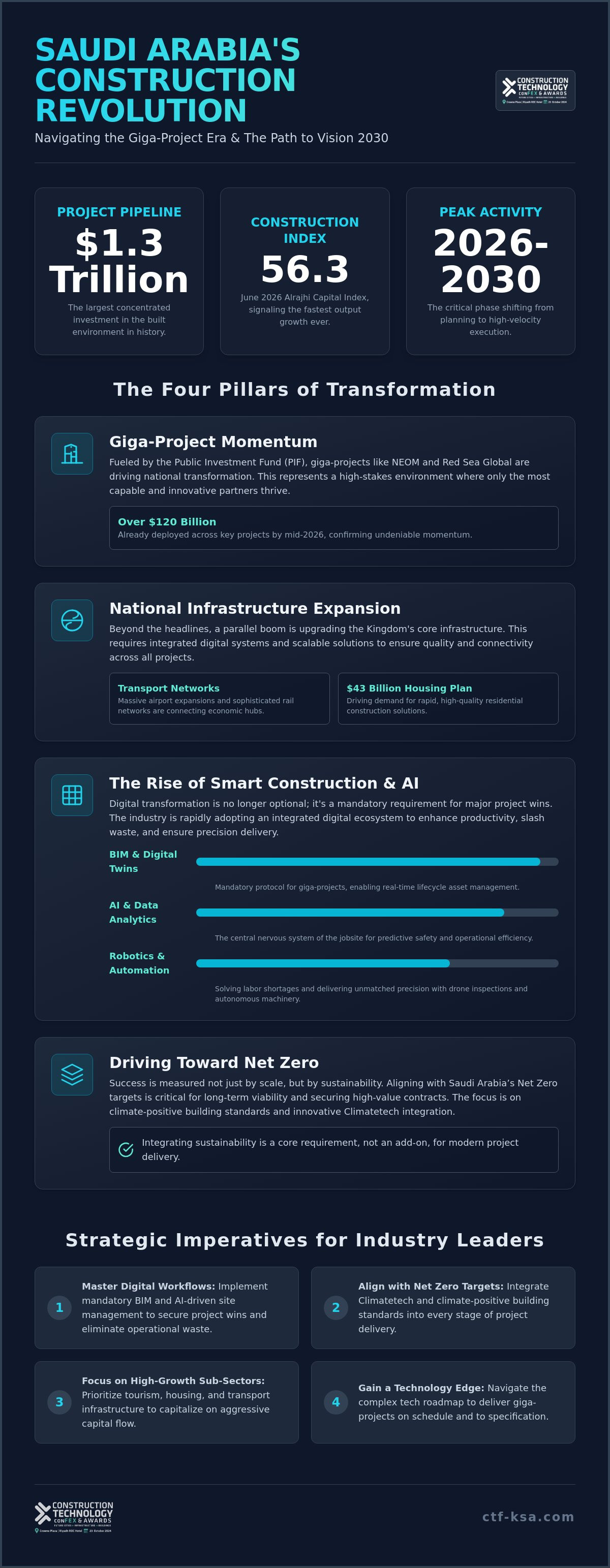
Saudi Arabia is no longer just a market. It's the epicenter of global infrastructure. With a project pipeline valued at $1.3 trillion, the Kingdom is setting a pace that few can match. The Alrajhi Capital Saudi Construction Index hit 56.3 in June 2026, confirming the fastest output growth in the nation's history. You understand the magnitude of this shift. Delivering on these massive commitments while hitting strict Net Zero targets and mastering fragmented digital twins is a challenge that defines the current era. Success now depends on precision, not just scale.
This guide analyzes the essential construction industry trends Saudi Arabia is deploying to meet Vision 2030 mandates. You'll discover the technological and sustainable breakthroughs redefining the built environment. We provide a clear preview of high-growth sub-sectors and the digital roadmap for ongoing giga-projects. You'll also find the strategic networking platforms necessary to secure your position as an industry leader. The transition from massive volume to digital performance is here. It's time to capitalize on the momentum.
Key Takeaways
- Analyze how the $1.3 trillion project pipeline is transitioning into a peak activity phase, prioritizing near-term economic impact and infrastructure resilience.
- Master the mandatory digital workflows, including BIM and AI-driven site management, to secure project wins and eliminate operational waste.
- Align your strategy with Saudi Arabia’s Net Zero targets by integrating Climatetech and climate-positive building standards into your project delivery.
- Identify the high-growth sub-sectors and construction industry trends Saudi Arabia is prioritizing to shift from traditional networking to high-value strategic technology partnerships.
- Gain a competitive edge by navigating the technology roadmap required to deliver the Kingdom’s most complex giga-projects on schedule.
The Giga-Project Momentum: Reshaping Saudi Arabia's Built Environment
The Saudi construction market has entered its most critical phase. As we approach the 2026-2030 peak activity period, the focus has shifted from planning to high-velocity execution. The Alrajhi Capital Saudi Construction Index rose to 56.3 in June 2026, signaling the fastest rate of output growth since the survey began. This isn't just about building; it's about national transformation. The $1.3 trillion project pipeline is the engine driving this surge, contributing significantly to non-oil GDP growth and redefining the Kingdom's economic identity. You are witnessing a transition where traditional methods are no longer sufficient. To meet the deadlines set by leadership, the industry is pivoting toward tech-enabled delivery, making construction industry trends Saudi Arabia a global benchmark for innovation and scale.
Vision 2030 and the $1.3 Trillion Pipeline
The Public Investment Fund (PIF) serves as the primary architect of this growth, fueling developments that were once considered impossible. As of 2026, the giga-project landscape represents the largest concentrated investment in the built environment ever recorded in human history. Capital is flowing aggressively into tourism, housing, and transport sectors to ensure the objectives of Saudi Vision 2030 are met with absolute precision. This massive capital allocation creates a high-stakes environment where only the most capable partners thrive. With over $120 billion already deployed across these projects by mid-2026, the momentum is undeniable.
National Infrastructure: Beyond the Giga-Projects
While NEOM and Red Sea Global capture headlines, a parallel boom is occurring in national infrastructure. Massive airport expansions and sophisticated rail networks are currently connecting the Kingdom's economic hubs at unprecedented speeds. The residential sector is equally active, driven by a $43 billion housing plan that demands rapid, scalable construction solutions. These projects require a departure from fragmented workflows, pushing the industry toward integrated digital systems that reflect the latest construction industry trends Saudi Arabia is adopting to ensure every riyal spent translates into tangible progress. The scale is vast, but the focus remains on quality and connectivity.
Digital Delivery: The Rise of Smart Construction and AI
Digital transformation isn't just a future goal; it's a ticket to play in 2026. Contractors aiming for major project wins must demonstrate a fully integrated digital ecosystem. This shift toward data-driven site management is essential for improving productivity and slashing material waste. By utilizing a digital marketplace for construction, stakeholders can optimize procurement and ensure transparency across the supply chain. AI and machine learning are now standard for predictive safety and complex project scheduling. This year marks the maturation of IoT, connecting smart infrastructure across the Kingdom to create a responsive, high-performance built environment. These construction industry trends Saudi Arabia is prioritizing demonstrate a clear commitment to precision and speed.
BIM and Digital Twins in Asset Management
The industry has evolved beyond basic 3D BIM. We're now seeing the full-scale implementation of real-time Digital Twins for lifecycle asset management. For giga-projects like NEOM and Red Sea Global, digital delivery is a mandatory protocol. This approach is fundamental to accelerating construction delivery KSA through real-time data insights that allow for immediate adjustments during the build phase. It ensures that the final asset performs exactly as designed from day one. Staying informed on these construction industry trends Saudi Arabia is adopting is vital for long-term project viability.
AI and Robotics on the Modern Jobsite
Robotics and automation are solving critical labor shortages while delivering unmatched precision on the jobsite. Whether it's autonomous masonry or drone-based site inspections, technology is filling the gaps left by traditional methods. In 2026, AI-driven data analytics has become the central nervous system of the jobsite, turning raw site information into a blueprint for peak operational efficiency. To stay ahead of these shifts, many leaders choose to attend high-level industry forums to align their digital roadmaps with national goals and secure their competitive standing.
Sustainable Construction: Driving Toward Net Zero and Climate Resilience
Sustainability isn't just an aspiration; it's a strategic mandate. The Saudi Green Initiative and the drive toward Net Zero by 2060 are reshaping the Middle East construction market, with the Kingdom at the helm. The 'Tech for Performance' trend shifts the focus toward climate-positive and wellbeing-centric building. It's about high-stakes environmental responsibility. You'll see Climatetech integrated into every phase of the project lifecycle to ensure targets remain achievable. These construction industry trends Saudi Arabia is implementing are essential for structures that must withstand a harsh desert climate while maintaining extreme energy efficiency.
Modern Methods of Construction (MMC) and DfMA
Traditional building can't keep up with the Vision 2030 clock. Modular, offsite, and precast methods are the new standard. The 'Design for Manufacture and Assembly' (DfMA) approach is now a core requirement for giga-project delivery. It's precise. It's fast. Modular construction can compress project timelines by up to 50%, which is vital for the Kingdom's rapid urban transformation. By shifting labor to controlled environments, you reduce waste and improve site safety instantly.
Climatetech and Green Building Standards
We're seeing a decisive pivot toward low-carbon materials and circular waste management on every major site. Smart cities now demand building systems that manage resources with autonomous precision. Innovative materials designed for thermal stability are the foundation of this sustainable surge. This is where elite reliability meets environmental impact. To position your brand at the center of this green revolution, you should explore sponsorship packages that connect your solutions with the Kingdom’s most influential developers.
Navigating the 2026 Landscape: Gaining a Strategic Competitive Edge
Winning in this market requires more than technical skill. It demands strategic positioning. As the Kingdom enters its peak execution phase, the roadmap to success shifts from competing on price to collaborating on innovation. Mastering the latest construction industry trends Saudi Arabia is prioritizing is only half the battle. The other half is ensuring your solutions are seen by the right decision-makers at the right time. Senior-level visibility has become the number one factor in securing contracts for giga-projects. You aren't just looking for business cards. You're looking for strategic technology partnerships that endure.
The Power of High-Level Networking
Networking in the Kingdom is a high-stakes endeavor. At premier industry events, 80% of attendees are typically clients and end-users with a direct intent to buy. This concentration of power makes construction sponsorship opportunities KSA offers a critical tool for building brand authority. Facilitated 1:1 meetings are the primary engine for closing deals onsite. They bypass traditional gatekeepers. They place you directly in front of procurement leaders who are ready to deploy capital. High-level visibility is no longer an option. It's a necessity.
CTF KSA: The Kingdom's #1 ConTech Platform
CTF KSA stands as the definitive facilitator for this transformation. It bridges the gap between global tech providers and PIF-backed developers. When you attend, you gain access to exclusive technical demonstrations and conferences that define the next decade of progress. It's a smart move. The co-location with the Data Centre Technology ConFex ensures your infrastructure solutions are integrated into the Kingdom's digital backbone. This is where the most influential players align their roadmaps. Stay ahead of the construction industry trends Saudi Arabia is setting. Secure your position at the center of the boom.
Lead the Global Standard for Urban Innovation
The transition from massive scale to elite digital performance is the defining characteristic of the current boom. You understand that hitting Net Zero targets and mastering AI-driven site management aren't just goals; they're the benchmarks for survival. To lead, you must align your capabilities with the specific construction industry trends Saudi Arabia is setting as it approaches 2030. This is the moment to move beyond observation and enter the epicenter of execution. The Kingdom is building the future. You have the expertise to shape it.
Supported by the PIF, CTF KSA provides the exclusive access needed to thrive in this $1.3 trillion market. With 80% of attendees being senior decision-makers and clients, the platform is designed for high-impact results. It's a proven environment where 87% of exhibitors develop tangible business opportunities. Secure your strategic position at the Kingdom's #1 ConTech event and ensure your brand is at the forefront of this regional transformation. The momentum is undeniable. It's time to capitalize on it.
Essential Insights for Industry Leaders
What are the most significant construction industry trends in Saudi Arabia for 2026?
The most significant construction industry trends Saudi Arabia is currently experiencing include the mandatory adoption of Building Information Modeling (BIM) Level 2, the rise of Climatetech for Net Zero targets, and the widespread use of modular construction. These shifts are essential for managing the sheer scale of the project pipeline while ensuring environmental compliance. Contractors are now prioritizing integrated digital workflows over traditional, fragmented methods to maintain speed and precision.
How is Saudi Vision 2030 influencing the adoption of construction technology?
Saudi Vision 2030 acts as the primary catalyst by setting aggressive delivery timelines and sustainability mandates that traditional construction cannot achieve. The policy framework demands higher efficiency and reduced waste, forcing the industry to pivot toward advanced robotics and AI. This top-down pressure has turned innovation from an optional advantage into a fundamental requirement for any firm looking to participate in the Kingdom's urban transformation.
Why is BIM and Digital Twin technology mandatory for giga-projects?
BIM and Digital Twin technologies are mandatory because they provide a single source of truth for the entire lifecycle of complex assets. For giga-projects like NEOM, these tools allow for real-time monitoring and predictive maintenance, which significantly reduces long-term operational costs. They enable stakeholders to visualize potential clashes and simulate performance before a single brick is laid, ensuring that these massive investments deliver their promised value.
What role does modular construction play in meeting the Kingdom's housing goals?
Modular construction is the key to achieving the Kingdom's target of increasing homeownership through its massive residential initiatives. By shifting construction to controlled factory environments, developers can compress project timelines by up to 50% compared to traditional on-site methods. This scalability is vital for delivering high-quality residential units at the volume required to meet the rapid growth of the Saudi population and its urban centers.
How can technology providers enter the Saudi construction market effectively?
Effective market entry depends on securing senior-level visibility and building strategic partnerships with PIF-backed developers. Technology providers should focus on demonstrating tangible ROI through technical demonstrations at premier industry forums. Engaging with the construction industry trends Saudi Arabia prioritizes, such as AI integration and sustainable materials, allows firms to align their value proposition with the Kingdom's specific national objectives and procurement requirements.