 DCTC KSA

- Blogs
- / Construction Industry Speakers for Leadership and Events
The right construction industry speakers do more than fill a conference slot: they connect leadership priorities with the realities shaping projects and the built environment. For Saudi Arabia’s construction events, choose speakers whose experience and message fit the audience, event format and decisions delegates need to make.
A strong programme needs more than a recognised name. Attendees want relevant perspectives, practical insight and a reason to continue the conversation beyond the stage. The challenge is to align those expectations with your event’s purpose, whether you’re bringing together senior leaders, technical specialists or a cross-section of the industry.
This guide explains how construction speakers can support leadership, which experience and presentation qualities to consider, and how to shape a compelling event programme. You’ll also see how speaking opportunities at Construction Technology ConFeX KSA connect industry voices with conversations about transforming Saudi Arabia’s built environment through digital technology and sustainability.
Key Takeaways
- Match a speaker’s industry, academic or policy experience to the audience and the leadership questions your event needs to address.
- Assess how clearly a speaker connects construction challenges with practical ideas delegates can apply after the event.
- Shape the programme around your event’s purpose, audience and format so each session earns its place.
- Explore how conference speaking opportunities can bring relevant perspectives to Saudi Arabia’s construction and built-environment discussions.
What qualifications and experience should I look for in a construction speaker?
Start with relevance, not reputation alone. A speaker’s experience should match the decisions your audience faces, from project delivery and workforce leadership to technology adoption and sustainability. For a Saudi construction event, consider whether the speaker can connect their expertise to the built environment and the questions delegates are likely to discuss.
Construction insight can come from several professional paths. Speakers may bring experience from industry, academia or policy, each offering a different perspective on the sector. A construction executive might explain how organisations manage change; an academic could discuss emerging research; a policy specialist may clarify how public priorities shape the industry. Choose the perspective that advances your programme’s purpose.
Look for evidence behind the speaker’s expertise
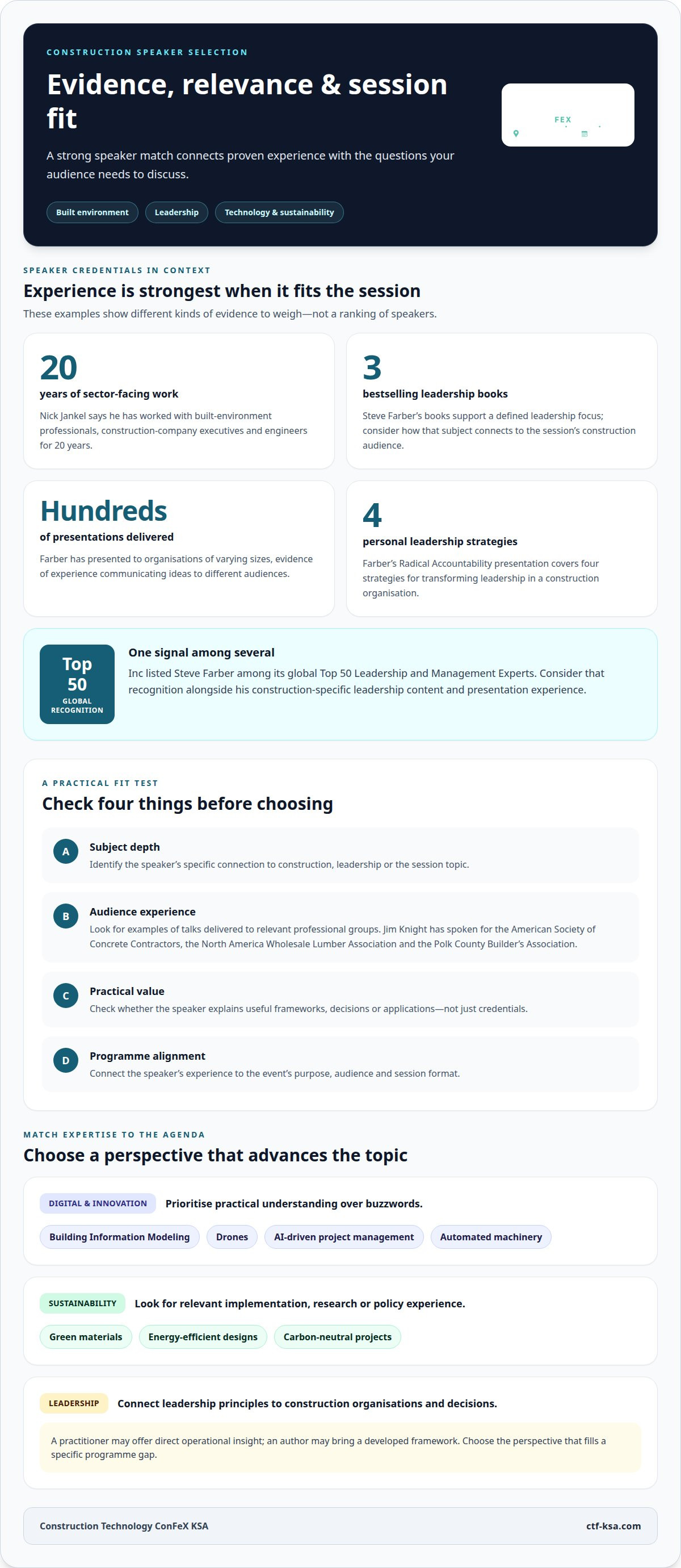
Review the speaker’s work history, subject focus and examples of previous presentations. Nick Jankel says he has spent 20 years working with built-environment professionals, construction-company executives and engineers. That experience indicates sustained exposure to sector audiences. The useful question is whether a speaker’s background connects directly to your session theme, rather than simply sounding impressive in a biography.
Relevant speaking experience matters, too. Jim Knight has spoken for construction-related professional groups, including the American Society of Concrete Contractors, the North America Wholesale Lumber Association and the Polk County Builder’s Association. For your event, look for evidence that a speaker can adapt their message to the audience’s knowledge and interests, whether delegates are technical specialists, executives or a mix.
Books and presentation history can reveal how a speaker develops ideas, but they should support, not replace, topic fit. Steve Farber has written three bestselling leadership books and delivered hundreds of presentations to organisations of varying sizes. His Radical Accountability presentation covers four personal strategies for transforming leadership in a construction organisation. These details indicate a defined leadership framework and experience communicating it to audiences.
Match credentials to the programme’s subject
- Check subject depth: Identify the speaker’s specific connection to construction, leadership or the session topic.
- Review audience experience: Look for examples of talks delivered to relevant professional groups.
- Assess practical value: Note whether the speaker explains frameworks, decisions or applications, such as Farber’s four leadership strategies.
- Test programme alignment: Connect the speaker’s experience to the event’s focus, from digital tools to sustainable design.
Distinguish a strong qualification from a useful contribution. A celebrated author may bring compelling ideas, while an experienced practitioner may offer direct operational insight. Steve Farber’s leadership work and Jim Knight’s experience speaking to professional groups reflect different strengths. Choose the profile that fills a specific gap in your programme and offers delegates a perspective they can use after the session.
As a final check, separate credentials that establish subject knowledge from evidence that a speaker can make that knowledge useful in the room. Ask whether the proposed session has a clear focus, its examples illuminate the event theme, and its level suits the delegates. A strong match is clear from the connection between the speaker’s experience and the questions the programme addresses, not just a long list of titles.
Inc listed Steve Farber among its global Top 50 Leadership and Management Experts. Treat that recognition as one signal alongside his construction-specific leadership content and presentation experience. Compare each candidate against the same criteria, then choose the person whose expertise, message and delivery best support the session’s purpose. This keeps selection grounded in relevance and gives organisers a consistent basis for deciding which credentials matter to their audience.
What should event organisers consider when choosing a construction industry speaker?
Begin with the event’s purpose, then select a speaker whose contribution advances it. A leadership conference may need an open discussion of decision-making, while an industry event may prioritise a focused conversation or live demonstration. For a Saudi construction audience, define the intended outcome first: shared insight, practical discussion or stronger connections across the built environment. This gives your speaker brief a clear direction.
Next, map the audience. Senior executives, project teams, technical specialists and emerging professionals bring different priorities to the room. A keynote can set a broad direction; a moderated panel can compare viewpoints; a fireside conversation can make a complex subject more accessible. A session on organisational change, for example, should give leaders room to discuss decisions, while a technical demonstration should leave time for detailed questions.
Shape the session around its purpose
Choose a format that suits both the topic and the speaker’s strengths. A solo presentation gives one expert room to develop an argument. A panel brings contrasting experience into one conversation, but needs a moderator who can keep the discussion focused. An interview can draw out examples through well-planned prompts. Reviewing speaker interview formats can help organisers consider how a guided conversation might serve their programme.
Set the session boundaries before confirming the programme. Specify the central question, audience level, format and expected takeaways. For a leadership session, ask the speaker to connect ideas to decisions faced by construction organisations. If the agenda combines a keynote with a panel, distinguish their roles: the keynote frames the issue, while the panel explores different perspectives. This limits repetition and gives each contribution a clear purpose.
Consider adaptability, especially for live programmes. Kate Davis hosted the BUID Awards Dinner for the Building Industry and Land Development Association and adapted her hosting as the programme changed. Her example highlights a practical selection criterion: a speaker or host should respond to changes while keeping the audience engaged. In the briefing, identify transitions, discussion priorities and the session’s essential message.
- Define the outcome: Decide whether the session should inform, challenge, connect or prompt discussion.
- Match the format: Select a keynote, panel, interview or demonstration that supports that outcome.
- Plan for interaction: Choose where audience questions, moderator prompts or discussion fit naturally.
- Clarify the brief: Set the topic boundaries, audience profile and takeaways before programme details are finalised.
Assess communication style as well as subject expertise. A speaker addressing a mixed audience should explain specialist concepts without losing precision. A panel moderator, for example, must listen, follow up on useful points and prevent one voice from dominating. A keynote speaker needs a coherent narrative that delegates can follow without assuming everyone has the same technical background. These skills help make a programme accessible and substantive.
Finally, align each speaker’s contribution with the wider event journey. A leadership keynote can open a conference by framing shared challenges; a specialist session can deepen a theme later. If the event includes networking, leave room for ideas from the stage to carry into conversations. A deliberate sequence gives the programme momentum instead of presenting a collection of unrelated sessions.
Assess whether a proposed speaker can connect the subject to pressures audiences recognise, without turning a broad theme into an unfocused talk. Burnout-related turnover, disengagement, and reduced productivity cost organizations an estimated $322 billion annually, so a session on workforce wellbeing can be framed as an operational concern as well as a personal one. Ask for a clear account of the decisions, practices or trade-offs the audience should consider, and make space for questions that test how ideas apply across different projects.
Check that the speaker’s experience suits the event’s remit and audience. Major international gatherings in the Middle East focus heavily on infrastructure and regional innovation, while specialist conventions in the USA cater to concrete and masonry professionals. Those distinctions can help organisers judge whether a contribution fits the programme rather than simply carries prominence. A testimonial on the page refers to an event attended by 550 people; treat that as context about event scale, not as a substitute for checking the speaker’s fit. Before confirming the choice, agree expectations for preparation, interaction and takeaways. A well-matched speaker should be able to address the central question, engage the intended audience and support the event’s purpose with a contribution that is clear and relevant.
Construction Technology ConFeX KSA
Construction Technology ConFeX KSA brings construction professionals and industry leaders together to explore how technology can support Saudi Arabia’s next generation of buildings, infrastructure and industrial facilities. If you’re shaping a programme or want to share relevant industry perspectives, its Speaking Opportunities offer a way to contribute. Delegate Passes provide access to conference sessions, live demonstrations and networking.
The event also brings together organisations and audiences through Sponsorship Packages and Exhibition Stands. These options can support a broader presence alongside the conference programme, while speaking participation helps place expertise within the event’s discussions. Consider Construction Technology ConFeX KSA when your goal is to engage with peers and contribute to Saudi construction’s evolving priorities. Contact Construction Technology ConFeX KSA to discuss taking part.
Turn the programme into lasting industry momentum
A well-designed event can do more than deliver a strong session. It can give Saudi Arabia’s construction community space to exchange ideas, build connections and carry new perspectives into future decisions. Choose construction industry speakers who serve that wider purpose, and shape the programme so the conversation continues beyond the stage.
Construction Technology ConFeX KSA offers Speaking Opportunities, Delegate Passes and Sponsorship Packages for professionals and organisations looking to take part. Each provides a different way to contribute to the event, engage with its audience or support its programme. Choose the role that fits your next step: share expertise, attend or build visibility around your organisation’s priorities.
Make your next event a platform for sharper discussion and stronger connections across the built environment.