
 DCTC KSA
- Blogs
- / Construction Data Analytics KSA: Driving Giga-Project Performance in 2026
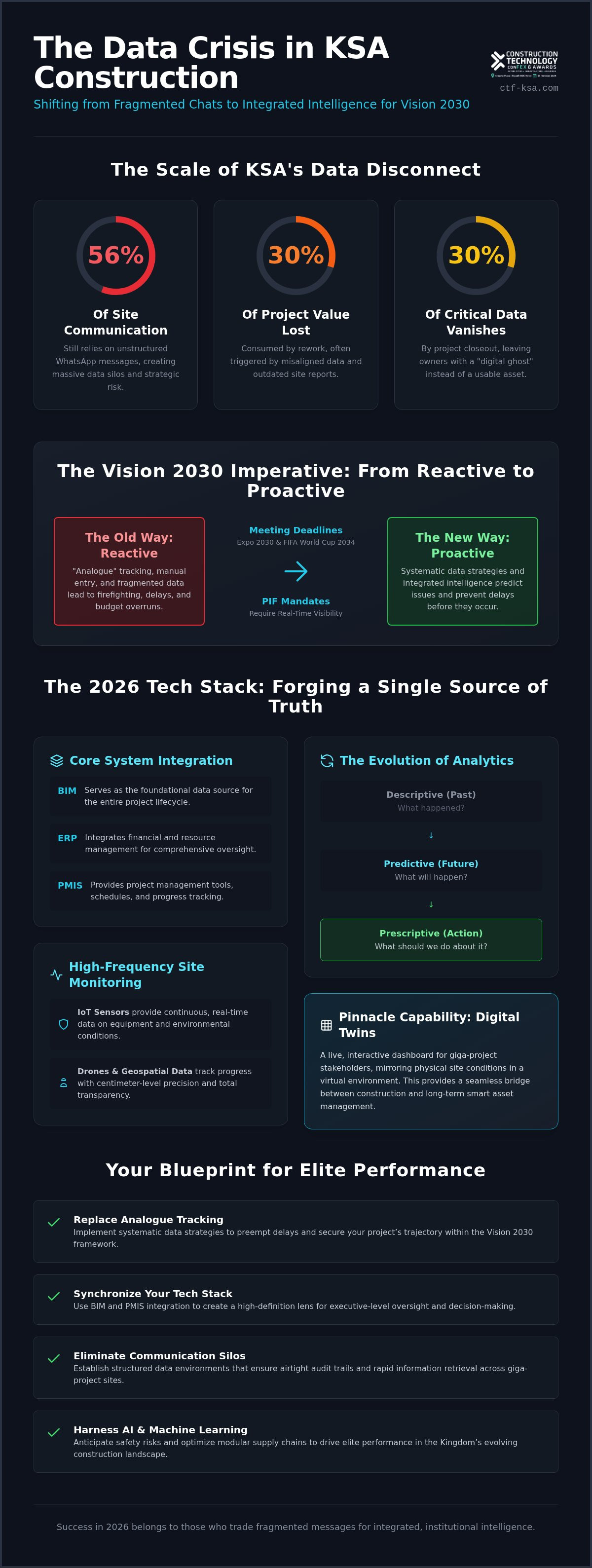
Did you know that 56% of communication on Saudi construction sites still flows through WhatsApp, according to WhiteHelmet research? In a month where project awards exceeded 29.5 billion SAR, relying on fragmented chat groups is a strategic risk that compromises construction data analytics KSA performance. You're likely feeling the immense pressure to meet aggressive Vision 2030 deadlines while fighting the high costs of data misalignment. It's a challenge shared by every leader in the Kingdom's fast-paced landscape.
Mastering advanced data systems is the definitive way to bridge these silos. This article reveals how sophisticated analytics can reduce rework costs by 30% and provide the unified oversight required for PIF-backed developments. We'll explore the shift toward real-time digital twins, the mandatory SBC 2024 standards, and how to transform raw data into a powerful engine for project delivery. Success in 2026 belongs to those who trade fragmented messages for integrated, institutional intelligence.
Key Takeaways
- Replace reactive "analogue" tracking with systematic data strategies to preempt delays and secure your project’s trajectory within the Vision 2030 framework.
- Synchronize your tech stack through BIM and PMIS integration, transforming construction data analytics KSA into a high-definition lens for executive-level oversight.
- Eliminate fragmented communication silos to establish structured data environments that ensure airtight audit trails and rapid information retrieval across giga-project sites.
- Harness AI and machine learning to anticipate safety risks and optimize modular supply chains, driving elite performance in the Kingdom’s rapidly evolving construction landscape.
The Data Crisis in KSA Construction: Beyond the Digital Facade
Scale is the defining characteristic of the Kingdom’s current construction cycle. Yet, beneath the rising skylines of NEOM and Qiddiya lies a systemic inefficiency that threatens delivery. Construction data analytics KSA is no longer a luxury; it's the systematic use of site data to predict and prevent delays before they derail critical milestones. It marks the shift from reactive firefighting to proactive command.
Traditional "analogue" tracking methods are failing. Manual entry and disjointed spreadsheets cannot support the sheer volume of the Saudi Vision 2030 pipeline. The financial consequences are staggering. In the Kingdom, rework can consume up to 30% of total project value, often triggered by misaligned data or outdated site reports. Implementing a robust construction data analytics KSA framework is the only way to safeguard these investments. This fragmentation directly contradicts the national strategy championed by the Saudi Authority for Data and Artificial Intelligence (SDAIA). Compounding this, a staggering 30% of critical project data vanishes by the time a project reaches closeout, leaving owners with a "digital ghost" rather than a usable asset for long-term operations.
Why Vision 2030 Demands a Data-First Approach
The timeline is absolute. With Expo 2030 and the FIFA World Cup 2034 approaching, infrastructure delivery must be flawless. PIF-backed developers are now enforcing rigorous digital mandates; they're requiring contractors to provide real-time visibility into every asset. Achieving this level of precision requires a comprehensive Digital Transformation in Construction KSA. Contractors who fail to integrate their data risk being sidelined by an industry that now prioritizes institutional intelligence. To lead in 2026, you must bridge the gap between the digital facade and operational reality.
From Raw Data to Actionable Insights: The 2026 Tech Stack
The giga-project era demands a sophisticated digital architecture. Building Information Modeling (BIM) serves as the foundational data source, feeding every other system in the chain. When integrated with Enterprise Resource Planning (ERP) and Project Management Information Systems (PMIS), it grants C-suite executives unprecedented visibility. This integration ensures that construction data analytics KSA provides a single version of the truth across multi-billion SAR portfolios. It’s about turning raw site metrics into strategic leverage.
Capturing this data requires high-frequency site monitoring. IoT sensors and drones now provide real-time geospatial data, allowing teams to track progress with centimeter-level precision and total transparency. This shift enables a transition from descriptive analytics, which merely explain past delays, to predictive models that forecast future bottlenecks. The Kingdom is rapidly adopting advanced technologies and modern building methods to ensure these insights lead to faster delivery and reduced waste. If you want to lead these high-level discussions, you should register to attend our next industry gathering.
Digital Twins and Real-Time Asset Management
Digital twins represent the pinnacle of current construction data analytics KSA capabilities. They offer a live, interactive dashboard for giga-project stakeholders, mirroring physical site conditions in a virtual environment. This isn't just for the construction phase. It’s a strategic shift toward long-term smart asset management, ensuring the value of the build persists for decades. For a deeper dive into this technology, read our Digital Twins in KSA Construction guide. By 2026, these virtual replicas will be the standard for every PIF-backed development, providing a seamless bridge between engineering and operations.
Overcoming the 'WhatsApp Problem' and Site Data Silos
Many contractors believe WhatsApp and Excel are sufficient for site tracking. This is a dangerous fallacy. Unstructured data creates deep silos where critical information goes to die. Without a centralized construction data analytics KSA strategy, you lose the ability to perform an empirical analysis of the construction industry within your own project ecosystem. Audit trails vanish. Retrieving a specific site instruction from three months ago becomes an impossible task during a high-stakes dispute.
Senior leadership must mandate digital accountability. It's not merely a technical upgrade; it's a strategic governance requirement. By enforcing a structured transition, you secure the project's integrity. Consider this 4-step framework for your teams:
- Audit: Map all current informal communication channels and data leakage points.
- Centralize: Migrate all site reporting into a unified Common Data Environment (CDE).
- Standardize: Train site teams on structured data entry to ensure consistency.
- Enforce: Mandate these digital standards across the entire supply chain.
This ensures every stakeholder, from the main contractor to the smallest supplier, contributes to a single, verified version of the truth. It eliminates the "he-said, she-said" culture that plagues traditional sites.
Standardizing Data Workflows for KSA Contractors
Adopting ISO 19650 standards is now a competitive necessity in the Saudi market. These international protocols eliminate the 35% time waste typically spent on over-processing documents and searching for lost files. Implementing construction data analytics KSA tools that align with these global standards allows firms to reclaim thousands of productive man-hours. It's the definitive difference between managing a project and leading an industry. You can attend CTF KSA to see these platforms in action and benchmark your current workflows against the Kingdom's best.
Secure your delegate pass to master data standardisation
The Future of Analytics: AI and Predictive Performance
The horizon of construction data analytics KSA is shifting toward absolute foresight. Artificial intelligence now processes millions of data points to predict safety hazards before they manifest as site accidents. By analyzing historical patterns and real-time sensor feeds, AI-driven systems provide safety officers with the predictive intelligence needed to protect the Kingdom's massive workforce. This proactive stance is essential as giga-projects scale to unprecedented heights in 2026. It's the difference between managing risk and eliminating it entirely.
Beyond safety, machine learning is revolutionizing supply chain logistics for modular and offsite construction. These algorithms optimize the flow of pre-fabricated components across borders and sites, ensuring that delivery timelines remain resilient against global disruptions. To maintain a competitive edge, stakeholders must move beyond curiosity and begin active engagement with technology providers. CTF KSA stands as the Kingdom’s premier platform for discovering these transformative innovations. It is the definitive hub where the future of Saudi construction is coded and executed.
Networking with the Architects of Saudi Innovation
Strategic selection of analytics partners requires high-level networking that transcends standard procurement processes. At CTF KSA, the industry’s most influential decision-makers convene to vet the next generation of construction data analytics KSA and ConTech. For technology providers, our Sponsorship Opportunities offer an exclusive stage to showcase predictive solutions to a PIF-backed audience. These interactions are where the Kingdom's most ambitious digital mandates are forged. Additionally, speaking slots at the event allow visionary leaders to define the data roadmap for the entire sector. Influence in the Saudi market is built on these high-stakes connections; don't leave your project's digital future to chance. Engaging with our ecosystem ensures your organization remains at the forefront of the Vision 2030 transformation.
Leading the Digital Vanguard of Saudi Construction
The transition from fragmented site communication to a unified construction data analytics KSA framework is the defining competitive advantage for 2026. By integrating predictive AI and structured data standards, contractors can effectively eliminate the rework costs that currently drain 30% of project value. This isn't just about adopting new software; it's about building institutional resilience in the face of the Kingdom's most ambitious delivery timelines. As the Kingdom's #1 ConTech platform supported by PIF, CTF KSA provides the exclusive environment where these transformations happen. With 80% of attendees being senior decision-makers, it's the definitive space to align with the developers shaping the nation.
Secure your delegate pass for CTF KSA 2026 to lead the digital transformation
The era of analogue tracking has ended. Join the elite group of innovators who are turning data into the Kingdom's most valuable building material. Your place at the forefront of Vision 2030 starts here.
Frequently Asked Questions
What is construction data analytics and why is it important in KSA?
Construction data analytics is the systematic processing of project-generated information to optimize site performance and delivery. In Saudi Arabia, it's vital for managing the 30.03 billion ﷼ in projects awarded in May 2026 alone. These tools ensure that massive giga-project portfolios remain on track with Vision 2030's rigid timelines by providing real-time visibility into complex site operations that manual tracking simply cannot match.
How does the 'WhatsApp Problem' affect Saudi construction projects?
The "WhatsApp Problem" refers to the use of informal chat apps for official project communication, which creates fragmented data silos. This lack of structure prevents the creation of a reliable audit trail and makes information retrieval nearly impossible during disputes. Moving toward a centralized construction data analytics KSA platform replaces these "dark data" pockets with institutional intelligence that senior leaders can actually verify and act upon.
Can data analytics really reduce rework costs on giga-projects?
Analytics platforms identify design clashes and procurement delays before they lead to physical errors on site, protecting project margins. By catching these issues early, contractors can significantly lower the financial burden of rework. This precision is essential for maintaining the 7.2% GDP contribution of the construction sector, as it protects the high-value investments made by PIF and other major institutional developers across the Kingdom's landscape.
What are the key BIM standards for data analytics in Saudi Arabia?
Saudi Arabia increasingly mandates ISO 19650 for giga-projects to ensure international data management standards are met. Additionally, the Saudi Building Code 2024 Edition, mandatory since June 2025, provides the regulatory framework that these digital models must satisfy. These standards ensure that construction data analytics KSA outputs are consistent and interoperable across all municipal and professional licenses issued through the Baladi platform, which is now the primary digital gateway for permits.
How can AI be used in construction data analytics for Vision 2030?
AI processes historical and real-time site data to forecast potential safety risks and supply chain bottlenecks before they occur. It allows project managers to transition from descriptive reporting to predictive performance management. In 2026, machine learning is also being used to optimize the deployment of local talent through specialized workforce development programs, ensuring that the right skills are applied to the right project phases for maximum efficiency.