 DCTC KSA
- Blogs
- / Cloud Computing for Construction KSA: The 2026 Strategic Roadmap
In 2026, the era of optional digital adoption is over; cloud computing for construction KSA has transitioned from a tactical choice to a non-negotiable regulatory mandate. You're likely managing the immense pressure of coordinating global consultants with local contractors across massive, remote sites where data fragmentation and strict residency laws create constant friction. It's a high-stakes environment where any latency in communication can stall the momentum of a multi-billion riyal giga-project. We've reached a turning point where technical infrastructure must match the scale of our physical ambitions.
This strategic roadmap clarifies how localized infrastructure is finally enabling Saudi Arabia's most ambitious developments to scale with precision. You'll discover how to leverage the new Cloud Computing Special Economic Zone regulations to ensure absolute compliance with SDAIA and CST standards while maintaining seamless collaboration. We'll examine the shift toward real-time Digital Twins and how the 2026 arrival of dedicated local cloud regions from global providers is solving the connectivity challenges of the deep desert.
Key Takeaways
- Master the transition to cloud computing for construction KSA to provide the mandatory digital backbone for delivering Vision 2030 giga-projects at scale.
- Synchronize global consultants and local contractors using cloud-native BIM environments to ensure a single source of truth across the project lifecycle.
- Navigate 2026 data residency laws and NCA cybersecurity standards to keep your sensitive project data secure and fully compliant within Saudi borders.
- Future-proof your operations by integrating construction data analytics and edge computing to solve connectivity challenges in remote desert locations.
The Strategic Shift: Why Cloud Computing is Mandatory for Saudi Construction in 2026
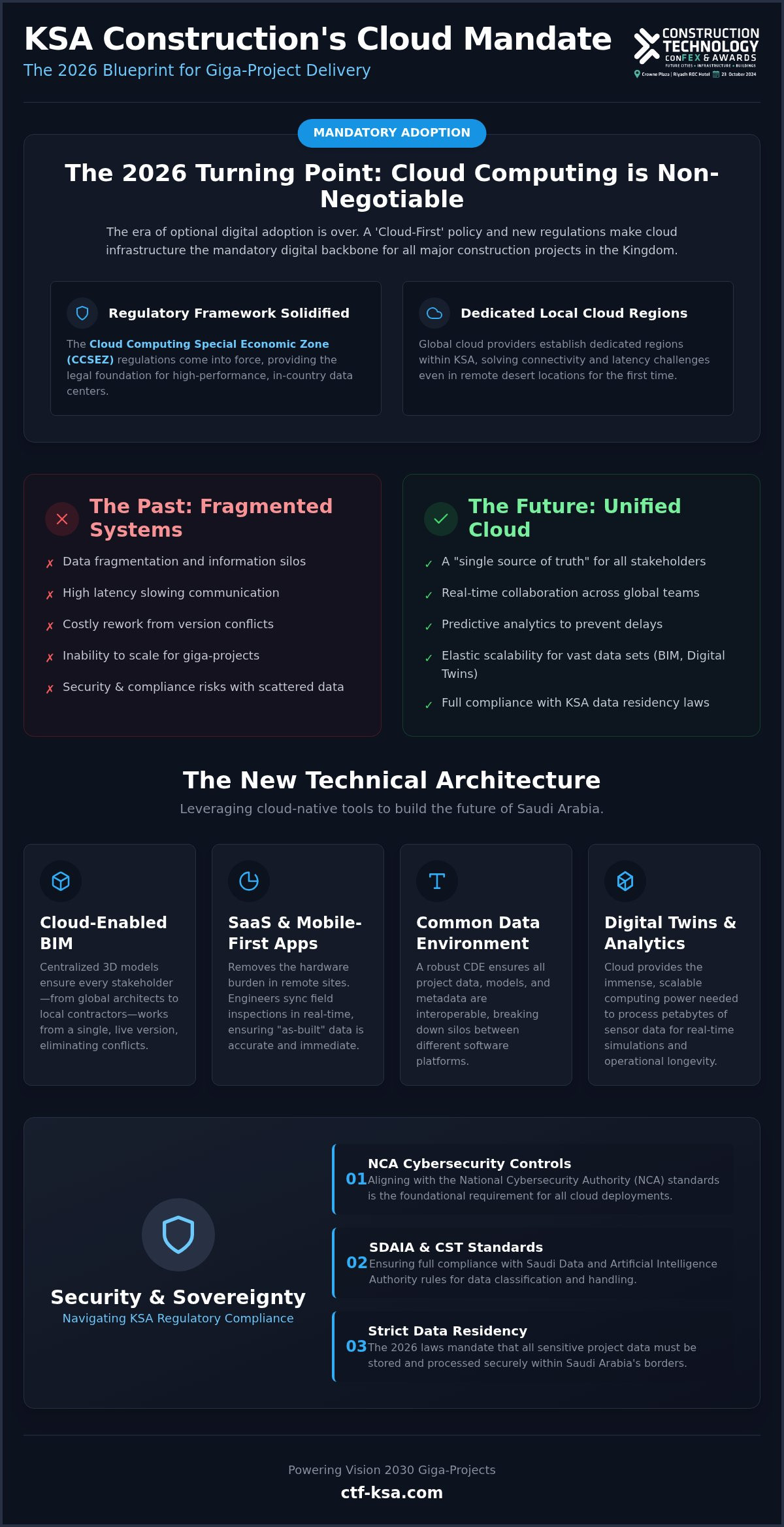
Cloud computing for construction KSA is no longer a peripheral IT upgrade. It is the centralized digital backbone that facilitates real-time data exchange across every phase of the project lifecycle. In the context of Saudi Arabia's 2026 construction market, this infrastructure serves as the only viable "single source of truth." Giga-projects like NEOM and the Red Sea Project are too vast for fragmented, on-premise systems. They demand a cloud-native environment where architects in global hubs, engineers across the Kingdom, and site managers on vast project sites operate on identical datasets simultaneously.
The year 2026 marks a decisive tipping point. With the Cloud Computing Special Economic Zone regulations coming into force in April 2026, the Kingdom has solidified the legal framework for high-performance data centers. This shift, bolstered by the government's "Cloud-First" policy, allows firms to move from reactive project management to predictive performance. By centralizing data, leaders can:
- Forecast supply chain bottlenecks before they stall site progress.
- Identify design clashes in real-time to prevent expensive rework.
- Monitor carbon footprints to meet strict sustainability mandates.
Aligning with Saudi Vision 2030 and Giga-Project Demands
Vision 2030 demands delivery that's faster, greener, and smarter. Cloud infrastructure is the catalyst for these goals. It enables the complex Building Information Modeling (BIM) workflows required for sustainable, high-tech urban environments. This isn't just about storage; it's about the digital transformation in construction KSA that bridges the gap between global AEC consultants and local Saudi contractors. Instant accessibility breaks down traditional silos. It ensures every stakeholder, regardless of their location, contributes to a unified, efficient delivery model. Adopting robust cloud computing for construction KSA is now the definitive standard for any firm looking to lead in the Kingdom's evolution.
Technical Architecture: Leveraging SaaS and BIM for Giga-Project Delivery
Software as a Service (SaaS) is the definitive choice for giga-project execution in 2026. It removes the burden of local hardware maintenance in remote desert environments where physical infrastructure is still catching up. Site engineers now utilize mobile-first cloud applications to sync field inspections directly with the central office. This real-time connectivity ensures that "as-built" data is captured accurately; it prevents the information gaps that typically plague large-scale infrastructure projects.
Centralizing project data requires a robust Common Data Environment (CDE). By aligning with BIM conference Saudi Arabia standards, firms ensure that metadata and 3D models remain interoperable across different platforms. High-performance cloud computing for construction KSA provides the elastic storage needed to host these complex models. It ensures that every design change is reflected across the entire stakeholder network within seconds, regardless of geographic distance.
Cloud-Enabled BIM and Real-Time Collaboration
Local file storage is a liability in the current fast-paced market. It leads to version conflicts and costly site errors that stall progress. Cloud-hosted models eliminate this risk by providing a single, live version of the project. Cloud-based CDEs reduce rework by ensuring all stakeholders access the latest design iteration.
As projects mature, the focus shifts to operational longevity. The datasets required for digital twins in construction KSA are astronomical. Robust cloud computing for construction KSA scales computing power dynamically to handle real-time sensor data and high-fidelity simulations. If you want to witness these architectures in action, you can secure your delegate pass to meet the innovators leading this change. This elasticity is vital for managing the petabytes of data generated by AI-driven analytics and BIM Level 3 workflows.
Overcoming Barriers: Security, Sovereignty, and KSA Regulatory Compliance
Security isn't a hurdle; it's the foundation of trust in the Kingdom's digital expansion. When deploying cloud computing for construction KSA, firms must align with the National Cybersecurity Authority (NCA) Essential Cybersecurity Controls. These aren't suggestions. They're strict mandates designed to protect critical infrastructure data from sophisticated threats. Compliance ensures your project isn't just innovative but also resilient against the evolving global threat landscape.
The Communications, Space and Technology Commission (CST) maintains a rigorous registration system for service providers. You've got to ensure your partners hold the correct registration class to handle sensitive sector data. This ensures project data remains within the Kingdom's borders, satisfying strict data sovereignty requirements. It's about maintaining absolute control over the digital assets that define our future cities.
Compliance with National Data Residency Laws
Global titans are responding to these demands with massive investments. AWS is launching a dedicated cloud region in Saudi Arabia in 2026 with an investment exceeding 19.8 billion riyals. Microsoft Azure is also finalizing availability zones to ensure residency is guaranteed. This localization is vital for complying with the Personal Data Protection Law (PDPL), which governs how stakeholder information is handled across the AEC supply chain. The regulatory landscape is shifting fast; the new Cloud Computing Special Economic Zone (SEZ) frameworks, effective April 16, 2026, allow licensed data centers to operate with specific benefits provided their headquarters remain in Riyadh. Check out the latest interviews with tech leaders on navigating KSA regulations.
Security at the site level remains a priority. Implement end-to-end encrypted data transfer and enforce multi-factor authentication for all site access points. Regularly auditing your cloud computing for construction KSA permissions prevents unauthorized leaks and keeps your digital twin data secure.
Sponsor the event to lead the security conversation
Future-Proofing Your Strategy: Integrating Cloud and Data Infrastructure
The future of the built environment depends on the seamless convergence of software and physical infrastructure. By 2026, cloud computing for construction KSA will integrate directly with advanced construction data analytics KSA to provide automated, predictive reporting. This isn't just about collecting data; it's about turning petabytes of site information into actionable intelligence. For projects in remote desert regions, edge computing provides the solution to latency. By processing data locally before syncing to the cloud, site teams maintain high-speed connectivity even in the most isolated locations.
Migration is the next strategic hurdle. Leaders must build a clear roadmap for transitioning legacy systems into hybrid cloud environments. This approach balances the need for immediate accessibility with the security of dedicated local hosting. It's a structured evolution that ensures your organization remains agile as project demands intensify. You can't lead the market while tethered to siloed, on-premise hardware.
The Synergy of Cloud and Local Data Center Infrastructure
Saudi Arabia's data center market is exploding. The sector generated approximately 4.13 billion riyals in 2025 and is projected to reach 10 billion riyals by 2033. This surge in physical infrastructure is the primary catalyst for construction cloud adoption. It provides the low-latency foundations required for AI-driven construction. High-fidelity, cloud-hosted data is the prerequisite for machine learning; you can't run predictive algorithms on fragmented, offline spreadsheets.
The co-location of the Construction Technology ConFeX KSA with the Data Centre Technology ConFex highlights this critical strategic link. It's the definitive venue where cloud innovators meet the architects of the Kingdom's physical data backbone. If you're ready to lead this transformation, you should attend the next ConFeX to engage with the stakeholders shaping the 2026 roadmap. Success in the next decade belongs to those who view cloud computing for construction KSA and data center infrastructure as a single, unified asset.
Commanding the Digital Frontier of 2026
The strategic roadmap for 2026 is definitive. Success in the Kingdom's built environment now requires a seamless integration of localized infrastructure and high-performance software. By adopting cloud computing for construction KSA, your organization secures a "single source of truth" that eliminates data fragmentation across global AEC teams. You've seen how strict adherence to NCA and CST regulations isn't just about compliance; it's about building the elite reliability required to deliver on Vision 2030. The convergence of cloud-native BIM and local data centers serves as the definitive catalyst for the next generation of giga-projects.
Secure your delegate pass for CTF KSA 2026 to lead the digital transformation
As the Kingdom's premier ConTech and innovation platform supported by the Public Investment Fund (PIF), we're shaping an environment where 87% of exhibitors develop tangible business opportunities. This is your invitation to join the industry titans at the absolute forefront of this regional transformation. The momentum is building, and the opportunity to lead is now.
Frequently Asked Questions
Is cloud computing for construction mandatory in Saudi Arabia?
Cloud computing is mandatory for all public sector entities and government-backed giga-projects under the national "Cloud-First" policy. This regulation requires organizations to prioritize cloud solutions over traditional on-premise hardware during IT procurement. For private contractors, adopting cloud computing for construction KSA has become an operational necessity to meet the digital delivery standards required by the Public Investment Fund (PIF) and other major project owners.
How do Saudi data residency laws affect cloud-based construction software?
Data residency laws require that all sensitive project information remains within the Kingdom's borders. Construction firms must ensure their software providers utilize local data centers, such as those operated by Google, Oracle, or the upcoming AWS region. This ensures absolute compliance with the Personal Data Protection Law (PDPL). Failure to host data locally can result in significant regulatory penalties and exclusion from major government infrastructure contracts.
What is the difference between private and public cloud for KSA projects?
Public clouds offer scalable, shared infrastructure through local regions provided by global tech giants. Private clouds provide dedicated environments for a single organization, offering enhanced control for highly sensitive giga-project data. Many Saudi firms now adopt a hybrid approach. This strategy combines the massive computing power of the public cloud with the isolated security of private servers to manage complex digital twin datasets efficiently.
Can cloud computing work on remote Saudi construction sites with poor connectivity?
Yes, modern cloud computing for construction KSA utilizes edge computing and "offline-first" synchronization to solve connectivity issues. Site teams capture data on mobile devices in remote desert locations without an active signal. Once a connection is established, the system automatically syncs the data to the central cloud environment. This ensures that field-to-office communication remains uninterrupted regardless of the site's proximity to major urban infrastructure.
Which KSA regulatory bodies oversee cloud adoption in the construction sector?
Three primary bodies govern the digital landscape. The Communications, Space and Technology Commission (CST) regulates service provider registration and data center licensing. The National Cybersecurity Authority (NCA) sets the essential security controls for critical infrastructure projects. Finally, the Saudi Data and AI Authority (SDAIA) oversees the Personal Data Protection Law. Firms must align their digital strategies with all three to ensure full legal and operational compliance.