
 DCTC KSA
- Blogs
- / Circular Economy in Construction Saudi Arabia: The 2026 Strategic Roadmap
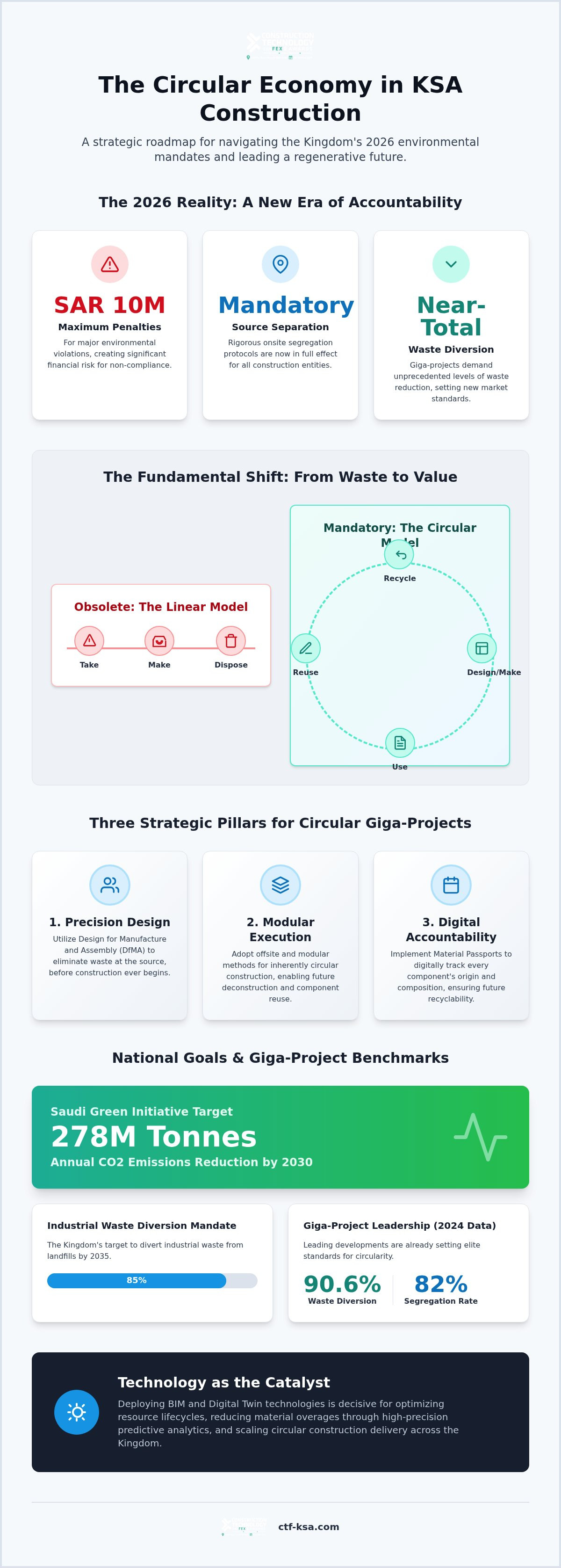
In 2026, the cost of ignoring sustainability has reached a critical tipping point. Penalties for major environmental violations now reach SAR 10 million. Mandatory source separation is in full effect. You understand that the pressure to align with the Saudi Green Initiative is immense. It's no longer just about compliance; it's about survival in a market where giga-projects demand near-total waste diversion. The circular economy in construction Saudi Arabia has shifted from a visionary concept to a mandatory operational reality for every major player in the Kingdom.
This strategic roadmap shows you how to turn these regulatory pressures into a distinct competitive edge. We'll explore how to navigate the costs of sustainable materials while securing a clear ROI through advanced technologies like Digital Twins. You'll gain the insights needed to master emerging supply chains for recycled materials and position your organization as a central leader. From the mandates of the Saudi Investment Recycling Company to the latest waste-to-energy pathways, this guide provides the clarity you need to lead this transformation.
Key Takeaways
- Master the transition to a regenerative framework that aligns with the Kingdom's 2026 environmental mandates and waste diversion targets.
- Adopt DfMA and modular construction techniques to eliminate waste at the design phase and lead the circular economy in construction Saudi Arabia.
- Deploy BIM and Digital Twin technologies to optimize resource lifecycles and reduce onsite material overages through high-precision predictive analytics.
- Secure a strategic advantage at CTF KSA 2026 by connecting with key project decision-makers to showcase your organization’s leadership in sustainable delivery.
Defining the Circular Economy in Saudi Arabia’s Construction Sector
The traditional "take-make-dispose" model is obsolete. In its place, a regenerative framework is redefining the built environment. This transition represents the circular economy in construction Saudi Arabia, where materials are treated as permanent assets rather than temporary liabilities. Circular construction in KSA is a resource-neutral approach to building the national infrastructure. This shift isn't just an environmental choice; it's a strategic necessity for managing the immense costs and scale of national giga-projects. By adopting a circular economy model, developers can mitigate price volatility while directly supporting the Saudi Green Initiative's goal to reduce carbon emissions by 278 million tonnes per annum by 2030.
The Role of the Public Investment Fund (PIF)
The PIF is the engine of this transformation. By backing the nation's most ambitious developments, the fund is setting elite standards for circularity that ripple across the national supply chain. Leading national giga-projects have already demonstrated this leadership, with some developments achieving a 90.6% waste diversion rate in 2024, while others reported an 82% segregation rate. These benchmarks incentivize contractors to innovate. They ensure every riyal invested contributes to a self-sustaining ecosystem. It's a top-down mandate that rewards efficiency and punishes waste, forcing a rapid evolution in how materials are procured and utilized.
Regulatory Landscapes and 2026 Mandates
Compliance has become a powerful differentiator. As of 2026, the Saudi Investment Recycling Company (SIRC) and the National Center for Waste Management (MWAN) have accelerated enforcement to meet national targets. Contractors must adapt to these strict requirements:
- Mandatory Source Separation: All construction entities must implement rigorous onsite segregation protocols.
- Industrial Waste Diversion: The Kingdom is aggressively pursuing the mandate to divert 85% of industrial waste from landfills by 2035.
- Environmental Penalties: Serious violations now trigger fines up to SAR 10 million and potential license suspension.
Organizations that master these requirements don't just avoid penalties. They secure their position as preferred partners for the nation's most prestigious contracts. In this high-stakes environment, circularity is the price of admission for leadership.
Strategic Pillars for Circularity in Saudi Giga-Projects
Circularity in the Kingdom's built environment isn't an afterthought. It's a design requirement. To achieve the scale required by Vision 2030, the circular economy in construction Saudi Arabia relies on three strategic pillars: precision design, modular execution, and digital accountability. These aren't just trends; they're the standard for elite project delivery.
Design for Manufacture and Assembly (DfMA) serves as the first line of defense against waste. By shifting construction into controlled factory environments, developers eliminate the onsite inefficiencies that lead to material overages. Modular and offsite methodologies aren't just faster. They're inherently circular, allowing for future deconstruction and component reuse. For deeper insights into these scalable techniques, review our guide on Modern Methods of Construction Saudi Arabia.
Digital accountability through Material Passports completes this framework. These digital records track the origin and composition of every building component. This ensures that when a structure is eventually decommissioned, its parts are already cataloged for immediate re-entry into the supply chain.
Waste as a Resource: Closing the Loop
The Saudi Investment Recycling Company (SIRC) is facilitating a robust market for high-quality recycled aggregates. Waste is now a national asset. Innovative onsite management technologies process debris into structural-grade materials, supporting the 85% industrial waste diversion mandate. This creates a closed-loop system that protects both the environment and project budgets.
Sustainable Materials and Low-Carbon Concrete
The transition to low-carbon concrete is accelerating as developers slash embodied carbon. By prioritizing durability and recyclability, the circular economy in construction Saudi Arabia is moving toward a resource-neutral future. If you want to lead this shift, you can position your brand as a pioneer in sustainable sourcing.
Technology as a Catalyst for Circular Construction Delivery
Technology is the decisive factor in scaling the circular economy in construction Saudi Arabia. High-stakes project delivery requires absolute precision, and BIM serves as the foundational architecture for this efficiency. By utilizing Digital Twins, developers simulate the entire building lifecycle before breaking ground. This simulation identifies exactly where materials can be recovered or reduced. AI-driven analytics further refine this process, predicting material requirements with surgical accuracy. This eliminates the "just-in-case" procurement mindset that historically led to massive onsite overages.
Climatetech solutions provide the real-time visibility necessary for 2026 mandates. These platforms monitor energy efficiency and carbon footprints across the project duration, ensuring that sustainability is a measurable operational reality rather than a vague design goal.
Digital Twins and Asset Management
Digital replicas are transforming asset management into a circular science. By maintaining a live data stream of building components, owners maximize the lifespan of national infrastructure. These twins facilitate future deconstruction by providing a clear blueprint of how to disassemble and reuse materials. This prevents valuable resources from ever reaching a landfill and ensures they remain high-value assets for the next generation of development.
Robotics and Automation in Circularity
Robotics bring a level of precision that eliminates human error and subsequent material waste. Onsite, automated sorting systems are now the standard for segregating waste streams with high purity. This technology ensures that the Kingdom’s market for recycled aggregates remains supplied with premium-grade inputs. It is a critical component for scaling the circular economy in construction Saudi Arabia and meeting the national goal to recycle 42% of all waste by 2035.
Leading the Circular Transformation at CTF KSA 2026
CTF KSA 2026 is the definitive arena for those ready to lead the circular economy in construction Saudi Arabia. It's the Kingdom’s premier platform where visionary policy meets disruptive technology. By participating, you position your brand at the center of a regional transformation. You aren't just observing the shift; you're driving it. Accessing exclusive conferences and technical demonstrations on climatetech gives your team the edge needed to navigate 2026 mandates. For a broader perspective on the path to decarbonization, explore our analysis of Sustainable Construction Solutions Saudi Arabia.
Thought Leadership and Speaking Opportunities
Influence is the ultimate currency. Speaking opportunities at CTF KSA provide a direct line to a senior-level audience of giga-project stakeholders. Whether through solo talks or strategic panels, you share circular economy insights that shape the national roadmap. This is your chance to command the room. Establish your organization as the definitive authority on sustainable delivery in front of the Kingdom’s most influential gatekeepers.
Networking for Performance and Climate
Performance requires the right connections. Our platform facilitates 1:1 meetings with high-intent buyers searching for circular solutions. Since 80% of attendees are clients and end users, you're building a network that matters. This is where significant things happen. The event is a catalyst for partnerships that accelerate project timelines and meet environmental goals. It’s a high-stakes opportunity to secure your place among industry titans.
Secure your place among industry titans: Attend CTF KSA 2026.
Architecting the Circular Future
The roadmap is clear. Circularity is now a mandatory operational standard for everyone building the Kingdom’s future. By integrating DfMA and digital accountability, your organization transforms waste into a permanent asset. This shift is the bedrock of the circular economy in construction Saudi Arabia, ensuring every giga-project meets the ambitious mandates of Vision 2030. Success requires more than compliance; it demands elite visibility.
CTF KSA 2026 is the premier platform where this transformation happens. Explicitly supported by the PIF and attended by an audience where 80% are clients and end users, this event is where the industry's most significant partnerships are forged. In fact, 92% of exhibitors recognize this as a critical event for their strategic business growth. It's the definitive venue for leaders ready to shape the national built environment.
Secure Your Sponsorship Package for CTF KSA 2026
Join the elite circle of innovators and secure your position at the forefront of the industry. The momentum is yours to capture.
Frequently Asked Questions
What are the primary goals of the circular economy in Saudi construction?
The primary goals focus on establishing a regenerative system that eliminates waste and maximizes resource productivity across the national built environment. This involves transitioning from a linear model to one that prioritizes the reuse of high-value materials. Key objectives include reducing carbon emissions by 278 million tonnes per annum by 2030 and ensuring that industrial waste is redefined as a valuable national asset rather than a liability.
How does Saudi Vision 2030 mandate circularity in giga-projects?
Saudi Vision 2030 mandates circularity through the Saudi Green Initiative and the Circular Carbon Economy framework. These policies require giga-projects to implement strict waste management protocols and sustainable procurement strategies. By integrating these principles, the Kingdom aims to generate 3 GW of electricity from waste-to-energy pathways by 2030. PIF-backed developments serve as the primary vehicles for demonstrating these standards, ensuring that national infrastructure delivery remains both sustainable and economically resilient.
Which technologies are most effective for implementing circular construction?
Implementation of the circular economy in construction Saudi Arabia relies on a suite of advanced digital tools. BIM and Digital Twins are essential for simulating material lifecycles and optimizing deconstruction. AI-driven analytics predict procurement needs to prevent overages, while robotics and automated sorting systems ensure high-purity recycling onsite. Additionally, Climatetech solutions enable real-time monitoring of energy efficiency and carbon footprints, providing the data-driven transparency required for modern regulatory compliance.
Can circular economy principles reduce construction costs in Saudi Arabia?
Circular principles significantly reduce costs by minimizing material waste and optimizing supply chain efficiency. By adopting DfMA and modular construction, developers eliminate expensive onsite errors and reduce the need for raw material procurement. Reusing high-quality aggregates processed onsite further lowers transportation and disposal fees. These strategies protect project budgets against global price volatility while ensuring that resources are utilized at their highest value throughout the entire building lifecycle.
How can companies showcase their circular solutions at CTF KSA?
Companies can showcase their innovations through strategic Sponsorship Packages and Exhibition Stands at CTF KSA. These platforms provide direct access to an audience where 80% of attendees are clients and end users from major giga-projects. Additionally, Speaking Opportunities allow thought leaders to present technical demonstrations and solo talks to senior decision-makers. This high-level engagement facilitates 1:1 meetings, helping technology providers convert sustainable solutions into tangible business opportunities within the Kingdom.