 DCTC KSA

- Blogs
- / Career Benefits of Industry Conferences: 2026 Guide
What if a conference’s greatest career value begins after the final session? The career benefits of attending industry conferences include practical insight, greater professional visibility, and connections that can grow into working relationships. Still, it is reasonable to question whether time away from work will pay off, especially when sessions seem too broad or too advanced.
The difference is preparation and follow-through. Choose an event that aligns with a current career goal, approach conversations with curiosity, and leave with clear steps for applying what you learn. Then share useful insights with your team and track how you put them into practice. This guide explains how to make each stage count, from choosing sessions to building professional relationships and demonstrating the value of attending.
For professionals in the built environment, Construction Technology ConFeX KSA offers conference sessions, networking, and technical demonstrations around themes such as AI, BIM, digital twins, robotics, and digital delivery. The aim is not simply to attend. It is to turn learning and new connections into lasting professional value.
Key Takeaways
- Match conference attendance to your career stage, whether you are developing expertise, tracking industry change, increasing visibility, or considering a transition.
- The career benefits of attending industry conferences extend beyond networking. They can include discovering new approaches and building relationships that support collaboration or mentorship.
- Set a clear goal, select relevant sessions, prepare a brief introduction and focused questions, then follow up to turn conversations into professional connections.
- Compare each event’s audience, programme, format, and participation opportunities with your next career move. A focused agenda may offer more value than a larger but less relevant event.
Why attending industry conferences can matter at different career stages
An industry conference brings people in the same profession together to learn, exchange expertise, and build relationships that can inform their work. As this general overview of Benefits of attending professional conferences explains, the format creates opportunities to hear specialist ideas and meet practitioners. Its career value depends on what you need next. The career benefits of attending industry conferences are strongest when the programme matches a clear goal and you participate actively, rather than simply being present.
Think of attendance as a strategic choice, not a milestone in itself. If you work in the built environment, for example, a specialist programme covering AI, BIM, digital twins, robotics, climatetech, or digital delivery can help you identify developments relevant to your role. The same principle applies across industries: choose an event based on the questions you want to answer, the expertise you want to build, or the professional perspective you want to gain, whether exploring construction tech or connecting with property investors and industry vendors through events like lagrandexpo.com.
Which career goals can conference attendance support?
At the start of a career, sessions and conversations can clarify industry vocabulary, show how roles differ, and introduce approaches used by experienced practitioners. Established professionals can gain fresh perspectives from peers and build connections across functions that are harder to develop within one team. For career changers, specialist talks can highlight transferable skills, emerging priorities, and adjacent roles to research before making a move.
Make your goal specific. “Learn more about digital delivery” is broad. “Identify two capabilities used in digital delivery roles” gives you a practical lens for choosing sessions and starting conversations.
When might a conference be a poor fit?
A broad event may offer limited value if its agenda barely touches your priorities. Even a relevant programme can be difficult to benefit from if your schedule leaves no time to ask questions, meet peers, or reflect on what you heard. Before committing, compare the agenda with your immediate career objective and decide how you will take part and follow up. If you cannot identify a relevant session or make time to engage, the event may be mistimed for your current goal.
The career benefits of industry conferences go beyond networking
Talks, panels, and technical demonstrations can introduce ideas that your daily responsibilities rarely leave time to explore. A session may introduce a method, a demonstration can show how it works, and discussion can help you assess whether it fits a challenge in your role. Learning becomes more useful when you connect it to decisions you are already facing.
Relevant sessions build knowledge, active discussions develop practical insight, professional relationships widen your perspective, and follow-through turns those gains into career development. That combination is central to the career benefits of attending industry conferences. Visibility can grow, too, when you ask informed questions or share a relevant example from your work. You do not need to dominate a conversation or deliver a sales pitch. Thoughtful contributions show how you think and what you can bring to a discussion.
How conference learning can strengthen professional skills
Listening builds knowledge, while workshops, demonstrations, and discussion help you practise evaluating ideas. In a construction-focused programme, a session on BIM, digital twins, AI, or climatetech can help you compare emerging approaches with the constraints and priorities of your work. As you take notes, record one method to investigate further and one question to raise with your team. This turns exposure into a learning objective, rather than a collection of disconnected notes.
How professional connections can create future opportunities
Networking starts with a relevant conversation and develops through considerate follow-up. A peer can exchange practical lessons; a potential mentor can offer perspective on professional growth; a subject expert can deepen your understanding; and a recruiter can explain the skills employers seek. No conversation guarantees a role or promotion. A clear question, genuine listening, and a thoughtful message afterward give a promising connection room to develop over time.
Construction Technology ConFeX KSA brings built-environment professionals together for conference sessions, networking, and technical demonstrations. Explore delegate attendance at Construction Technology ConFeX KSA to find an event setting focused on technology and the changing construction sector.
How to turn conference attendance into career progress
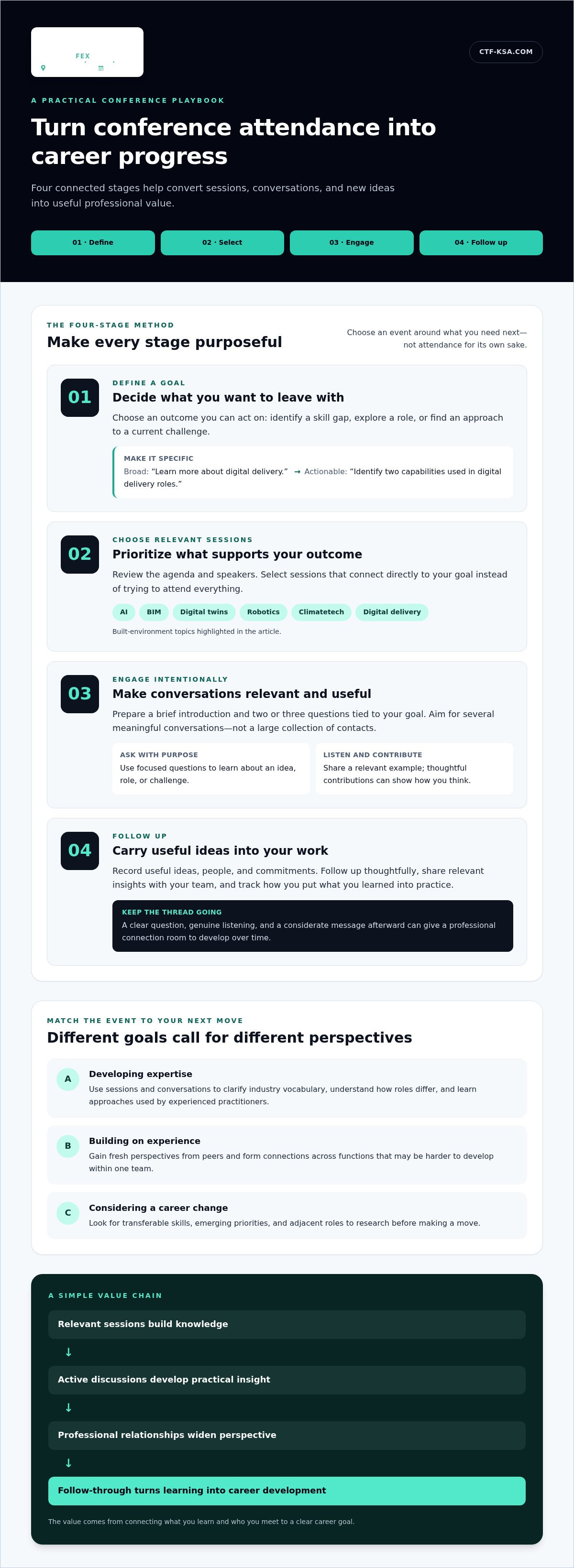
Make attendance a deliberate cycle, not a packed calendar. This four-stage method connects preparation, participation, and follow-through so you can bring useful learning back into your work.
- Define a goal. Choose an outcome you can act on, such as identifying a skill gap, exploring a role, or finding an approach to a current challenge.
- Choose relevant sessions. Review the agenda and speakers, then prioritize sessions that directly support your outcome instead of trying to attend everything.
- Engage intentionally. Prepare a brief introduction and two or three questions tied to your goal. Aim for several meaningful conversations, not a large collection of contacts.
- Follow up. Record useful ideas, people, and commitments promptly. Apply one relevant insight to your current work, then reconnect with people you met.
Repeat this preparation-to-application process at each conference. Define an objective, select aligned sessions, participate with purpose, and follow up with a practical action. That turns attendance into an intentional part of your career development.
What should you do before and during an industry conference?
Before the event, scan session descriptions and speaker backgrounds to identify the most relevant discussions. During sessions, take concise notes under three prompts: an idea to explore, a person to remember, and an action to consider. This keeps your attention on outcomes instead of transcript-style note-taking. Leave space in your schedule for focused conversations and reflection.
How can you make conference learning visible afterward?
Share a useful insight with colleagues or your professional network, crediting the speaker and adding your own perspective. Follow up with each new contact by referring to a specific point from your conversation and suggesting a clear next step, such as exchanging resources. To place emerging ideas in a wider industry context, explore this digital construction transformation guide. Applying an idea and communicating what you learned makes the career benefits of attending industry conferences easier to demonstrate.
Explore delegate attendance opportunities
Choose an industry conference that supports your next career move
Start with the career outcome you want, then compare each event’s audience, programme, format, and ways to participate. Ask whether the sessions address a skill you need, whether attendees work in roles you want to understand, and whether the format allows for discussion or demonstrations. A large event can offer breadth, but a focused conference may be more valuable when its agenda closely matches your next step.
What signals that a conference is professionally relevant?
Look for a clear connection between the topics, the people attending, and the questions you want answered. A programme for a specialist audience may suit you if you are deepening expertise; cross-functional sessions may be more useful if you are exploring adjacent responsibilities. Consider whether the event combines talks with discussion, technical demonstrations, or other ways to engage—an approach often seen in well-planned corporate conferences managed by teams like amaeventmanagement.com.au. When comparing audience figures, check that they relate to the event edition and audience being described.
How can a specialist event broaden your professional perspective?
Specialist events can bring disciplines into the same conversation. In the built environment, digital tools, project delivery, and sustainability intersect. Construction Technology ConFeX KSA offers sessions, networking, and technical demonstrations focused on themes including BIM, digital twins, robotics, and climatetech. Exploring these topics can help you identify connections across your work and understand how different disciplines approach shared challenges.
Use a simple test before committing: can you name the professional question you want the event to help answer and point to agenda elements that address it? If not, keep comparing options. If the programme aligns with your goal, explore the delegate attendance options to see how the conference supports participation. A deliberate choice makes the career benefits of attending industry conferences more relevant to your priorities.
Explore delegate attendance options
Make your next conference a deliberate career move
Choose one professional question to carry into your next event. It might concern a capability you want to develop, a challenge you are ready to approach differently, or a direction you are considering for your career. Let that question guide the sessions you attend and the people you speak with. Then decide how you will put one useful insight into practice when you return to work. The career benefits of attending industry conferences build over time through purposeful choices and consistent action, not attendance alone.
Construction Technology ConFeX KSA brings together conference speakers and industry professionals, with 120+ combined speakers and 500+ facilitated meetings reported for the event. Use the programme and delegate access details to decide how the sessions and networking align with your objectives.
Explore delegate attendance options and plan how you will use the event to support your professional goals.
Your next step does not need to be dramatic. Set a clear goal, choose an event with purpose, and give yourself the opportunity to move forward with greater insight and confidence.
Frequently Asked Questions
Are industry conferences worth attending for career development?
Yes, they can be worthwhile when you connect attendance to a professional objective. The career benefits of attending industry conferences might include understanding a role’s skill requirements or learning how specialists approach a work challenge. Before deciding, write down what you hope to gain and how you will use it. If the event cannot support that outcome, another development activity may be a better fit.
Can attending a conference help you get a job?
A conference can help you understand an industry and meet people in it, but it cannot guarantee employment. Treat it as one part of a broader search, not a substitute for applications or interviews. For example, note recurring skills and job titles mentioned in sessions, then use that insight to refine your CV and identify relevant vacancies through formal recruitment channels.
How do you network at a conference if you are shy?
You can network effectively without working a room. Choose a session you genuinely care about, then use a specific point from the talk as a low-pressure conversation starter with another attendee or the presenter. Listening well can make an exchange feel more natural than trying to impress people. If speaking on the day feels difficult, a brief, personal message afterward can continue the discussion.
What should you do after attending an industry conference?
Turn your notes into a short action record: capture the idea, why it matters to your work, and what evidence would show it helped. Share a relevant takeaway with your manager or team, and set a reminder to review progress after applying it. This makes learning easier to revisit and gives you a concrete account of how the event informed your work.
How can you tell whether an industry conference is right for your career?
A strong fit should help answer a question tied to your next step. For instance, if you are considering a move into digital delivery, look for content that clarifies the responsibilities and capabilities involved, not just broad technology trends. Also consider whether the session level suits your current knowledge. You should be able to explain what you expect to understand better after attending.