 DCTC KSA

- Blogs
- / Career Advancement via Conferences: A 2026 Guide
A conference badge won’t advance your career on its own. Preparation, purposeful participation, and follow-through can turn attendance into visible progress. Using conference attendance for career advancement starts with a clear objective: build a specific skill, explore a new direction, or contribute more effectively in your current role.
To decide which sessions and conversations deserve your time, connect the event to a real development need. You may also need to show your manager how attending can benefit the team, not just your own growth. This guide explains how to assess an event, plan useful conversations, and turn relevant insights into workplace contributions. Construction Technology ConFeX KSA brings conference sessions, technical demonstrations, and built-environment connections together in one setting. The value you gain depends on how deliberately you use it before, during, and after the event.
Key Takeaways
- Define career progress in practical terms, such as stronger capability, wider responsibility, or better-informed decisions, before choosing an event.
- Make conference learning, professional exchanges, and visible contributions useful by connecting them to a work priority.
- Use a four-stage plan to prepare, participate, follow up, and apply what you learn, with clear objectives and a simple way to track progress.
- Discuss the value of attending with your manager by explaining your objective, a relevant insight, how you plan to apply it, and your next development step.
Why using conference attendance for career advancement starts with a clear goal
Career advancement isn’t limited to a promotion. It can mean building a capability, taking on wider responsibility, making better-informed decisions, or earning recognition for meaningful contributions. A conference can support these outcomes, but attendance alone doesn’t make its value visible. Connect what you learn and who you meet to a real work priority, then put relevant insights into practice. Conferences can be one part of Professional Development, alongside other activities that build capability over time.
Definition: Strategic conference attendance means choosing and engaging with an event to advance a specific career objective, then applying what you learn and building on relevant connections.
Which career goal should guide your conference choice?
Choose one primary goal: develop a skill, understand an industry shift, build peer relationships, or contribute expertise through thought leadership. Tie it to a current work challenge or a realistic next career step. For example, a digital-delivery professional who wants to improve coordination across project teams could focus on learning about digital workflows and speaking with a peer who has applied them. A specific goal gives you a practical reason to attend and a way to judge whether the experience was useful.
How do you judge whether a conference fits that goal?
Look beyond the event title. Compare the programme with your objective: do the sessions address the topic you need to understand, do speakers bring relevant experience, and will demonstrations help you see a tool or approach in context? Consider whether the attendee community includes professionals whose work or perspectives align with your next step. For built-environment professionals, CTF KSA delegate passes provide access to conference sessions, technical demonstrations, and industry networking. Before attending, identify the session, demonstration, or conversation most likely to give you a useful insight to take back to work.
How conference learning, networking, and visibility support career growth
Conference value comes through relevant knowledge, relationships built through exchange, and professional contribution. Each can strengthen your work. The link to career growth becomes clearer when you can show how you used what you learned or contributed.
Applied conference learning supports career growth when you turn a useful insight into a better decision, process, or result at work.
For example, a session on digital twins might prompt you to assess whether model-based insights could help a project team improve coordination. You could share the idea as a practical recommendation, a small pilot, or a short presentation. Visibility comes from demonstrating expertise through a relevant question, insight, or work example, not from promoting yourself without context.
How can a conference help you build professional relationships?
Start conversations around shared challenges and specific expertise. Instead of asking only what someone does, try an open-ended question such as, “What has helped your team improve information coordination?” or “Which implementation challenge are you working through?” Listen closely, offer a relevant example from your own work, and identify a useful point to follow up on. A thoughtful exchange gives both people a reason to continue the conversation; collecting contacts without a shared topic rarely does.
How does conference learning become career evidence?
Translate an insight into a practical recommendation, pilot, presentation, or improved work process. Keep a brief record of three things: the problem you addressed, your contribution, and the outcome you observed. Be precise about your role and avoid claiming results you can’t substantiate. This gives you credible examples of applying new knowledge, rather than relying on attendance alone.
CTF KSA brings learning and professional exchange together for people working in the built environment. The event has reported 1,200+ attendees, 120+ combined speakers, and 500+ facilitated meetings. These figures describe the event, not guaranteed career outcomes. Your individual value still depends on how you participate and follow through. CTF KSA delegate passes provide access to sessions, demonstrations, and industry conversations, giving you opportunities to pursue a specific learning objective and make relevant connections.
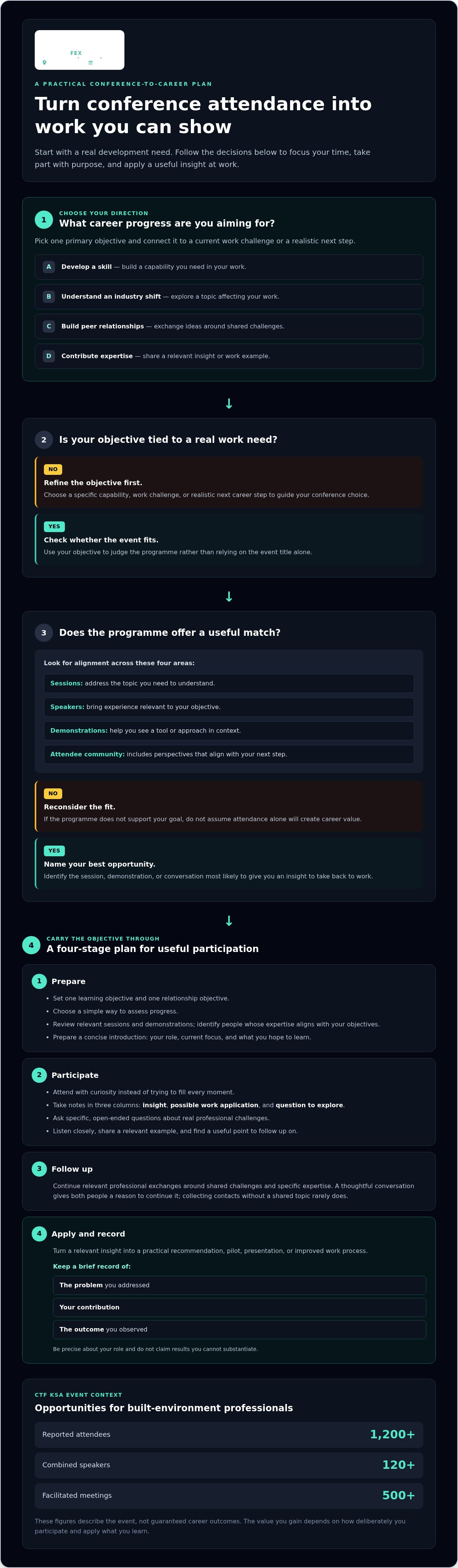
How to use conference attendance for career advancement before, during, and after
A simple process helps you turn conference time into work you can carry forward. Use these four stages to connect your objectives with focused participation and practical follow-through.
- Prepare. Set one learning objective, one relationship objective, and a simple way to assess progress. For example, aim to understand an approach to digital information coordination, speak with a professional who has implemented it, and leave with one idea to assess at work. Review the agenda for relevant sessions and demonstrations, then identify speakers or attendees whose expertise aligns with your objectives. Review CTF KSA attendance information to see how delegate participation connects you with sessions, demonstrations, and industry conversations. Prepare a concise introduction that covers your role, current focus, and what you hope to learn.
- Participate. Attend with curiosity rather than trying to fill every moment. Take notes in three columns: insight, possible work application, and question to explore. Ask specific, open-ended questions about real professional challenges. For instance, ask how a team addressed a particular implementation barrier, then share a related experience of your own. This helps make the exchange useful for both people.
- Follow up. Send a personalized message that recalls your conversation and names a relevant point you discussed. Offer a useful resource, observation, or follow-up question instead of sending only a generic request to connect. Keep a brief record of who you met and what you agreed to revisit, so a promising exchange has a clear next step.
- Apply. Choose one insight to test, present, or adapt to your work. Share a short internal briefing that explains the idea, why it matters, and a practical next step. Note feedback and any outcome you observe. This sequence is central to using conference attendance for career advancement because it makes learning and contribution visible without overstating results.
Explore delegate attendance at CTF KSA
How to turn conference participation into a credible next career step
Attendance is not proof of impact by itself. A credible career case connects what you learned, the professional relationships you developed, and what you applied at work. Present these as evidence of growth, not as a promise of promotion. Be specific about your contribution and distinguish it from results achieved by your wider team.
How can you show your employer that attendance mattered?
Prepare a concise update using four points: your development objective, the most relevant insight, how you applied it, and the next capability you want to build. For example, explain that you attended to explore digital coordination, shared a practical recommendation with your team, and helped assess whether it fits an existing workflow. Support your account with verifiable outputs, such as a briefing, tested idea, process change, or useful professional connection. Describe your role accurately, then discuss a realistic next step with your manager.
When is conference attendance not the right development choice?
Conferences require time away from regular responsibilities, and their value depends on a relevant programme and deliberate follow-through. If your immediate need is to practise a specific skill or prepare for trade licensing, structured training resources like Casaflex or a focused workplace project may be a better fit. Choose a conference when its content and professional community address a genuine development need and you have a practical way to apply what you learn afterward.
For professionals working in the built environment, CTF KSA brings together conference sessions, technical demonstrations, and networking focused on digital and sustainable transformation. Compare those elements with your development objective, then plan how you would use the learning and conversations in your role. This makes conference participation a deliberate part of your development, rather than treating attendance as a guaranteed career outcome.
Explore CTF KSA attendance opportunities
Make your next professional step deliberate
The strongest career progress often begins with a small, visible action: a recommendation you put forward, a capability you strengthen, or a professional conversation you continue. Decide what your next opportunity may require, then choose experiences that help you prepare for it. That’s the practical value of using conference attendance for career advancement: it can help you move from intention to informed action, while the results depend on what you do with what you gain.
If your goals connect with digital and sustainable transformation in the built environment, CTF KSA offers a relevant setting to explore industry ideas and engage with professionals. Plan your participation around the contribution you want to make next, and carry that purpose into your work afterward.
Choose your next step with confidence. The progress you build from it is yours to shape.
Frequently Asked Questions
Can attending conferences help you advance your career?
Yes, a conference can support career advancement when it helps you build expertise or demonstrate readiness for new responsibilities. For example, an emerging digital-delivery lead might use an event to understand how other teams manage model coordination, then bring a relevant approach into a project discussion. Attendance alone doesn’t guarantee a promotion, but it can strengthen your experience and professional perspective.
How do you use a conference to advance your career?
Using conference attendance for career advancement means treating participation as part of a wider development plan. Before registering, identify a capability you want to strengthen and connect it to your role. During the event, note ideas that challenge your current assumptions. Afterwards, discuss one relevant takeaway with a colleague and consider whether it could inform an upcoming project or team decision.
What should I say to my manager when requesting conference attendance?
Explain the work need the event addresses and the value you’ll bring back. You could say: “I’d like to attend because our team is assessing ways to improve digital coordination. I plan to focus on approaches relevant to our projects, then share a short briefing with the team. I’ll also plan coverage for my current responsibilities while I’m away.”
How do you network at a conference without feeling awkward?
Give yourself a simple opening: ask someone what brought them to a particular session or what challenge they’re exploring. That creates a natural topic and gives the other person room to respond. Listen for common ground before introducing your own work. If the conversation has run its course, close warmly: “Thanks, I’ve enjoyed hearing your perspective. I’ll let you continue meeting people.”
Should conference attendance go on your résumé?
Include it when the event is relevant to your field or supports a skill you use professionally, but give more space to what you did with the experience. A concise entry might name the event and its subject area, followed by a project, briefing, or new responsibility informed by your learning. Avoid presenting attendance as a qualification unless the event provided a credential you actually earned.