
 DCTC KSA
- Blogs
- / Built Environment Transformation: The 2026 Guide to Saudi Infrastructure Digitization
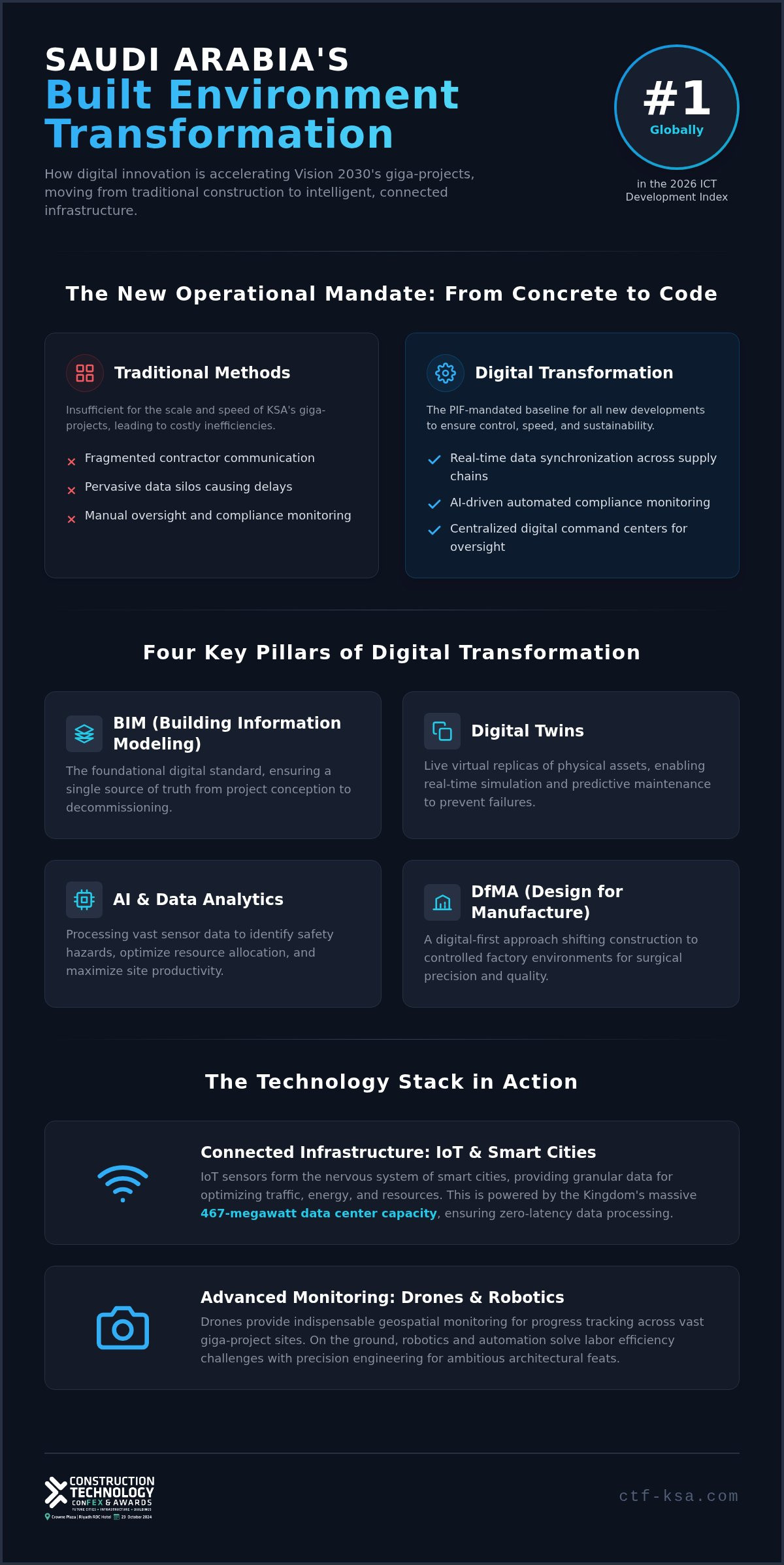
Saudi Arabia officially ranks first globally in the 2026 ICT Development Index. This isn't just a badge of honor. It's the engine room of a total national overhaul. You're likely feeling the pressure of managing massive giga-project timelines where data silos and fragmented contractor communication threaten to stall momentum. It's a high-stakes environment where traditional construction logic no longer applies. You need more than just tools; you need a strategic architecture for growth.
Digital transformation in Saudi infrastructure has shifted from an elective upgrade to an absolute operational necessity. In this guide, you'll discover how the Kingdom's 467-megawatt data center capacity and the latest DGA governance standards are reshaping project delivery to meet Vision 2030 goals. We'll explore the specific ConTech roadmap required to scale innovation across vast networks, identify high-ROI technologies like Digital Twins and AI, and connect you with the strategies used by the industry's most influential leaders. The future isn't coming. It's being built right now through code and concrete.
Key Takeaways
- Understand why traditional construction methods are insufficient for the Kingdom's giga-projects and why built environment transformation has become the new operational mandate.
- Master the foundational roles of BIM and Digital Twins in creating a connected, predictive, and real-time infrastructure network.
- Learn how to overcome data silos and secure long-term ROI through the implementation of unified Project Management Information Systems.
- Discover how to leverage premier innovation platforms to connect with technology partners and accelerate the digital transformation in Saudi infrastructure.
The Strategic Imperative of Built Environment Transformation in KSA
The Kingdom isn't just building cities; it's engineering a future where data is as foundational as concrete. Built environment transformation in 2026 represents the total convergence of physical construction and digital intelligence. It's the shift from static structures to sentient assets that communicate, evolve, and optimize. For decision-makers, this isn't a luxury. It's a survival strategy. Traditional construction methods, reliant on manual oversight and fragmented communication, simply cannot sustain the velocity required for today's giga-projects. When managing developments of this scale, a single day of delay can cost millions. Digital integration is the only way to maintain control over these sprawling timelines.
- Real-time data synchronization across global supply chains.
- Automated compliance monitoring using AI-driven benchmarks.
- Centralized digital command centers for multi-site oversight.
The Public Investment Fund (PIF) serves as the primary architect of this shift. By mandating advanced tech adoption across its portfolio, PIF has ensured that digital transformation in Saudi infrastructure is the baseline for all new developments. This strategic push aligns perfectly with the core pillars of Saudi Vision 2030, which seeks to diversify the economy through world-class, tech-driven urban centers. Embracing digital transformation in Saudi infrastructure allows the Kingdom to bypass legacy inefficiencies and lead the global market in smart city execution.
Meeting Vision 2030 Deadlines through Innovation
Speed is the new currency. Digital workflows and automated project management reduce delivery timeframes by eliminating the friction of data silos. These technologies allow stakeholders to visualize bottlenecks before they occur, ensuring that massive developments stay on track for their 2030 targets. Beyond speed, these innovations are critical for sustainability. By utilizing AI-driven resource management, the built environment can significantly reduce waste and energy consumption, meeting the Kingdom's ambitious climate goals while maintaining a rapid pace of growth. It's an era where efficiency and ambition are finally perfectly aligned.
Key Pillars of Digital Transformation in Saudi Infrastructure
The blueprint for success in the Kingdom's built environment rests on four critical pillars. First, Building Information Modeling (BIM) has transitioned from a design tool to the foundational digital standard for all major projects. It ensures a single source of truth from conception to decommissioning. Second, the evolution of Digital Twins allows for real-time asset management. These virtual replicas use live data to run simulations, enabling predictive maintenance that prevents costly infrastructure failures before they occur.
- AI and Data Analytics: Processing sensor data to identify safety hazards in milliseconds while maximizing site productivity.
- DfMA (Design for Manufacture and Assembly): A digital-first manufacturing approach that shifts construction to controlled factory environments for surgical precision.
This technological stack is the heart of digital transformation in Saudi infrastructure, turning visionary plans into high-performance reality. By integrating these systems, developers can bypass traditional bottlenecks and achieve the scale required by the PIF's ambitious portfolio.
Connected Infrastructure: IoT and Smart Cities
IoT sensors form the nervous system of the Kingdom's smart cities. These devices provide the granular data layer necessary for optimizing traffic flow, energy usage, and resource management. There's a powerful synergy here; the co-location of infrastructure projects with advanced data center technology ensures that this massive influx of IoT data is processed with zero latency. If you're looking to lead these developments, you can secure a delegate pass to engage with the architects of these connected networks.
Advanced Monitoring: Drones and Robotics
Scale requires a bird's-eye view. Drones have become indispensable for geospatial monitoring across expansive giga-project sites, providing high-resolution progress tracking that manual inspections miss. On the ground, robotics and automation are solving labor efficiency challenges. From autonomous bricklaying to robotic welding, these technologies provide the precision engineering required for the Kingdom's most ambitious architectural feats. The integration of these tools ensures that the 2026 infrastructure landscape remains both record-breaking and reliable.
Navigating Challenges in Large-Scale Digital Adoption
The scale of the Kingdom's ambition inevitably meets operational friction. The most persistent objection remains the perceived gap between high initial capital expenditure and long-term return on investment. In the context of digital transformation in Saudi infrastructure, viewing technology as a line-item expense is a strategic error. It's actually a high-performance risk mitigation tool. Without these digital foundations, the cumulative cost of project overruns and miscommunication in giga-projects far exceeds the price of the technology itself.
Data silos represent another significant barrier to progress. When owners, contractors, and consultants operate on disparate platforms, information rot sets in almost immediately. Unified Project Management Information Systems (PMIS) are the mandatory solution. They create a centralized nervous system where data flows without friction between every stakeholder on the site. This transparency is what allows a project to scale without losing its structural or financial integrity.
Upskilling the workforce is equally critical for long-term success. We aren't just building structures; we're building a high-tech delivery ecosystem. This requires a new breed of professional who is as comfortable with data analytics as they are with physical site management. For small and medium contractors, the path forward involves adopting lean digital tools that allow them to plug into these larger giga-project supply chains seamlessly. Integration is no longer optional; it's the ticket to participation.
Explore sponsorship opportunities to lead the digital conversation
Ensuring Interoperability Across Giga-Projects
Massive developments involve thousands of stakeholders and millions of data points. Standardized digital workflows are the only way to ensure these moving parts stay synchronized across the project lifecycle and across different regional zones. Interoperability is the bridge between disparate technology platforms in 2026. Without it, the digital transformation in Saudi infrastructure remains a collection of isolated islands rather than a unified national network. Leaders must prioritize open standards that allow different software ecosystems to speak the same language at every stage of construction.
Accelerating Infrastructure Delivery through Collaborative Innovation
Innovation thrives in ecosystems, not isolation. For the digital transformation in Saudi infrastructure to reach its zenith, the industry requires a central catalyst. Construction Technology ConFeX KSA stands as the Kingdom’s premier platform for built environment transformation, bridging the gap between visionary strategy and on-site execution. Supported by the Public Investment Fund (PIF), this event serves as the primary arena where the architects of Vision 2030 meet the technology disruptors of tomorrow. It’s where the roadmap for 2026 is finalized.
Procurement in a high-stakes environment demands speed and precision. Facilitated meetings and high-level networking at Construction Technology ConFeX KSA accelerate this process, allowing stakeholders to bypass traditional bureaucratic delays. With 80% of attendees representing clients and end users, the platform offers unparalleled access to decision-makers from the Kingdom's most significant giga-projects. To influence the direction of these developments, industry leaders should leverage speaking opportunities to establish definitive thought leadership. It’s the most direct route to becoming an indispensable partner in the national roadmap.
Participation is the first step toward leadership. We encourage all serious stakeholders to attend and connect with the developers and contractors driving the Kingdom's growth. This is where the future of the digital transformation in Saudi infrastructure is negotiated and finalized. No other platform offers this level of institutional support and commercial momentum.
The Value of Strategic Industry Partnerships
Visibility in a crowded market is a strategic asset. Our sponsorship opportunities provide technology innovators with a prestigious stage to showcase their solutions to a global audience. The synergy created by co-locating with the Data Centre Technology ConFeX ensures that smart infrastructure and data management are addressed as a unified whole. Excellence within this sector is further cemented through industry awards that recognize the pioneers of Saudi digital construction. These partnerships don't just build brands; they build the legacy of the Kingdom's new era.
This legacy of excellence is also reflected in the hospitality and retail sectors, where the demand for world-class facilities drives the selection of premium catering equipment from established global manufacturers like TFSE Products Ltd.
Leading the Next Era of Global Infrastructure
The shift toward digital transformation in Saudi infrastructure has transitioned from a strategic vision to a mandatory operational baseline. We've established that foundational pillars like BIM and Digital Twins are essential for navigating giga-project complexities. We've also seen how unified data systems dismantle the silos that threaten project timelines. Success in 2026 requires more than just adopting tools; it requires a total commitment to a connected, data-driven ecosystem where innovation and execution are perfectly aligned, a goal facilitated by the expert guidance of Syntric Hub Advisory Services.
As the Kingdom's #1 platform for ConTech and innovation, CTF KSA provides the definitive space to master this transition. The event is officially supported by the Public Investment Fund (PIF). It offers an exclusive environment where 80% of attendees are senior decision-makers and project owners looking for the next generation of solutions. This is where the future of the built environment is finalized.
To protect your interests in these high-stakes developments, you can discover شركة علي المسردي للمحاماة, a leading legal firm in Riyadh that specializes in navigating the Kingdom's complex regulatory environment.
Join the leaders of built environment transformation at CTF KSA
The decisions you make today will define the Kingdom's skyline for decades. Position your organization at the center of this historic transformation and lead the charge toward a smarter, more efficient future.
Frequently Asked Questions
What is the current state of digital transformation in Saudi construction?
Saudi Arabia currently leads the global ICT Development Index in 2026, signaling a mature and rapidly evolving digital ecosystem. Digital transformation in Saudi infrastructure is no longer in a pilot phase; it's the operational standard for all Public Investment Fund (PIF) projects. This maturity is driven by robust government governance, including the Digital Government Authority's latest IT governance controls and the Cloud First Policy, which mandates cloud-centric solutions for all new public investments.
How does BIM support Saudi Vision 2030 infrastructure goals?
Building Information Modeling (BIM) acts as the mandatory digital blueprint that ensures project accuracy and cross-stakeholder alignment. By providing a unified data environment, BIM minimizes the costly rework and material waste that often plague large-scale developments. It's the primary tool for meeting the aggressive delivery schedules of Vision 2030, allowing for surgical precision in design and assembly across the Kingdom's expanding urban landscape.
What are the main benefits of Digital Twins for Saudi giga-projects?
Digital Twins offer the ability to simulate and manage physical assets in a virtual environment before and during their operational life. For Saudi giga-projects, this means predictive maintenance that identifies structural issues before they manifest and real-time optimization of energy and water consumption. This technology ensures that massive investments remain sustainable and high-performing throughout their multi-decade lifecycles, protecting the Kingdom's long-term sovereign wealth assets.
How can companies participate in the Saudi built environment transformation?
Stakeholders can engage with the digital transformation in Saudi infrastructure by joining the CTF KSA platform. This institutional hub offers sponsorship packages, delegate passes, and speaking opportunities designed to connect technology innovators with PIF-backed developers. It's the definitive venue for securing the partnerships required to navigate the Kingdom's complex and high-value infrastructure market.
What role does AI play in improving construction site safety in KSA?
AI enhances site safety by utilizing computer vision and real-time data analytics to monitor high-risk zones and equipment usage. With 45.2% of internet users in the Kingdom already utilizing AI tools as of July 2026, the construction sector is rapidly integrating these algorithms to detect safety violations and potential hazards in milliseconds. This proactive approach reduces on-site accidents and ensures that human capital is protected as the pace of development accelerates.