 DCTC KSA

- Blogs
- / Applying Conference Learnings Across Your Organization
A conference insight matters when it moves beyond personal notes and informs a decision, a shared capability, or an organizational initiative. The clearest way to decide how to present conference learnings to your team is to distill your notes into relevant themes, connect each theme to current priorities, and turn promising ideas into practical actions colleagues can discuss and test; although it’s tempting to share every useful point, a focused handover gives people a clearer route from insight to application. This guide explains how to share notes in an accessible format, choose lessons that fit your organization, tailor them to different roles, and connect them to initiatives already in motion, including work advancing digital transformation, sustainability, and collaboration across Saudi Arabia’s built environment.
Key Takeaways
- Turn raw notes into a concise, accessible summary that colleagues can revisit and discuss.
- Prioritize insights that connect with your organization’s current challenges and goals.
- Frame each lesson around the responsibilities and decisions of the colleagues who can use it.
- Move from discussion to action by selecting a relevant idea to test within an existing initiative.
1. Sharing conference notes in a collaborative space
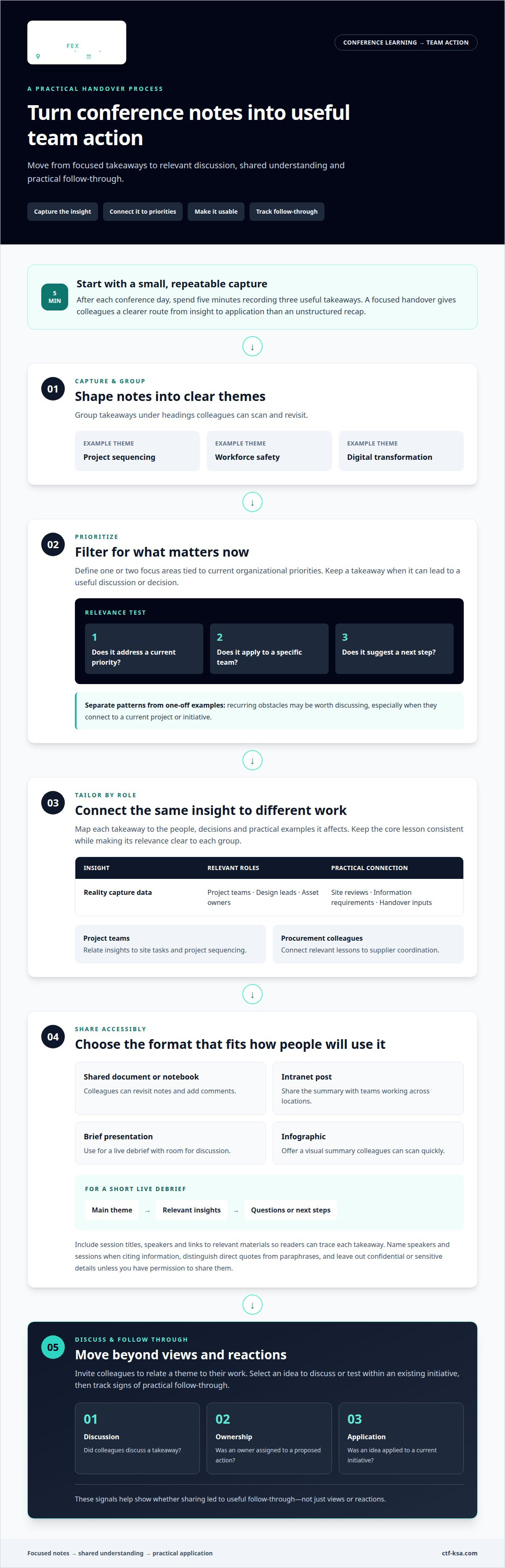
After each conference day, spend five minutes recording three useful takeaways. Then group them under clear themes, such as project sequencing, workforce safety, or digital transformation. A concise summary gives colleagues a useful starting point without sending them an unstructured email. The United Nations recommends headings and subheadings to make information easier to follow.
Choose a format based on how colleagues will use the information. A shared document or notebook lets them revisit notes and add comments; an intranet post can reach teams working across locations. Use a brief presentation for a live debrief, or an infographic for a visual summary. Include session titles, speakers, and links to relevant materials so readers can trace each takeaway.
To structure a short presentation of conference learnings, open with the event’s main theme, share a few relevant insights, then close with questions or proposed next steps. Keep the debrief within the time your team can give it, allowing room for discussion. A focused briefing is more useful than a session-by-session recap.
For a live debrief, present one theme and invite colleagues to discuss how it relates to their work. For asynchronous discussion, post the summary in a shared space and invite comments or questions. When citing information, name the speaker and session, distinguish direct quotes from paraphrases, and leave out confidential or sensitive details unless you have permission to share them.
Track whether colleagues discuss a takeaway, assign an owner to a proposed action, or apply an idea to a current initiative. These signals show whether sharing led to useful follow-through, not just views or reactions.
Discussion and brainstorming help teams consider initiatives based on new information. An accessible summary also keeps useful learning available for later reference.
2. Choosing lessons relevant to the organization
Before choosing sessions, define one or two focus areas tied to current organizational priorities. If your construction team is working on project sequencing, prioritize sessions on planning, readiness, or coordination. This filter helps keep compelling ideas from distracting you from the challenges colleagues need to address now.
Build a short session plan around those priorities, but leave room to adapt if a speaker raises an unexpected issue. If several colleagues attend, divide sessions by topic instead of following the same schedule. One person can track digital transformation while another explores sustainability or workforce safety. Compare notes afterward to identify useful connections.
Look for patterns across presentations. If several presenters describe the same obstacle, such as fragmented project information, it may be a theme worth discussing with your organization. Distinguish recurring challenges from isolated examples, then ask whether the issue relates to a current project or initiative. An idea is more relevant when colleagues can connect it to a real decision.
For events in Saudi Arabia, consider whether a local conference better fits your projects, stakeholders, and operating context. If colleagues attend the same event, travelling together can make shared attendance easier and leave time to compare session priorities. Choose this option when routes and schedules align; otherwise, divide sessions and exchange notes afterward.
Use a practical relevance test before sharing a takeaway: Does it address a current priority, apply to a specific team, and suggest a next step? A session on construction automation, for example, may matter most to project teams assessing repetitive site tasks, while procurement colleagues may need insights on supplier coordination. Keep lessons that support a clear discussion or decision. Set aside ideas with no current organizational connection, even if the presentation was memorable.
3. Adapting conference topics to colleagues’ roles
Translate each insight into decisions that different functions own. A session on reality capture data could mean clearer site reviews for project teams, defined information requirements for design leads, and better handover inputs for asset owners. Keep the core lesson consistent while showing how it affects each group’s workflow.
Before presenting, map every takeaway to a role, decision, and practical example. Consider what the audience manages and which challenge the insight could address. Procurement colleagues may focus on supplier coordination, while site teams consider workforce safety or project sequencing. This makes the topic relevant without forcing one explanation on everyone.
For diverse teams across Saudi Arabia, explain a shared takeaway in clear language, then connect it to each group’s responsibilities and project context. Pair a concise written summary with discussion, giving colleagues different ways to review key terms and contribute. Use examples from their work rather than assuming one scenario applies to every team.
In a meeting, start with the work problem, not the conference slides. Explain the insight, give a role-specific example, then invite colleagues to identify where it applies. A digital team might consider information flow, while project managers discuss coordination. Record questions separately from recommendations so the discussion leads to clear next steps.
A shared template can capture each takeaway, relevant roles, practical implications, and open questions. Keep technical detail in an appendix and focus the main presentation on decisions. Afterward, ask a colleague from each function how the insight could affect their work. Their responses show whether your explanation connected the conference topic with daily responsibilities.
Expanding on conference topics can make them more relevant to colleagues’ roles and specialist areas. Show how each learning applies to their work by framing it around the responsibilities and expertise already present in the audience. Choose examples that clarify how an idea might inform a colleague’s decisions, and invite them to explain its relevance in their context. This keeps the discussion grounded in practical application rather than the topic alone. If a takeaway does not fit every role, adapt the explanation while preserving the central insight.
4. Applying conference learning to organizational initiatives
A conference insight creates value when it informs a decision, a test, or an existing initiative. Choose one idea from a session, then define the work problem it could address. For example, a lesson about construction IoT sensors might support an initiative to improve how site teams gather information. Keep the proposal specific enough for colleagues to discuss and assess.
Connect the idea to an organizational priority before assigning work. If sustainability is already a project objective, consider whether a conference lesson supports material reuse or the circular economy. If digital transformation is underway, ask whether the insight could improve information flow or project coordination. This makes the learning part of existing work rather than a separate task competing for attention.
Move from conversation to a controlled test. Agree on the intended outcome, the responsible team, and the evidence that would help decide whether to continue or adapt the idea. A project team might trial a revised handover process on a current project, then discuss what changed and what needs adjustment. Treat the test as a learning step, not proof that the approach will work everywhere.
Skills and collaboration shape whether an initiative can put an insight into practice. Identify who needs to contribute, what expertise they bring, and which decisions require coordination. Engaging development specialists like Humanise Solutions can help cultivate the leadership and team alignment required to implement fresh strategies effectively. For an idea involving offsite manufacturing, project, design, and procurement colleagues may need to align requirements and timing. Record responsibilities and follow-up actions in the initiative’s existing planning process.
Close the loop by sharing the test’s findings with colleagues and deciding whether to adopt, adapt, or set aside the idea. This turns conference learning into an organizational decision, while allowing evidence and feedback to guide the next step.
Construction Technology ConFeX KSA
Construction Technology ConFeX KSA is a natural next step when you want conference learning to connect with Saudi Arabia’s built-environment community. The platform brings technology providers and industry stakeholders together around construction technology and innovation. You can use the event to hear different perspectives, discuss practical challenges, and bring relevant ideas back to colleagues. That exchange can help you relate emerging approaches to organizational priorities, including digital transformation, sustainability, and collaboration.
Delegate Passes suit professionals who want to attend conference sessions, build connections, and take insights back to their teams. As you listen, capture ideas relevant to your organization’s work, then consider which colleagues could apply them. Speaking Opportunities give industry experts a way to share knowledge with an audience engaged in construction and the built environment. A clear, practical presentation can prompt useful discussion beyond the event itself.
Technology providers can explore sponsorship packages and exhibition stands to present their work and engage with industry stakeholders. Sponsorship provides a strategic role in the event, while an exhibition stand gives your organization space to demonstrate solutions and discuss potential applications. For growing B2B technology firms, collaborating with senior marketing specialists like Budget Boosters can help align event positioning with a cohesive commercial strategy. Choose the participation route that fits your goals, whether you want to share expertise, build industry connections, or introduce a solution to relevant professionals.
Whichever route you take, plan how your team will share and use the learning afterward. Identify the organizational priorities you want to explore, capture useful conversations, and bring relevant insights into a team discussion. That preparation connects event participation with practical next steps instead of leaving ideas in individual notes. Contact Construction Technology ConFeX KSA to discuss participation.
Turn shared learning into your next opportunity
Give valuable ideas a place to grow. Choose one insight that aligns with your organization’s direction, invite the right colleagues into the conversation, and agree on a practical way to explore it. Conference learning can become part of the work shaping your team’s future.
When considering how to present conference learnings to your team, look beyond the internal debrief. Construction Technology ConFeX KSA connects technology providers with built-environment stakeholders. Its team’s understanding of construction technology and industry priorities supports conversations that bring fresh perspectives into organizational initiatives.
Whether you attend to learn, share expertise, or explore sponsorship, make your participation serve a clear purpose. Focused engagement can open up collaboration and fresh ideas for sustainable progress.
Bring your next insight into the conversation and help turn it into progress.
Frequently Asked Questions
How soon should you share conference learnings with your team?
Share an initial summary promptly after the event, while session details and context remain clear. If several colleagues attended, align on one account before circulating it. For an urgent project decision, share the relevant insight sooner and follow up with a fuller discussion. Let the team’s next decision guide the timing instead of waiting until you have documented every presentation.
What is the best format for presenting conference takeaways to colleagues?
Choose a format that suits the decision your colleagues need to make. A short written brief works when they need to review details independently; a discussion session suits an idea that needs debate. For example, share a concise pre-read before a project meeting, then use the meeting to test assumptions and capture questions. Make the next step easy to understand.