
 DCTC KSA

- Blogs
- / 4 Ways to Maximize Exhibitor ROI at Construction Trade Shows
A crowded stand can still produce a weak return. To measure trade show ROI, subtract total event costs from revenue attributable to the show, divide by total event costs, then multiply by 100. Maximizing exhibitor ROI at construction trade shows means tracking what happens after each conversation, from qualified leads to pipeline and closed sales, not counting booth traffic alone.
Exhibiting requires investment, so you need a clear view of what it delivers. Set specific, measurable objectives before the event, then compare results with those targets and your previous performance.
This guide explains how to link booth activity to sales outcomes, benchmark performance, set realistic lead targets, and improve results through advance planning, stand placement, and staff preparation. The goal is a sharper exhibition strategy grounded in measurable outcomes.
Key Takeaways
- Set clear, measurable exhibition objectives so booth activity can be connected to sales outcomes.
- Assess booth performance through visitor engagement, stand layout, lead quality, and staffing effectiveness.
- Define lead-generation targets that reflect your audience and sales priorities, then track progress after the event.
- Build stronger results through advance promotion, strategic stand placement, and staff prepared to engage visitors.
1. How Do You Measure Trade Show ROI and Connect Booth Activity to Sales Outcomes?
Set a SMART objective, then track each visitor from first conversation to qualified lead, sales opportunity, and signed contract. To set measurable ROI goals, define a target, assign an owner, and record results against a deadline.
Make objectives specific to the event: generate qualified construction-sector leads, book meetings with decision-makers, or build awareness among a defined audience. Track both financial return and return on objectives. Financial measures link event costs to attributable revenue; objective measures can include meetings held, demonstrations completed, or relationships developed.
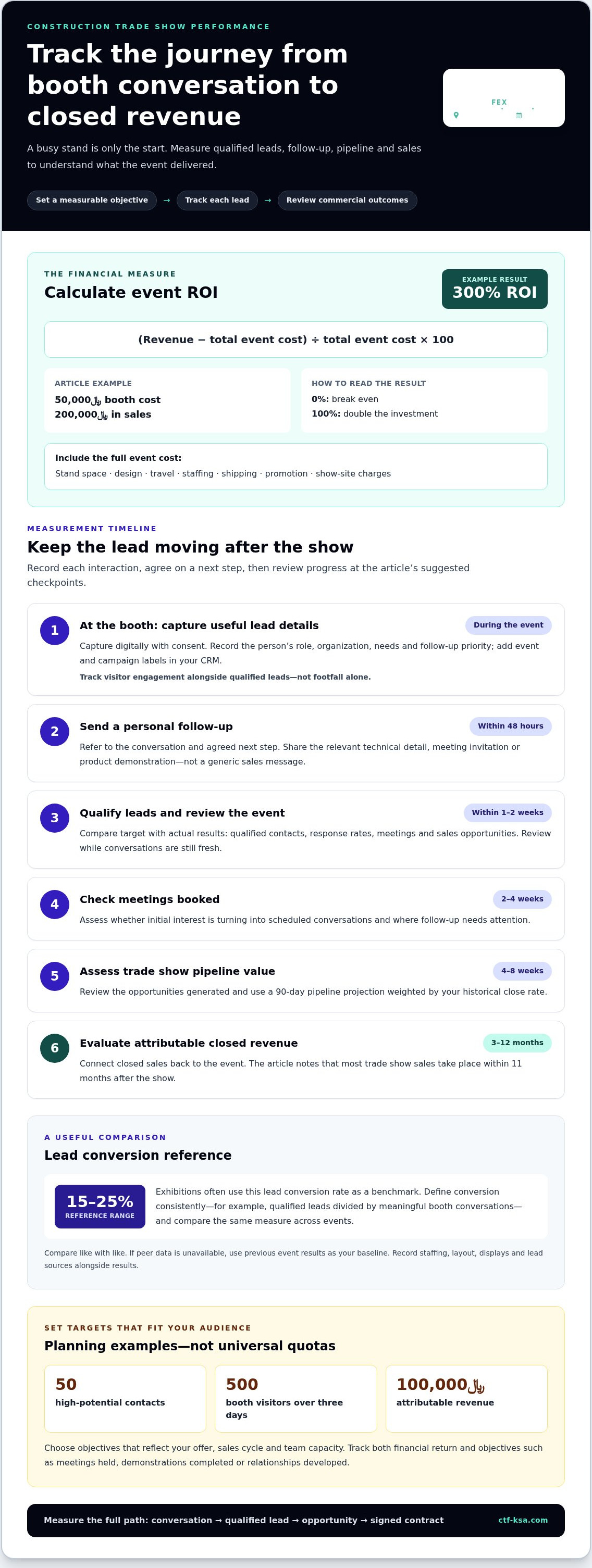
Calculate ROI using this formula: (revenue minus total event cost) ÷ total event cost × 100. Include stand space, design, travel, staffing, shipping, promotion, and show-site charges in the cost total. A booth costing ﷼50,000 and generating ﷼200,000 in sales produces 300% ROI. A 0% ROI means breaking even; 100% means doubling the investment.
Record more than immediate sales. Tag captured leads by event, interest, and follow-up status in your customer relationship management system. Compare qualified leads, conversion rates, and closed revenue, then review a 90-day pipeline projection weighted by your historical close rate. Track booth visitors and engagement alongside sales outcomes, so you can see where the journey loses momentum.
Start targeted outreach weeks or months before the event. Use email and social updates to explain your value proposition and schedule meetings with priority prospects. Record website traffic, social engagement, and follower counts before the event, then compare them afterwards. This helps show whether the event generated attention, even before a contract closes. Review results afterwards and use them to refine objectives, follow-up, and investment decisions for your next show.
2. How Can Exhibitors Benchmark Booth Performance Against Similar Exhibitors?
Compare like with like. Measure booth visitors, meaningful conversations, qualified leads, and follow-up outcomes, then compare results with exhibitors pursuing similar audiences and objectives. If peer data is unavailable, use your previous event results as a baseline and distinguish raw traffic from lead quality. A busy stand signals awareness, but qualified opportunities indicate whether you reached the right buyers.
What booth design and live demonstrations attract construction buyers? Use bold, legible displays to communicate a clear value proposition, and make the booth easy to enter and navigate. Product demonstrations, live presentations, and VR or AR experiences can show how a solution works in a practical construction context. Give staff a clear action for each interaction: explain, demonstrate, capture relevant lead details, and agree on follow-up.
Make booth design functional as well as distinctive. Consistent graphics and concise marketing materials help visitors understand your offer quickly, while a custom-built exhibit can reflect your brand and event goals. Where suitable tools are available, track dwell time, engagement hotspots, and visitor flow. Compare these observations with lead quality rather than treating footfall alone as success.
Choose stand size according to audience volume, staffing capacity, and planned experiences. A 10×10 booth can suit a focused approach with fewer interactions and stronger qualification. A 10×20 layout can add a second zone if traffic and staffing support it. A 20×40+ booth has greater volume potential, but more space alone doesn’t create more qualified leads.
For a performance benchmark, exhibitions often use a 15-25% lead conversion rate as a reference. Define conversion consistently, such as qualified leads divided by meaningful booth conversations, and compare the same measure across events. Record staffing levels, layout, displays, and lead sources alongside the result. This reveals which changes drive stronger engagement and gives your next booth a clear opportunity for improvement.
3. Trade show objectives and lead-generation targets
Set targets around the audience you need to reach, not just total traffic. For example, define a goal of 50 high-potential contacts, 500 booth visitors over three days, or ﷼100,000 in attributable revenue. These are planning examples, not universal quotas. Choose targets that reflect your offer, sales cycle, and team’s capacity to deliver meaningful conversations.
How soon should exhibitors follow up with trade show leads, and what should follow-up include? Send a personalized follow-up within 48 hours after the event, referencing the conversation and agreed next step. Include relevant information, such as a requested technical detail, meeting invitation, or product demonstration, rather than a generic sales message.
Capture each lead digitally with consent, recording the person’s role, organization, needs, and follow-up priority. Sync records with your customer relationship management system in real time when your tools support it. Add event and campaign labels so marketing and sales teams can trace each conversation from booth engagement to opportunity.
Use a consistent qualification process after the show. Evaluate lead qualification within 1–2 weeks after the show, then review meetings booked 2–4 weeks after the show. Assess trade show pipeline value 4–8 weeks after the show. These checkpoints show whether initial interest is developing into commercial progress, and where follow-up needs attention.
Review performance two weeks after the show, while visitor interactions remain fresh. Compare target and actual results, including qualified contacts, response rates, meetings, and sales opportunities. Evaluate closed revenue attributable to the event 3–12 months after the show; most trade show sales take place within 11 months after the show. Use the findings to refine audience selection, lead definitions, and follow-up messaging for future events. This staged evaluation captures both immediate engagement and longer-term sales impact.
4. Pre-show strategy, stand placement and staff training
Start planning at least six months before the event. Set goals first, then align your stand layout, promotion, staffing, and demonstrations with those objectives. Choose a position based on how attendees move through the venue and where relevant sessions or demonstrations draw attention. A high-traffic location helps only when the team can engage visitors and capture useful leads.
How should exhibitors choose booth size, location, and sponsorship packages? Match booth size to expected traffic, staffing capacity, and planned experiences; first-time exhibitors can consider a 10×10 or 10×20 inline booth. Select a location that supports your audience and engagement goals, then choose a Sponsorship Package according to the visibility and participation objectives it serves.
Promote your presence before the show through targeted email and social campaigns. A strong pre-event campaign can account for 30–50% of an exhibitor’s total booth traffic. Leveraging strategic digital marketing for construction companies makes it easier to invite priority prospects to book meetings, share what they can see at your stand, and coordinate each message with your event objectives.
Prepare Arabic-English materials that communicate your value proposition clearly in both languages. Where possible, staff the stand with Arabic-speaking team members who can explain technical details and connect with local attendees. Brief the team on respectful greetings, attentive listening, and using professional titles where appropriate. Ask visitors which language they prefer, then adapt the conversation.
Train every staff member on a consistent visitor journey: open with a relevant question, identify the attendee’s needs, explain your offer concisely, and record agreed follow-up. Rehearse product demonstrations and lead-capture steps before the event, including who enters each contact into the CRM. Assign clear roles for welcoming visitors, presenting technical details, and arranging meetings. This keeps the stand active without leaving prospects unattended.
For strategic visibility beyond the stand, consider whether a Sponsorship Package or Speaking Opportunity supports your target audience and message. Compare each option with your objectives, available staff, and ability to engage attendees, then choose a format your team can deliver effectively.
Explore sponsorship opportunities
Construction Technology ConFeX KSA: Sponsorship Packages
Construction Technology ConFeX KSA gives construction technology exhibitors a focused platform to connect with industry leaders and present solutions shaping the built environment in Saudi Arabia. Consider the event when your objectives call for direct engagement with relevant professionals, stronger visibility, or a platform to share your expertise.
Choose an Exhibition Stand to demonstrate your offering and start conversations with attendees. Sponsorship Packages can support wider event visibility, while Speaking Opportunities provide a forum to present insights and engage an audience. Professionals seeking conference access, networking sessions, and technical demonstrations can attend with Delegate Passes.
Match your participation format to your goals, audience, and team’s capacity to follow up. A well-planned presence makes it easier to connect event activity with your wider exhibition strategy. Visit Construction Technology ConFeX KSA to explore the participation options.
Turn Exhibition Insights Into Your Next Growth Opportunity
Make every event part of a continuous improvement cycle. Use what your team learns to sharpen its audience focus, strengthen conversations, and make future investment decisions with greater intent. That is how maximizing exhibitor ROI at construction trade shows becomes an ongoing commercial discipline, not a one-event calculation.
For companies building their presence in Saudi Arabia’s construction technology sector, Construction Technology ConFeX KSA offers participation options for different objectives. Sponsorship Packages can support event visibility, Speaking Opportunities can put expertise before an industry audience, and Delegate Passes provide access to conference and networking experiences. Choose the option that fits the role you want your business to play.
Take the next step with a clear objective and a plan to measure progress. A focused presence can help your team build valuable industry connections and apply new insights to its next growth phase.
Frequently Asked Questions
How Do You Measure Trade Show ROI and Connect Booth Activity to Sales Outcomes?
Link booth activity to sales by tagging each contact with the event source and tracking progress through your sales pipeline. Separate leads that originated at the stand from existing opportunities the event helped advance. For example, record whether a meeting led to a technical review, proposal, or contract. This distinguishes direct event outcomes from the event’s influence on deals already in progress.
How Can Exhibitors Benchmark Booth Performance Against Similar Exhibitors?
Compare results with exhibitors targeting similar buyers and pursuing similar objectives, using consistent definitions for a visitor, conversation, and qualified lead. If comparable peer data is unavailable, compare your own events and note differences in audience, stand position, staffing, and demonstration format. A higher lead count may reflect heavier traffic, while a higher share of qualified leads can indicate better audience alignment.
How Can You Maximise ROI on a Limited Budget?
Prioritise spending that supports a defined buyer interaction, such as a product demonstration or pre-booked meeting, instead of spreading resources across low-impact extras. Choose a stand your team can present professionally, reuse suitable displays, and focus outreach on named prospects. Maximizing exhibitor ROI at construction trade shows on a limited budget requires disciplined choices and consistent follow-up, not simply cutting every expense.
How to Calculate Trade Show ROI (Step-by-Step)?
First, total the event expenses, including space, stand preparation, travel, staffing, shipping, and promotion. Next, identify revenue attributable to the event and avoid counting unrelated sales. Subtract total expenses from attributable revenue, divide by total expenses, then multiply by 100: ROI = ((revenue − expenses) ÷ expenses) × 100. Keep the reporting period consistent with your sales cycle, and record later-attributed revenue separately.
What Common Mistakes Undermine Accurate Trade Show ROI Measurement?
Common mistakes include overlooking indirect expenses, treating every badge scan as a qualified lead, and attributing sales from other sources to the event. Double-counting opportunities across campaigns can also distort results. Avoid these errors by agreeing on lead and attribution definitions before the show, recording costs in one event ledger, and reviewing sales records afterwards using the same attribution rules.
What Should You Do Before a Trade Show to Maximize Results?
Build a focused preparation plan: define the target buyer, create a priority-account list, and invite relevant contacts to meet your team. Give each staff member a clear role, prepare demonstration talking points, and test lead-capture fields before the event. Align the stand message with the audience’s business challenges, then prepare follow-up materials so the team can respond consistently to questions raised in conversations.