 DCTC KSA

- Blogs
- / 3D Construction Printing Expo Saudi Arabia: 2026 Guide
What should you look for at a 3D construction printing expo Saudi Arabia? The most useful conversations go beyond impressive demonstrations to assess whether the method fits a project’s design, delivery needs and wider digital workflow. To make those conversations practical, bring clear questions about evidence, adoption requirements and the people involved in project decisions.
This guide offers a framework for assessing potential use cases, weighing delivery evidence and understanding how 3D printing connects with technologies such as BIM, Digital Twins, robotics and DfMA. It also explains how Construction Technology ConFeX KSA connects construction technology stakeholders: the event brings together 1,200+ attendees, 50+ sponsors and exhibitors, and 500+ facilitated meetings, with 80% of attendees being clients and end users. Use the guidance to identify relevant stakeholders and evaluate where the technology may fit within Saudi Arabia’s evolving built environment.
Key Takeaways
- Distinguish printed building components from the wider on-site and off-site workflows involved in construction-scale additive manufacturing.
- Trace how digital design, model preparation and site coordination connect, while recognizing that BIM and Digital Twin roles depend on project requirements.
- Assess project fit in stages: define the use case, examine design and delivery interfaces, then evaluate technical feasibility, commercial value and organizational readiness separately.
- Use a 3D construction printing expo Saudi Arabia to explore how broader ConTech connections can help compare project needs, delivery evidence and complementary technologies.
What 3D Construction Printing Means for Saudi Arabia’s Built Environment
Construction-scale additive manufacturing uses digitally guided equipment to place material in successive layers, forming building elements from a prepared design. In concrete printing, this may involve depositing a cement-based material through a nozzle along programmed paths. The method is one approach within modern construction, not a single solution for every building. This overview of 3D concrete printing describes common methods, applications and challenges. For teams exploring a 3D construction printing expo Saudi Arabia, distinguishing a printed element from a complete project workflow is a practical starting point.
A printed component might be produced off site and transported for installation, while on-site printing places material at the project location. In either case, printing is one part of delivery. Design coordination, foundations, reinforcement where required, building services, finishing, inspection and connections to other construction work remain relevant. A printed wall or component does not mean an entire building has been produced by printer.
How construction printing differs from conventional building methods
Conventional construction commonly forms elements through processes such as casting, cutting or assembling materials. Printing instead creates a form through controlled, layer-by-layer placement. That changes how geometry is produced, but does not by itself establish faster delivery, lower labour demand or reduced environmental impact. Results depend on the design, material behaviour, equipment, production setup and site conditions.
Assess the method against defined project objectives. Does the design benefit from shapes or custom elements that are difficult to produce conventionally? Can production and installation fit the project sequence and coordinate with other work? Are sustainability goals supported by project-specific evidence on material use, waste or other relevant measures? Treat these as questions to investigate, not automatic benefits. Compare the proposed printing scope with alternatives to determine whether it complements modern construction methods such as off-site fabrication and design for manufacture and assembly.
How 3D Construction Printing Fits into a Digital Delivery Workflow
Printing becomes a project delivery method when design information connects with production planning and site coordination. Teams start with a digital design, then prepare the geometry and details required for the intended printing process. From there, they plan production, coordinate delivery or on-site activity, and manage interfaces with other work, including foundations, services and installation. Each handoff needs clear information and assigned responsibilities.
In practice, the workflow moves from design and model preparation to production planning, material and equipment coordination, and integration with site activities. Use this sequence as a planning framework, not a promise of a particular outcome. The wider digital transformation roadmap provides context for considering how connected information and delivery processes fit into construction technology decisions.
Where BIM, Digital Twins, and DfMA connect
Building Information Modelling (BIM) can help teams coordinate design information and identify interfaces relevant to fabrication planning. A Digital Twin may support ongoing project or asset coordination when its data, purpose and update process are defined. Neither tool automatically controls a printer or guarantees coordination; its role depends on project requirements and information workflows. DfMA means designing components with their manufacture and assembly in mind, so the intended production method and how elements connect on site inform design decisions early.
Robotics may form part of a production setup, but equipment, digital models and materials are not universally compatible. Align the selected material’s requirements with the printer’s capabilities and the design, then coordinate the output with transport, installation and adjacent trades. These interfaces help distinguish a promising digital model from a workable delivery plan.
For professionals exploring a 3D construction printing expo Saudi Arabia, these connections offer a practical lens for conversations with developers, contractors, consultants and technology providers. Ask how digital information, production systems and project teams would work together. To explore construction technology discussions as an attendee, review the delegate attendance options.
How to Assess Whether 3D Construction Printing Fits a Project
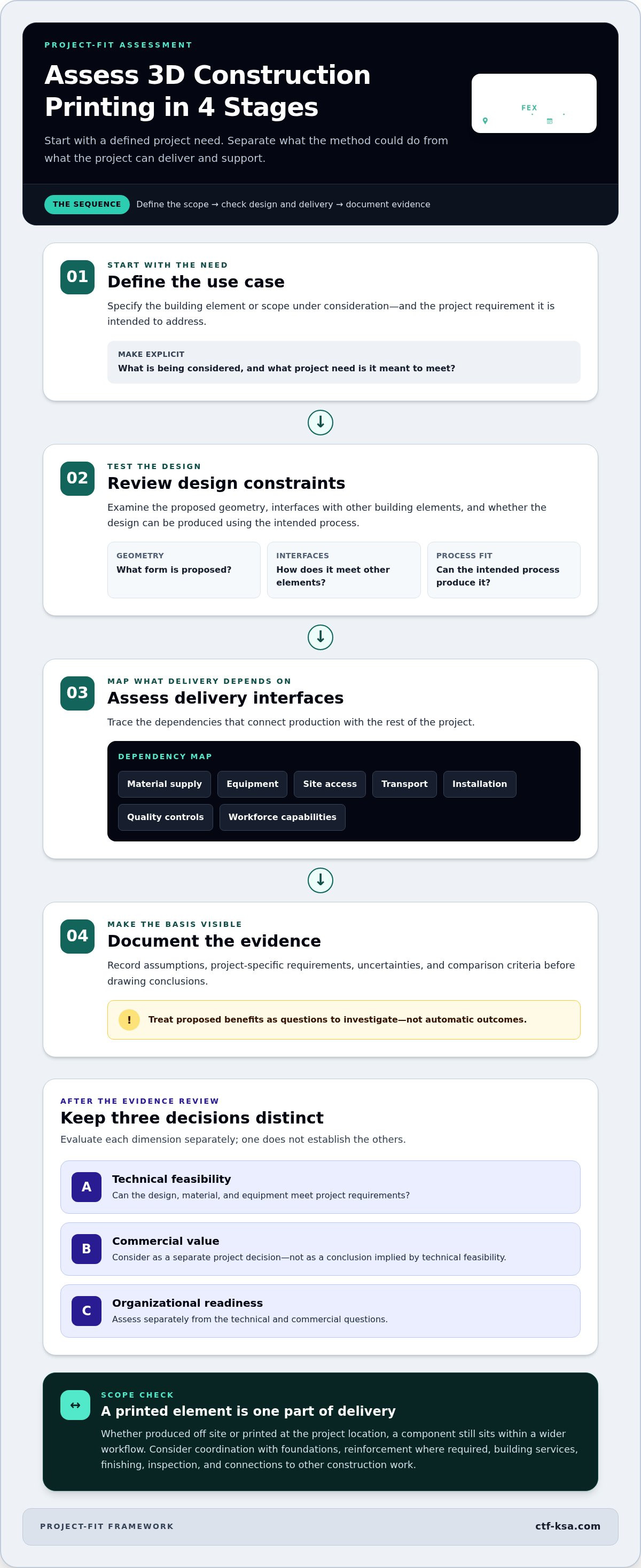
Start with a defined project need, not the appeal of a new method. A structured review helps teams separate what the technology could do from what the project can deliver and support.
- Define the use case. Specify the element or scope under consideration and the project requirement it is intended to address.
- Review design constraints. Examine geometry, interfaces with other building elements, and whether the proposed design can be produced using the intended process.
- Assess delivery interfaces. Map dependencies such as material supply, equipment, site access, transport, installation, quality controls and workforce capabilities.
- Document the evidence. Record assumptions, project-specific requirements, uncertainties and comparison criteria before drawing conclusions.
Keep three decisions distinct. Technical feasibility asks whether the design, material and equipment can meet project requirements. The commercial case compares the full delivery approach with alternatives, including coordination and operational implications, without assuming savings. Organizational readiness considers whether the owner, contractor, consultants and delivery partners can assign responsibilities, manage interfaces and support the required capabilities.
What evidence should a project team examine?
Give greater weight to verified project examples with documented specifications and delivery conditions comparable to the proposed work. Review material requirements, quality processes, logistics and workforce implications in context. A demonstration alone may not establish how a method performs across a project’s actual constraints. Project owners can define success criteria, contractors can map sequencing and site interfaces, consultants can assess design coordination, and technology providers can explain process requirements and evidence. Resolve assumptions together and record what remains untested. The modern construction methods roadmap can help frame printing alongside adjacent delivery approaches.
For professionals researching a 3D construction printing expo Saudi Arabia, this framework turns broad interest into focused questions about project fit and evidence.
To continue exploring the event as an attendee, review the delegate attendance options.
Take 3D Construction Printing Conversations into Saudi Arabia’s ConTech Ecosystem
Assessing a construction technology takes more than reviewing its technical promise. Conversations with project owners, developers, contractors, consultants and technology providers can clarify which needs matter, what evidence decision-makers expect, and how a method could connect with other tools and delivery approaches. A broader ConTech event creates opportunities to compare perspectives across the built environment and consider 3D printing alongside related technologies.
CTF KSA brings together construction technology stakeholders, with 1,200+ attendees, 50+ sponsors and exhibitors, and 500+ facilitated meetings. Its ecosystem spans digital construction, including BIM, Digital Twins, robotics, DfMA and innovative building materials. These connections can help participants explore market fit and complementary technologies. Organizations seeking strategic industry visibility can use CTF KSA sponsorship opportunities to engage with the wider construction technology community.
Choose a participation goal before engaging
Set a clear objective before deciding how to take part. For market learning, attend as a delegate and compare project priorities with industry perspectives. To build thought leadership, consider a speaking opportunity that contributes relevant expertise to broader ConTech discussions. If your goal is to present a solution and increase its visibility among industry stakeholders, an exhibition stand offers a way to do so. Sponsorship can support a strategic visibility objective within the event ecosystem. Shape each conversation around practical questions: whose project need does the technology address, what evidence supports its use, and which delivery partners or complementary systems are relevant?
For teams exploring a 3D construction printing expo Saudi Arabia, purposeful participation can turn general interest into focused ecosystem engagement. Choose the route that best aligns with your objectives.
Explore CTF KSA sponsorship options
Turn Project Questions into Forward Momentum
Make your next move specific. Before your next industry conversation, write down the project challenge you want to address, the evidence you still need and the stakeholders who can help assess it. This brief will keep discussions focused on real delivery requirements rather than technology in the abstract.
A 3D construction printing expo Saudi Arabia search can be the start of a wider exploration of the Kingdom’s ConTech ecosystem. Approach each conversation with curiosity and clear criteria, then use what you learn to refine your project’s next steps. Progress comes from connecting innovation with practical questions and informed collaboration.
Stay ambitious, stay evidence-led, and help shape the future of construction technology in Saudi Arabia.
Frequently Asked Questions
What is 3D construction printing?
3D construction printing is an additive building process that forms an element by depositing material in successive layers. Unlike many conventional methods, which cast material in formwork or assemble pre-made parts, a printer follows a digital path to build the shape. Printing may produce a component or part of a structure; it does not automatically replace foundations, services, finishing or other project work.
Is 3D construction printing used in Saudi Arabia?
Reported Saudi projects show that the technology has been used, but they do not establish broad adoption. TradeArabia and Modula3D report that Dar Al Arkan completed a three-storey, 9.9-metre villa in 2023, described at the time as the tallest on-site 3D-printed building. Treat this as a project example, not evidence that printing is routine across Saudi projects or building types.
What materials are used in 3D construction printing?
Concrete construction printing typically uses cement-based mixtures formulated to pass through printing equipment and retain shape as layers are deposited. Exact compositions vary with the application and production process, so “printable concrete” is not one universal recipe. Examine documented material specifications and suitability for the intended design. The overview of 3D concrete printing outlines the method and its material considerations.
Can 3D construction printing reduce construction time?
It can affect production time for some scopes, but do not assume time savings across an entire project. The comparison depends on what is printed, how the work is sequenced, and how production connects with transport, installation and other trades. Look for verified evidence from comparable projects, including what the reported duration measures and which activities it includes, before using it to inform a schedule.
What should companies look for at a construction technology expo?
At a 3D construction printing expo Saudi Arabia, look for conversations that connect project needs with relevant decision-makers and complementary technologies. Prepare a short description of the intended use case, then discuss evidence, delivery interfaces and open technical questions. Distinguish documented project results from demonstrations, and note which stakeholders should be involved in follow-up. The strongest conversations clarify a practical next step, not just a general expression of interest.